



KARACHI: When Muhammad Imran arrived in neighboring India last month, he thought the journey would culminate in his son recovering from an unfortunate spinal injury. Little did he know that he would be forced to head back to Pakistan. That too, without his wife.
Imran, 43, traveled to India with his wife Nabeela Imran, an Indian national, and children in March clinging to the hope that doctors at New Delhi’s Apollo Hospital would help his 17-year-old son Muhammad Ayan walk again. Ayan was left paralyzed in 2023 after he suffered a gunshot wound in his spine after getting in the crosshairs of a gunfight between police and street criminals in Karachi.
However, ties between India and Pakistan deteriorated after New Delhi blamed Islamabad for being involved in a militant attack on tourists in Indian-administered Kashmir on Apr. 22 that killed 26 people. Islamabad denies involvement.
Both nations downgraded ties, with India suspending visas for almost all Pakistani nationals and Islamabad responding with tit-for-tat measures. The move triggered panic among visiting families — including Imran’s, who had married his maternal cousin Nabeela, a resident of New Delhi, 18 years ago.
Since then, Nabeela had been living in Pakistan on a visa that was intermittently renewed without her ever needing to acquire Pakistan’s nationality. But the suspension of visas meant Imran and his Pakistani children’s 45-day medical visa was no longer valid, and Nabeela was left behind in India.
“She was separated from us while crying and we also came here with great difficulty, crying,” an emotional Ayan told Arab News.
Imran said he arrived in India after spending “every single rupee” with the hope that his son would walk again. However, bilateral tensions between India and Pakistan, and the ensuing atmosphere in India made his family “very scared.”
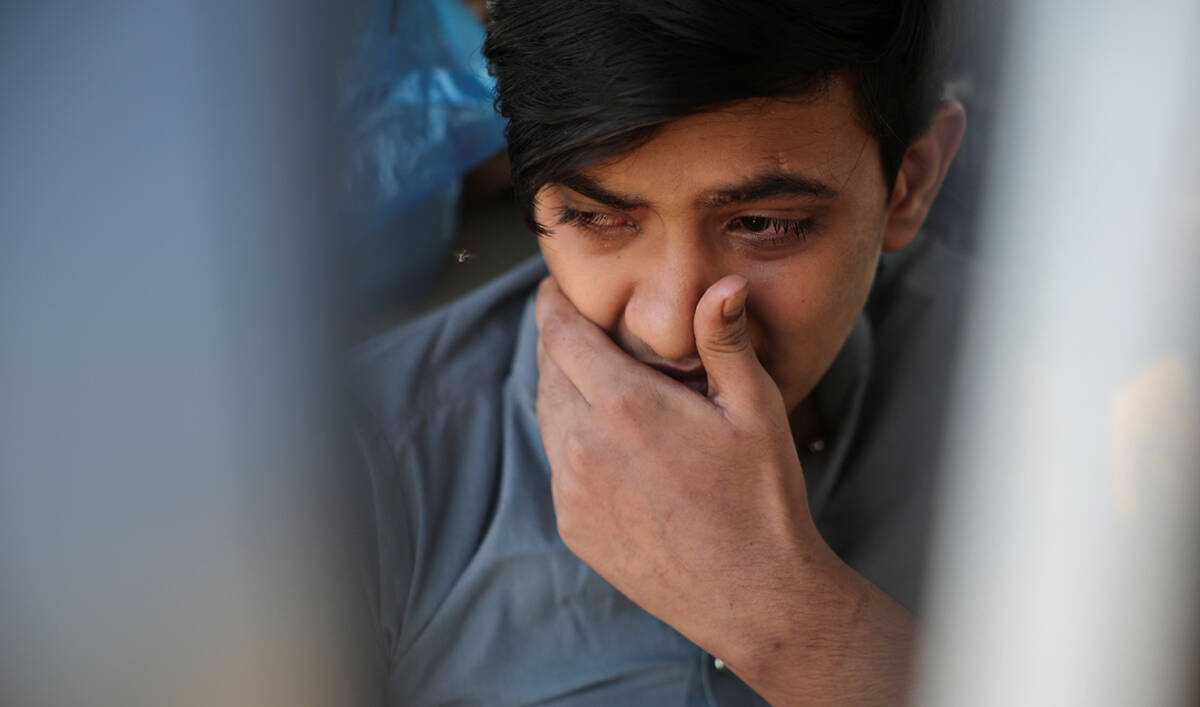
Pakistani citizen Muhammad Ayan cries, as his mother, who is an Indian citizen couldn’t accompany him and his father, as they prepare to leave India after India revoked visas issued to Pakistani citizens, at the Attari-Wagah border crossing near Amritsar, India on April 27, 2025. (REUTERS)
“I told them, ‘I am married [to her],’ I pleaded with them, cried, and showed a lot of humility,” Imran said about his interaction with Indian authorities. “But they said, ‘No, write an exit and leave.’“
‘PEOPLE SHOULDN’T BE DIVIDED BY BORDERS’
For Ayan, the shock of being separated from his mother compounded the trauma of his paralysis and incomplete treatment.
“I went for treatment with a hope but that hope shattered because of that accident and then the fact that my mother was not coming with us,” he said.
“I was completely separated from a mother’s love. We were far apart; it made me cry.”
The ordeal is also tough for Imran, who is the sole caregiver to Ayan now that Nabeela is in India.
“Should I go to work or take care of my child,” Imran asked. “Because his mother used to handle everything — feeding him, taking care of him, and everything else.
“Now that she’s not here, I am facing a lot of distress,” he added.
Back in India, Nabeela is consumed by the same worry for her son.
“Over there, my child is paralyzed and in distress, and I am the one who takes care of everything for him,” she told Arab News via a video call.
“Now, his father will be going to work— who will take care of him? Who will look after him?“
Nabeela appealed to governments in India and Pakistan to reunite her with her children.
“I am in a lot of distress; I cannot live without my children,” she said. “My child is helpless, what should I do?“
Robbed of his mother’s affection, Ayan had the same plea.
“I appeal to both the Pakistani and Indian governments to reunite me with my mother as soon as possible,” he said.
“And I also appeal to the Pakistani government to help me with my treatment,” he added. “Please reunite me with my mother.”
Imran recalled how he saw with his own eyes when many families were separated from their loved ones and sent to the border.
“Borders may exist but people shouldn’t be divided by them,” he said.


