

Pakistani truck art elevates heavy transport into mobile masterpieces

An artisan paints art on a truck at a yard for workshops in Rawalpindi, Pakistan, on April 19, 2025. (AP)
Short Url
Updated 01 May 2025
Follow

Pakistani truck art elevates heavy transport into mobile masterpieces

  • Roots of Pakistani truck art go back to British colonial rule, when owners began adorning their vehicles
  • Trucks also bear poetry, religious messages and personal slogans, reflecting drivers’ aspirations and humor

RAWALPINDI: Trucks thunder along Pakistan’s dusty highways and through bustling city streets, like rolling canvases ablaze with color and poetry, transforming heavy transport into mobile masterpieces and offering a window into the country’s folk culture.
The roots of Pakistani truck art go back to British colonial rule, when owners began adorning their vehicles with intricate floral patterns, calligraphy, and cultural motifs.
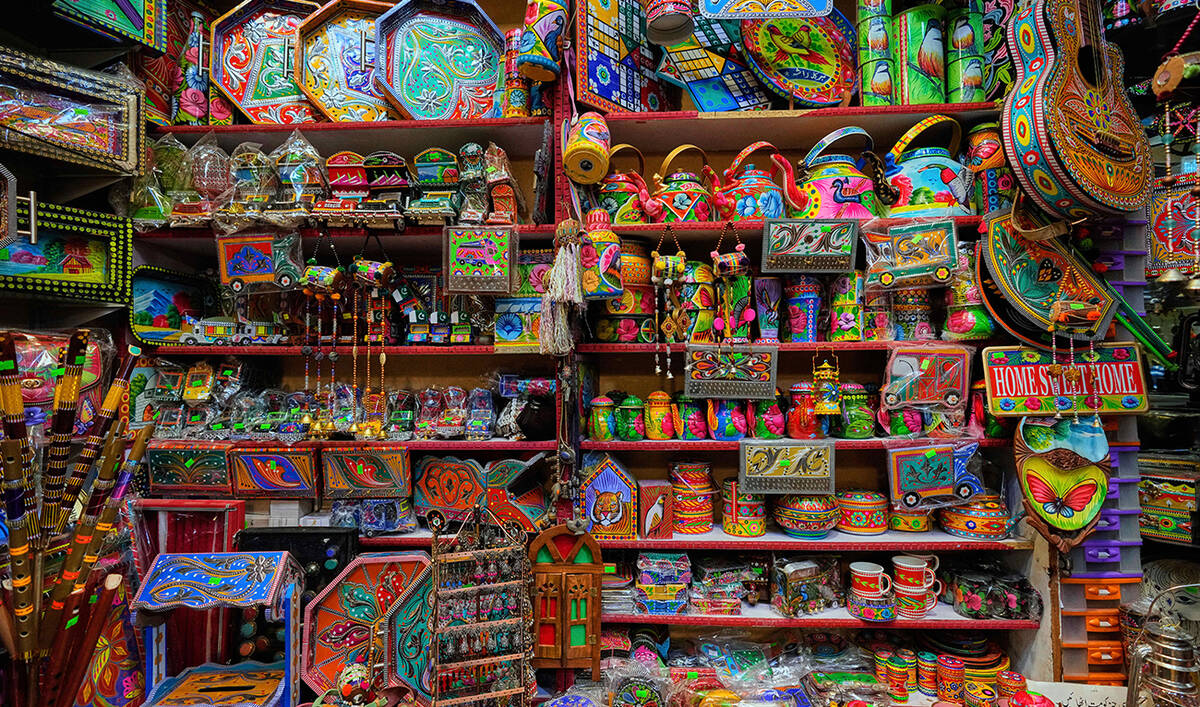


Various household decorative items painted in truck art patterns are displayed for sale at a shop in Islamabad, Pakistan, on April 22, 2025. (AP)

What started as modest embellishments has evolved into artistry. Painters, welders, electricians, and metalworkers collaborate to elevate commercial trucks into personalized symbols of pride and regional identity.
There are camel bone inlays in Balochistan, intricate wood carvings in Peshawar, and disco-inspired detail in Rawalpindi.
Muhammad Ashfaq, a 55-year-old from Rawalpindi, has been painting trucks for over four decades.
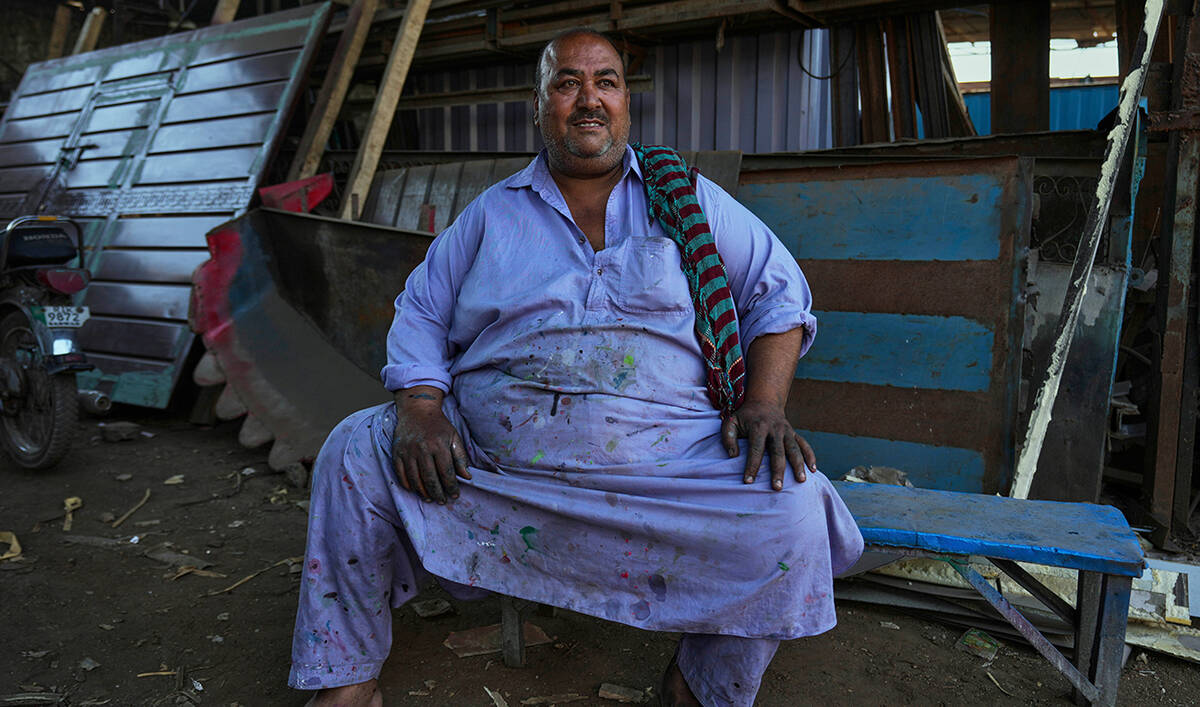


Artisan Muhammad Ashfaq, 55, sits for a portrait at his workshop in Rawalpindi, Pakistan, on April 27, 2025. (AP)

“Each client comes with their own vision and budget,” said Ashfaq. “We ask which style they prefer: Peshawar, Hazara, Swat, Pindi, Mandi Bahauddin, or Karachi.”
Pindi style is considered the most flamboyant, characterized by vivid colors, elaborate stickers, mirror work, and dense layering of design elements.
“Pindi style is like a bride getting ready for her wedding,” says Farrukh Sana, a truck driver who recently upgraded his vehicle with the vibrant design. “We feel happy when people admire our truck. It’s a symbol of hard work and beauty.”
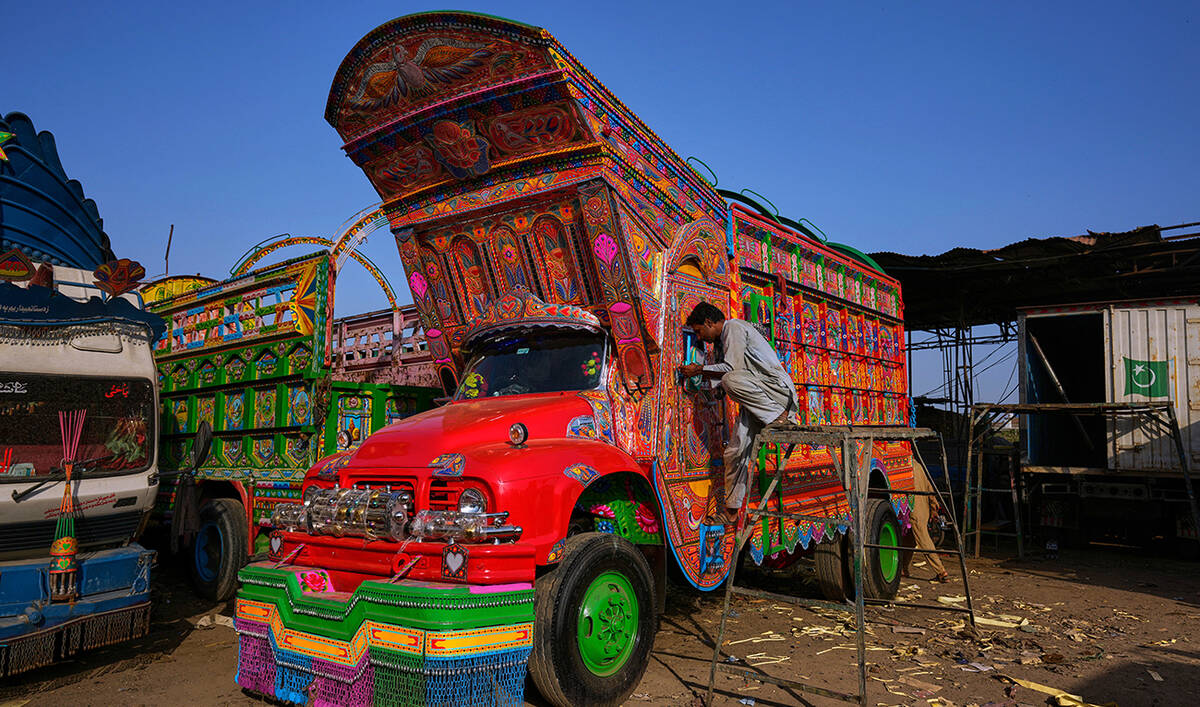


A worker fixes the side mirror of a newly refurbished decorated truck at a yard for workshops in Rawalpindi, Pakistan, on April 21, 2025. (AP)

Styles vary according to cost and components, as well as color and complexity.
A full refurbishment of a truck can cost between 2 to 5 million rupees (about $7,000 to $17,790), depending on the materials used and if major elements like the tires and the chassis are replaced.
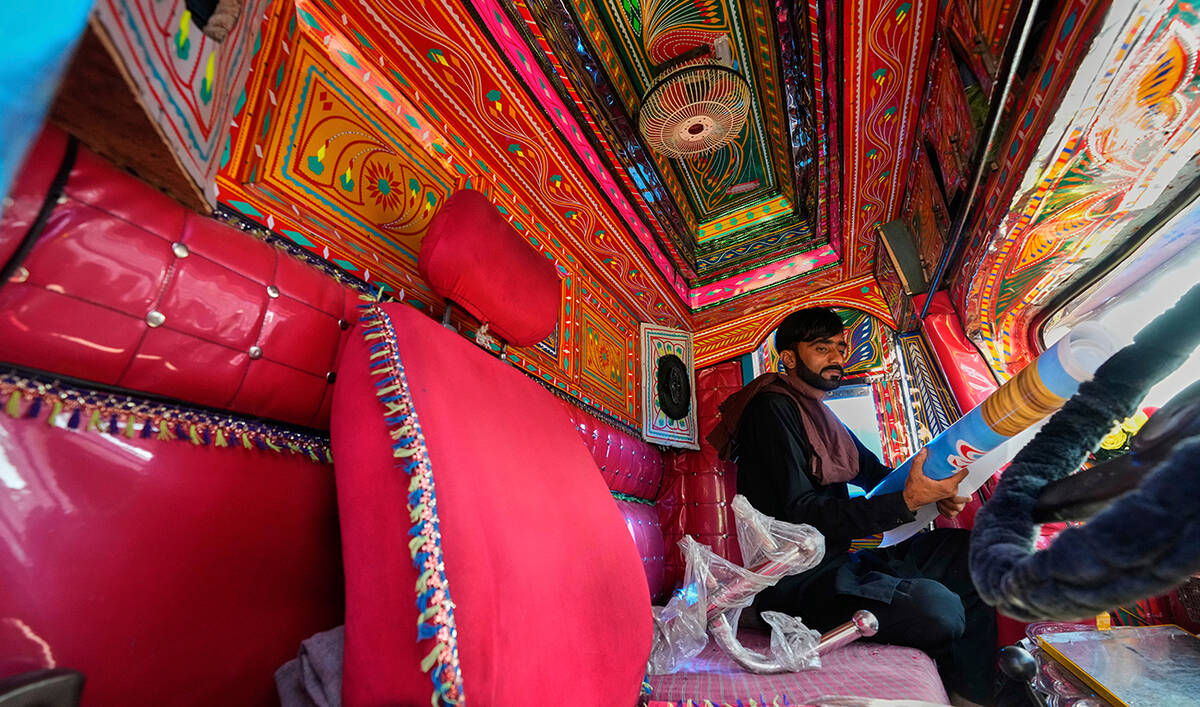


Driver Farrukh Sana checks items inside the cabin of a newly refurbished truck painted with traditional artwork at a yard for workshops in Rawalpindi, Pakistan, on April 21, 2025. (AP)

But, beyond mere decoration, the trucks also bear poetry, religious messages, and personal slogans, reflecting the aspirations, humor, and emotions of their drivers.
Truck art has transcended cargo vehicles, finding its way onto rickshaws, buses, and even household decor.


An artisan makes traditional patterns with colorful stickers used to decorate trucks at a yard for workshops in Rawalpindi, Pakistan, on April 19, 2025. (AP)

It first caught global attention in the 1970s, when foreign tourists started photographing the unusually bright vehicles. Since then, truck art has inspired international exhibitions and influenced contemporary fashion and product design.
The distinctly South Asian tradition endures despite Pakistan’s economic hardships. Artisans like Ashfaq remain devoted to the craft, while drivers like Sana view their trucks as more than a livelihood. They are seen as roving cultural ambassadors.
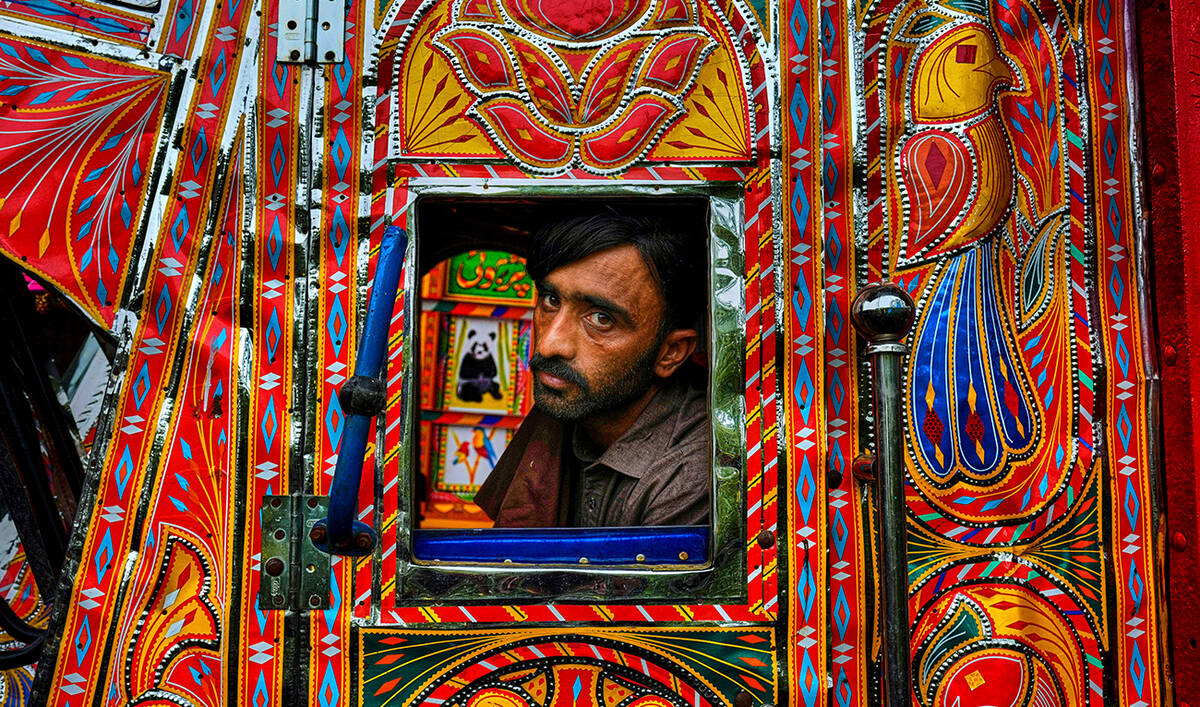


Driver Farrukh Sana looks out from the window of a newly refurbished truck at a yard for workshops in Rawalpindi, Pakistan, on April 19, 2025. (AP)

“Every driver dreams of making his truck look unique,” Sana says with pride. “When we drive it out and people turn their heads, we know we’ve created something special.”


Pakistan in talks with Saudi Arabia, China, banks for $2 billion refinery expansion— official

Updated 6 sec ago
Follow

Pakistan in talks with Saudi Arabia, China, banks for $2 billion refinery expansion— official

  • Islamabad seeks to expand Pakistan Refinery Limited’s crude oil processing capacity from 50,000 bpsd to 100,000 bpsd, says official
  • Official says three-year project would need $2 billion investment, with 60-70 percent to be raised through debt financing

KARACHI: Pakistan’s government and the state-owned Pakistan Refinery Limited (PRL) are in talks with Saudi Arabia, China, global commercial banks and financial institutions to secure funding for a $2 billion refinery expansion project, an official said on Tuesday.

The PRL is an energy company located in Pakistan’s commercial hub Karachi. With a processing capacity of 50,000 barrels of crude oil per day, it supplies refined petroleum products countrywide. It is a subsidiary of the state-owned Pakistan State Oil (PSO), which owns 63.56 percent of its shares.

Pakistan is seeking partners that can finance PRL’s Refinery Expansion and Upgrade Project (REUP). The official confirmed that REUP is part of Pakistan’s Brownfield Refinery Policy, which aims to upgrade the nation’s five existing oil refineries to deep conversion refineries, with a combined crude processing capacity of about 350,000 barrels per stream day (bpsd). The total project cost to upgrade these five refineries has been estimated at $5-6 billion. 

“We are in contact with Saudis, Chinese, Export Credit Agencies and Development Finance Institutions and others to obtain the financing and firms have shown interest,” an official with direct knowledge of the development told Arab News on condition of anonymity as he was not authorized to speak to media. 

The official said that the government was in talks with investors in Saudi Arabia while the PRL was in contact with the Chinese government and ECAs, DFIs and global commercial banks. 
 
The PRL aims to double the crude processing capacity of its Karachi hydro-skimming plant to 100,000 bpsd, produce Euro V-compliant motor spirit and diesel, meet evolving environmental standards and decrease Pakistan’s reliance on imported fuels. 

The move would help Pakistan reduce its reliance on costly fuel imports. The South Asian country imported petroleum products worth $16 billion in fiscal year 2025, more than 27 percent of its total imports.

“The project is estimated at $2 billion and is to be implemented in 36 months with debt ranging between 60-70 percent,” the official said.

He added that potential investors may secure an equity stake in the project. 

Pakistan’s Petroleum Minister Ali Pervaiz Malik visited Saudi Arabia earlier this month to lead a high-level delegation at the Future Minerals Summit. There, he reportedly met investors and briefed them on REUP. 

Malik and the petroleum ministry spokesperson Zafar Abbas did not respond to Arab News’ request for comments on the matter. 

The official said Saudi authorities have asked Pakistan to brief them on the project. He said the government has planned an official visit “in the near future” to the Kingdom, where Saudi investors would be given the required briefing. 

The official said once the required financing is available, PRL would aim to achieve REUP’s financial close by December and begin work on the project in January 2027.

“All our potential financers are expected to undertake due diligence of the project in the coming months,” the official said. 

Sheikh Imran ul Haque, project director of the PRL, said the company was making steady and measurable progress on REUP, a strategically significant initiative designed to enhance refining capabilities and product quality.

“PRL has successfully completed detailed technical and commercial evaluations with EPC (engineering, procurement and construction) bidders,” he told Arab News. 

Haque said the company’s next target is signing the EPC contract in the first quarter of 2026.

He said this would be followed by the financial close at the end of the year, marking the formal transition of REUP from its development phase to the execution one. 

Pakistan has desperately tried to reform its economy by looking for cheaper sources of fuel. Its refining sector has long struggled with aging infrastructure, limited upgrading and thin margins. 

Industry officials argue that over-reliance on imports increases exposure to global price volatility, shipping disruptions and foreign exchange pressure.