RIYADH: Saudi Arabia’s National Center for Wildlife has conducted a study of marine biodiversity in the Red Sea.
The research examined underwater habitats, and was part of efforts to safeguard the Kingdom’s natural resources, the Saudi Press Agency reported.
Scientists used an environmental sensitivity map to classify different underwater areas based on the vulnerability of the species found there, prioritizing areas with a high number of at-risk species.
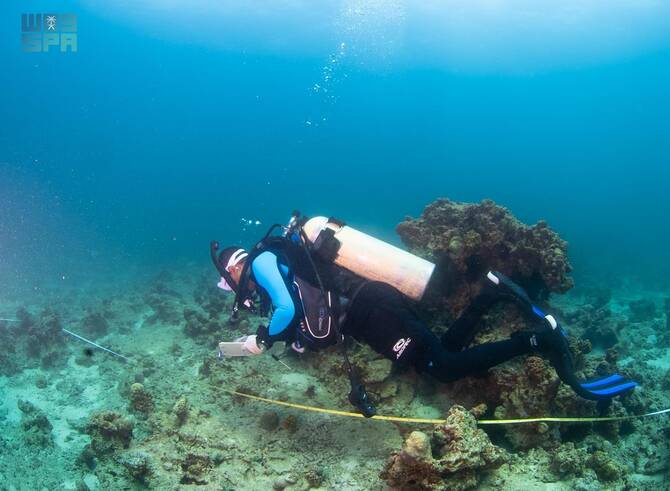
Surveys were carried out on 64 locations along the coastline to investigate the health of the species in those regions.
Changes in water temperature were measured in 37 different spots, to monitor the impact that higher temperatures have on wildlife.
CEO of the NCW, Mohammed Qurban, said that the study aligned with the green development goals of Saudi Arabia, which promote environmental sustainability in the Kingdom.
He also talked about the significance of surveys and how they were a critical tool to detect signs of any changes to habitats, which allowed organizations to address any issues.
NCW said in a statement that it would continue a number of studies and programs throughout the year to protect the marine and terrestrial biodiversity in the Kingdom.
The Red Sea is home to an array of wildlife including whales, dolphins, hammerhead sharks and sea snakes.
This week, one of the largest coral colonies in the world was discovered in the Red Sea.
The massive Pavona coral colony is expected to become an environmentally friendly tourist attraction managed by Red Sea Global.
Earlier this month, marine scientists found creatures thriving in deep waters of the Red Sea under seemingly unfavorable conditions of low oxygen levels and high acidity.
The unusual ecosystem was found in Difat Farasan near the border between Saudi Arabia and Yemen.
The NCW is also leading initiatives to protect the dugong population in the Red Sea from further decline.
Efforts by the center include satellite tracking and scientific research to monitor its distribution in Saudi Arabia’s territorial waters.
Additionally, national plans are in place to manage and rehabilitate the species’ natural habitats, supporting long-term sustainability and the conditions necessary for dugong reproduction and survival.

NCW carries out study of marine biodiversity in Red Sea
https://arab.news/ny9kr
NCW carries out study of marine biodiversity in Red Sea
- The research examined underwater habitats
- Scientists used an environmental sensitivity map to classify different underwater areas
Historic Bab Al-Bunt in Jeddah reborn as Red Sea Museum
- From manuscripts to contemporary art, the museum takes visitors on a journey through seven galleries celebrating the Red Sea’s heritage
JEDDAH: The recently renovated Bab Al-Bunt building in Historic Jeddah, known as Al-Balad, opened on Saturday night as the Red Sea Museum, giving visitors a first glimpse of a space celebrating the region’s cultural and natural heritage.
The exclusive preview marked the culmination of years of meticulous restoration, preserving one of Jeddah’s most historic landmarks while creating a space that bridges past and present.
The event was attended by Prince Saud bin Mishaal bin Abdulaziz, the deputy governor of Makkah, and Prince Badr bin Abdullah bin Farhan, minister of culture and chairman of the Museums Commission.
Prince Badr said that the Red Sea Museum provides a broad space for creativity and provides a comprehensive cultural platform that fosters dialogue between civilizations and encourages cultural and intellectual exchange.
He noted that the museum reflects the Kingdom’s commitment to preserving its cultural and natural heritage and is a key part of the effort to revive Historic Jeddah. Supported by the Kingdom’s leadership, this initiative contributes to building a vibrant cultural future where diverse forms of culture and the arts can flourish.
Eman Zidan, director of the Red Sea Museum, said: “Red Sea Museum is a revival of Bab Al-Bunt, originally built in 1866. It once served as a bustling port for travelers, pilgrims, and adventurers arriving by sea, and now it opens its doors to visitors, retelling the stories of the Red Sea. It is a cultural anchor that celebrates the legacy, heritage, and rich diversity of the people of the Red Sea."
Zidan detailed the care taken in the restoration, noting the use of original materials such as coral stone and concrete to return the building to its original form.
“This was achieved through a thorough study by experts — architects and heritage specialists — who were able to restore Bab Al-Bunt to its origins. Now the museum speaks to the people and the community, telling the stories of pilgrimage, biodiversity, maritime exchange, and the open dialogue between the countries on the Red Sea,” she added.
Zidan also emphasized the museum’s commitment to providing an enriching visitor experience through diverse programs, from archaeological objects and historical artifacts to modern and contemporary artworks.
Collaborations with local artisans and artists, including Ahmad Angawi, founder of Zawiya97, have produced Red Sea-inspired projects, while the Red Sea Symphony, featuring children’s choirs, is organized with the Tariq Abdulhakim Museum to celebrate the region’s musical traditions.
“Composing a symphony of seven movements representing the countries of the Red Sea, with the participation of the children’s choir, adds a lot, because this is the kind of rebirth of music that unites people and connects them from everywhere,” Zidan said.
Ibrahim Alsanousi, CEO of the Museums Commission, said: “What makes this museum unique is that we rehabilitated and revitalized a historic building with a powerful story to tell, transforming it into the Red Sea Museum, which is now a public space, just as it was before as a port building.”
Alsanousi added that the museum not only displays artifacts from the Red Sea region but also integrates contemporary art to create a dialogue between past and present.
“We hope first and foremost that it is an open and accessible museum, a living space where people feel welcome and a sense of belonging. This is a place for them to come, learn, create, and discover,” he said.
“We also hope that, in the future, there will be more museums reflecting Jeddah’s historic district. While nothing specific is planned yet, several excavations have uncovered numerous objects, some of which will be exhibited here. There may even be potential for a museum dedicated entirely to the district’s artifacts.”
Tayeb Altayeb, acting director of the Tariq Abdulhakim Museum, said: “The Red Sea Museum is one of the unique additions to the historic district. It is a great addition to the city of Jeddah and a testament to how we view experiences through museology — in a modern way, while preserving heritage.”
Speaking about the Silk Road Symphony, Altayeb emphasized the museum’s focus on connecting the Red Sea’s seven countries through music. He highlighted the extensive research and collaboration that went into composing the seven-movement symphony, which draws inspiration from the traditional music, soundscapes, and coastal cultures of Saudi Arabia, Yemen, Jordan, Egypt, Sudan, Eritrea, and Djibouti.
The symphony was performed by the acclaimed Silk Road Ensemble during the opening ceremony, accompanied by a children’s choir, bringing the region’s diverse musical heritage to life. “The idea is communication through the universal language that is music,” he said.
Angawi also highlighted his collaboration with the museum, creating works inspired by the Red Sea’s natural and cultural heritage.
“I was inspired by the sea, its waves, and sea creatures like fish. In my work with the Mangurs, I have been documenting this for many years and innovating new units and openings. With the Red Sea Museum, I developed the idea of the wave, designing pieces that align with the sea view and the beautiful directional geometry.
“Each design works with the museum team to develop a full story and narrative,” he said, noting that this project is just the beginning of ongoing collaborations to produce Red Sea-inspired objects and products.
The museum offers visitors a journey through seven thematic sections that span 23 galleries, displaying more than 1,000 artifacts and artworks. From manuscripts and maps to coral reef specimens and contemporary art, it celebrates the Red Sea’s tangible and intangible heritage.
Temporary exhibitions, such as The Gate of Gates by Saudi photographer Moath Alofi, along with workshops, talks, and special events such as Music of the Red Sea, complement the permanent displays, inviting visitors of all ages to engage with the region’s cultural and natural legacy.