

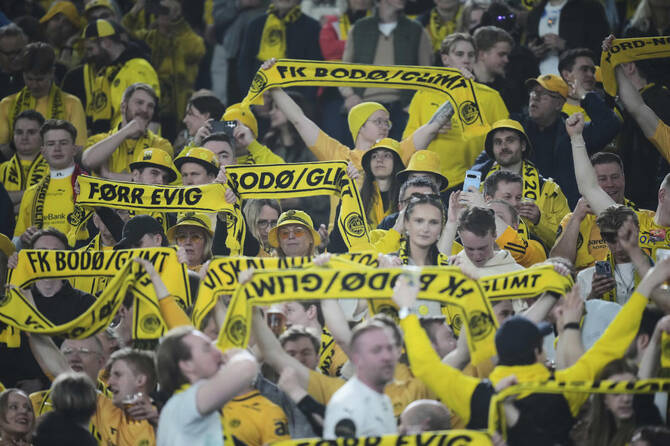

OSLO: How did an unheralded Norwegian team from a tiny town north of the Arctic Circle become one of the fairytale stories of European soccer?
For Bodø/Glimt, the transformation has been underpinned by a fighter pilot who developed mental techniques for his squadron before bombing missions in Libya.
Bjørn Mannsverk discovered a group of players exuding negative energy and prone to “a collective mental breakdown” when he was asked in early 2017 to join the backroom staff of a team that had just been relegated to Norway’s second tier.
His task as “mental coach” at Bodø/Glimt? To make players talk openly about their feelings, lower stress levels, change their attitudes and routines about things like preparation and nutrition, and remove the stigma around mental training.
Winning or losing no longer mattered. It was all about following a philosophy and culture established by Mannsverk, a former Royal Norwegian air force squadron leader whose military duties took him to Afghanistan after the 9/11 attacks and to Libya for a NATO-led intervention in 2011.
The results have been extraordinary.
After securing an immediate return to Norway’s top division, the team — based more than 1,000 kilometers (620 miles) north of Oslo in a fishing town, Bodø, with a population of around 55,000 — have captured four of the country’s last five league titles. It started in 2020 with a first in the history of a club founded in 1916.
Bodø/Glimt have also had some big results in Europe in recent seasons — a 6-1 thrashing of Jose Mourinho’s Roma in the Conference League 2021 stands out — and this year they have become the first Norwegian club to reach the semifinals of a major European competition.
The first leg against Tottenham in the Europa League takes place in London on Thursday. It’s Bodø/Glimt’s biggest ever match.
“It is a fairy tale, almost a miracle,” Mannsverk told AP in a video interview. “How can you actually come from (Norway’s) second division in 2017 to playing a Champions League playoff and teams like Arsenal five years later?
“But I think it’s possible ... if you have the right mentality and you work hard over time.”
An active air force pilot for more than 20 years, Mannsverk and others in his squadron were the subjects of a mental training project in 2010 where the focus was on meditation and “every day repeating boring stuff, but with 100 percent attention.”
It meant that when he was in Libya the following year, he had the mental capacity to handle the dangerous missions he was asked to perform. His squadron’s mantra — “train as you intend to fight” — worked.
“Even though I got strong feelings when my first bombs hit the target and it was in infernal flames and fragments and everything,” he said, “it was like, ‘My training said that it’s OK, this is happening, recognize that, but know I have to return and do my job.’”
With Bodø until recently having a NATO air base, it was simply a happy coincidence that Bodø/Glimt’s leadership came across members of the squadron at the same time as they were seeking a “silver bullet” — as Mannsverk put it — to improve the team’s mental conditioning.
A project was born and fully embraced by manager Kjetil Knutsen following his appointment in 2018.
Bodø/Glimt have never looked back.
Mannsverk’s fingerprints are all over the team’s behavior, though he acknowledges there has been such a buy-in by the players that they now take decisions by themselves.
Like having a rotating cast of eight captains to share leadership duties. Like when the players gather into a circle — Mannsverk calls it the “Bodø/Glimt Ring” — after conceding a goal to discuss what happened and maintain solidarity. Like the players having no specific targets, apart from being the best version of themselves.
Inge Henning Andersen, Bodø/Glimt’s chairman, told the AP that midfielder Ulrik Saltnes considered retiring because he used to suffer from stress-related stomach issues that flared up around matches. Saltnes opened up about his problems to Mannsverk and “finally found a way out of it,” Andersen said.
The team play at an intensity that far exceeds its rivals, which players attribute to Mannsverk.
“I don’t think it would be possible to play like that without Bjørn and the mental work we do,” Saltnes once told the BBC.
This season’s Europa League campaign is giving Bodø/Glimt widespread attention, notably for its location. The team’s Aspmyra stadium — with a capacity of less than 9,000 — is one of the most northernly in world soccer at 67 degrees latitude. Tourists have long come to the town on the tip of Norway’s west coast because it is a good spot to see the northern lights.
Bodø, named the European Capital of Culture in 2024, has less than an hour of sunlight during its shortest days, meaning players take supplements to combat a lack of sunlight. It can be bitterly cold and windy in the long winters, making for tough trips for opponents from other countries.
On paper, Tottenham, one of the world’s richest clubs, start as a huge favorite against Bodø/Glimt. The crowd at Tottenham Hotspur Stadium on Thursday will be bigger than Bodø’s population.
Yet the English club are having one of their worst seasons in a generation and currently lies in 16th place in the 20-team Premier League. It gives Bodø/Glimt a realistic shot at an upset, like they produced when getting past Italian team Lazio in the quarterfinals.
Another chance, then, for the club to write another amazing chapter in their remarkable journey.
“We like to tell our story,” Mannsverk said. “The philosophy is a good thing. We know it’s difficult in football, where there’s so much money involved, to give a coach or a team the time. And it takes time to change and drill in the mentality.
“This was not done overnight ... but I’m totally convinced that it will work more or less all over.”


