

Bangladesh to tour Pakistan for five-match T20 series in May

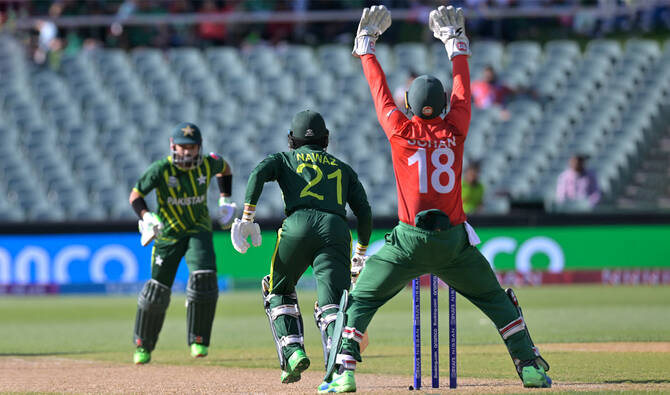
Bangladesh's wicketkeeper Nurul Hasan (R) shouts an Leg-Before-Wicket (LBW) appeal against Pakistan's Mohammad Nawaz (C) during the ICC men's Twenty20 World Cup 2022 cricket match between Pakistan and Bangladesh at Adelaide Oval in Adelaide on November 6, 2022. (AFP/File)
Short Url
Updated 30 April 2025
Follow

Bangladesh to tour Pakistan for five-match T20 series in May

  • Bangladesh last toured Pakistan in August 2024 and achieved a historic 2-0 Test series victory
  • The upcoming five-match series in May is scheduled to prepare for T20 World Cup next year

ISLAMABAD: Bangladesh will tour Pakistan in May for a five-match Twenty20 International series, the Pakistan Cricket Board (PCB) said on Wednesday, confirming the shift from the originally planned three One Day Internationals and three T20s to an all-T20 format ahead of next year’s T20 World Cup.​

The announcement of the series, scheduled from May 25 to June 3, comes as Pakistan hosts the Pakistan Super League (PSL) matches.

Bangladesh last toured Pakistan in August 2024 for a Test series, where they achieved a historic 2-0 whitewash, marking their first Test win on Pakistani soil.

“Bangladesh team will arrive on 21 May and will undergo training sessions at the Iqbal Stadium [Faisalabad] from 22 to 24 May,” the PCB said in a statement.​

The upcoming T20 series will be played in Faisalabad and Lahore.

Iqbal Stadium, which last hosted an international match in 2008, will stage the first two T20Is on May 25 and 27.

The remaining three matches will be held at Lahore’s Qaddafi Stadium on May 30, June 1 and June 3. All matches are scheduled to begin at 8:00 PM local time.​

The series is part of the ICC’s Future Tours Program (FTP). The decision to replace the ODIs with additional T20Is was made mutually by both boards to better prepare for the upcoming T20 World Cup, said the PCB.


Pakistan PM calls PIA privatization ‘vote of confidence’ as government pushes reforms

Updated 52 min 8 sec ago
Follow

Pakistan PM calls PIA privatization ‘vote of confidence’ as government pushes reforms

  • The loss-making national flag carrier was sold to a Pakistani consortium for $482 million after two failed attempts
  • Finance minister vows to continue economic reforms, engage international partners through trade and investment

KARACHI: Prime Minister Shehbaz Sharif said on Tuesday the privatization of state-owned Pakistan International Airlines marked a “vote of confidence” in the country’s economy, as the government presses ahead with structural reforms aimed at easing pressure on public finances and attracting investment.

The sale of the loss-making national carrier by a Pakistani consortium, which secured a 75 percent stake for Rs135 billion ($482 million), follows two previous attempts to privatize PIA. The development comes as Pakistan seeks to build on macroeconomic stabilization after a prolonged balance-of-payments crisis, with authorities trying to shift the economy toward export-led growth and policy continuity.

“It was our firm commitment to the people of Pakistan that speedy and concrete steps would be taken to privatize loss-making state-owned enterprises that have been a burden on the economy,” Sharif said in a post on X. “The successful completion of the transparent and highly competitive bidding process for the privatization of PIA marks an important milestone in fulfilling that commitment.”

“The strong participation of our leading business groups and some of Pakistan’s most seasoned and respected investors is a powerful vote of confidence in our economy and its future,” he added.

The government has made privatization of state-owned enterprises a key pillar of its reform agenda, alongside changes to taxation, energy pricing and trade policy, as it seeks to stabilize the economy and restore investor confidence.

Meanwhile, Finance Minister Muhammad Aurangzeb told an international news outlet Pakistan had reached a critical turning point, with macroeconomic stability and sustained reforms helping shift the economy from stabilization toward growth.

“Macroeconomic stability, sustained reforms and policy continuity are restoring confidence, shifting the economy from stabilization to export-led growth,” he said in an interview with USA Today, according to a statement issued by the finance ministry, adding that the government was opening new opportunities for domestic and global investors.

Aurangzeb said inflation had eased sharply, external balances had improved and foreign exchange reserves had risen above $14.5 billion, while Pakistan had recorded both a primary fiscal surplus and a current account surplus for the first time in several years.

The finance minister noted that economic growth remained insufficient to meet the needs of a fast-growing population, pointing out the importance of continuing structural reforms and encouraging investment in sectors such as agriculture, minerals, information technology and climate resilience.

Despite ongoing risks from global commodity prices, debt pressures and political uncertainty, Aurangzeb said the government remained committed to staying the reform course and engaging international partners through trade and investment.