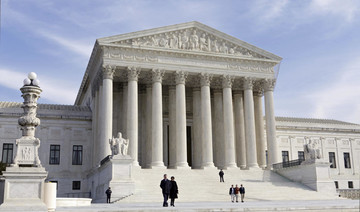
WASHINGTON: The conservative US Supreme Court will weigh a case on Wednesday challenging the ban on using public money to fund religious charter schools.
Nearly all 50 states already allow charter schools, which are privately managed but publicly funded.
But the Catholic Church in Oklahoma is vying to open the nation’s first publicly funded religious charter school, Saint Isidore of Seville.
Named in homage to the patron saint of the Internet, a 7th century Spanish bishop, plaintiffs say the school would promote “parental choice, individual liberty, educational diversity, and student achievement.”
“Excluding religious groups from Oklahoma’s charter school program denies these opportunities and causes real harm,” plaintiffs add.
If the Supreme Court sides with the Catholic Church, taxpayer funding for religious education could see a huge uptick.
The separation between church and state is a bedrock principle of the US government, rooted in the First Amendment of the Constitution. The separation has been upheld in many Supreme Court decisions.
In the case before the court, the Oklahoma Supreme Court ruled that the creation of the school violates both US and state constitutions.
“A ruling for petitioners would eliminate the buffer this Court has long enforced between religious instruction and public schools, including in areas where charter schools are the only or default public school option,” the Oklahoma Attorney General has argued.
Six of nine judges on the conservative-majority Supreme Court have demonstrated support for extending religion into public spaces, particularly schools.
However, Justice Amy Coney Barrett has recused herself from this case, possibly because of connections to jurists advocating for the creation of contracted religious schools.
In 2022, the Supreme Court compelled the northeastern state of Maine to include religious schools in a system of public subsidies, saying their exclusion amounted to discrimination against religion.
The conservative majority also, in the same year, invalidated the dismissal of an American football coach in the Seattle area who prayed on the field.
The plaintiffs are represented by religious legal advocates Alliance Defending Freedom, who are expected to argue that the prohibition on funding schools will inhibit the First Amendment right to free worship.
Nationally, there were more than 3.7 million students enrolled in 8,150 charter schools during the 2022-2023 school year, according to the National Alliance for Public Charter Schools.


US Supreme Court to weigh case about public funds in religious schools

https://arab.news/294yn
US Supreme Court to weigh case about public funds in religious schools

- Nearly all 50 states already allow charter schools, which are privately managed but publicly funded
- If the Supreme Court sides with the Catholic Church, taxpayer funding for religious education could see a huge uptick


Ethiopia’s prime minister accuses Eritrea of mass killings during Tigray war
- Landlocked Ethiopia says that Eritrea is arming rebel groups, while Eritrea says Ethiopia’s aspiration is to gain access to a seaport
- Ethiopia lost sovereign access to the Red Sea when Eritrea seceded in 1993 after decades of guerrilla warfare
ADDIS ABABA: Ethiopia’s government Tuesday for the first time acknowledged the involvement of troops from neighboring Eritrea in the war in the Tigray region that ended in 2022, accusing them of mass killings, amid reports of renewed fighting in the region.
Ethiopian Prime Minister Abiy Ahmed, while addressing parliament Tuesday, accused Eritrean troops fighting alongside Ethiopian forces of mass killings in the war, during which more than 400,000 people are estimated to have died.
Eritrean and Ethiopian troops fought against regional forces in the northern Tigray region in a war that ended in 2022 with the signing of a peace agreement.
Eritrea’s Information Minister Yemane Gebremeskel told The Associated Press that Ahmed’s comments were “cheap and despicable lies” and did not merit a response.
Both nations have been accusing each other of provoking a potential civil war, with landlocked Ethiopia saying that Eritrea is arming and funding rebel groups, while Eritrea says Ethiopia’s aspiration is to gain access to a seaport.
“The rift did not begin with the Red Sea issue, as many people think,” Ahmed told parliamentarians. “It started in the first round of the war in Tigray, when the Eritrean army followed us into Shire and began demolishing houses, massacred our youth in Axum, looted factories in Adwa, and uprooted our factories.”
“The Red Sea and Ethiopia cannot remain separated forever,” he added.
Ethiopia lost sovereign access to the Red Sea when Eritrea seceded in 1993 after decades of guerrilla warfare.
Gebremeskel said the prime minister has only recently changed his tune in his push for access to the Red Sea.
Ahmed “and his top military brass were profusely showering praises and State Medals on the Eritrea army and its senior officers. … But when he later developed the delusional malaise of ‘sovereignty access to the sea’ and an agenda of war against Eritrea, he began to sing to a different chorus,” he said.
Eritrea and Ethiopia initially made peace after Abiy came to power in 2018, with Abiy winning a Nobel Peace Prize for his efforts toward reconciliation.
In June, Eritrea accused Ethiopia of having a “long-brewing war agenda” aimed at seizing its Red Sea ports. Ethiopia recently said that Eritrea was “actively preparing to wage war against it.”
Analysts say an alliance between Eritrea and regional forces in the troubled Tigray region may be forming, as fighting has been reported in recent weeks. Flights by the national carrier to the region were canceled last week over the renewed clashes.


