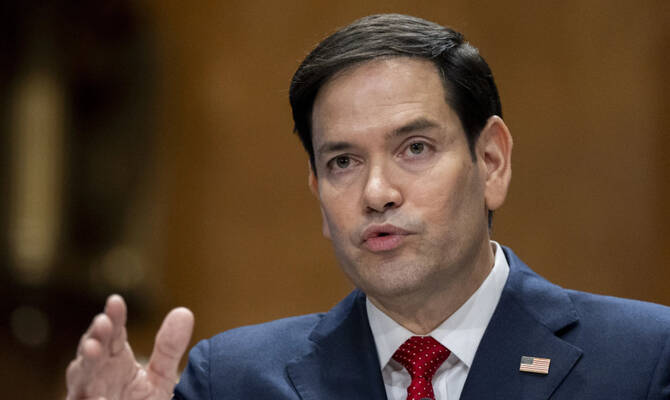
WASHINGTON: Secretary of State Marco Rubio warned Tuesday that the United States would end mediation unless Russia and Ukraine put forward “concrete proposals,” as US patience wanes on an early priority for Donald Trump.
The US president had vowed to end the war in his first 24 hours back in the White House but, as Trump celebrates 100 days in office, Rubio has suggested the administration could soon turn attention to other issues.
“We are now at a time where concrete proposals need to be delivered by the two parties on how to end this conflict,” State Department spokeswoman Tammy Bruce told reporters, in what she said was a message from Rubio.
“If there is not progress, we will step back as mediators in this process.”
She said it would ultimately be up to Trump to decide whether to move ahead on diplomacy.
Russian President Vladimir Putin recently proposed a three-day ceasefire around Moscow’s commemorations next week for the 80th anniversary of the end of World War II.
But Putin has rebuffed a Ukrainian-backed US call for a 30-day ceasefire.
The United States wants “not a three-day moment so you can celebrate something else — a complete, durable ceasefire and an end to the conflict,” Bruce said.
It remains unclear if Rubio is actually ready to turn the page or is seeking to pressure the two countries — especially Russia, which believes it has an upper hand on the battlefield and in diplomacy since Trump’s outreach.
US diplomat James Kelley, addressing a UN Security Council session, said both sides would benefit from working off the “framework proposal” outlined by Washington.
Condemning Russian strikes on Ukraine, he said: “Right now, Russia has a great opportunity to achieve a durable peace.”
Trump, criticizing his predecessor Joe Biden’s support for Ukraine, reached out to Putin after taking office, easing him from the international isolation he has been in since he ordered the February 2022 invasion of Ukraine.
Putin again last week met with Trump’s business friend Steve Witkoff, who has taken on the role of a globe-trotting envoy.
Trump in turn berated Ukrainian President Volodymyr Zelensky in a February 28 White House meeting, with Trump and Vice President JD Vance accusing the wartime leader of ingratitude for US weapons.
Ukraine quickly tried to make amends by backing US diplomatic efforts and pursuing a deal in which the United States would control much of the country’s mineral wealth.
But Zelensky has held firm against one part of the US framework — formal international recognition of Russia’s 2014 takeover of Crimea.
Trump has insisted that Ukraine has lost Crimea and Zelensky should give it up.
Speaking by videoconference to an event in Poland on Tuesday, Zelensky said: “We all want this war to end in a fair way — with no rewards for Putin, especially no land.”
US Senator Jeanne Shaheen, the top Democrat on the Senate Foreign Relations Committee, said Tuesday that recognizing “Russia’s illegal annexation of Crimea would invite additional aggression from Moscow and Beijing.”
“I have endeavored to give President Trump the space to negotiate a just and lasting peace in Ukraine, which is a goal we both share,” she said.
“However, President Trump and his team have fatally mismanaged these negotiations — offering concession after concession to Russia, throwing away our leverage and fracturing the united front with our allies that is critical to ending this war,” she said.
Ukraine on Tuesday ordered the evacuation of seven villages in the eastern Dnipropetrovsk region which used to be remote from the frontlines but are now under threat as Russian forces close in.
Russia has been trying to break into the region from the neighboring Donetsk but has not succeeded, even after more than three years of grinding battles.
Last week a ballistic missile ripped into a residential area of Kyiv in one of the deadliest attacks on the capital since the invasion.
Trump, who has boasted of his rapport with Putin, wrote, “Vladimir, STOP,” on social media after the attack.


![]()

US threatens to quit Russia-Ukraine effort unless ‘concrete proposals’
Short Url
https://arab.news/wz7c4
US threatens to quit Russia-Ukraine effort unless ‘concrete proposals’
- It remains unclear if Rubio is actually ready to turn the page or is seeking to pressure the two countries — especially Russia


Latest updates


© 2026 SAUDI RESEARCH & PUBLISHING COMPANY, All Rights Reserved And subject to Terms of Use Agreement.