UAE and Gates Foundation launch $500m maternal health fund for Africa

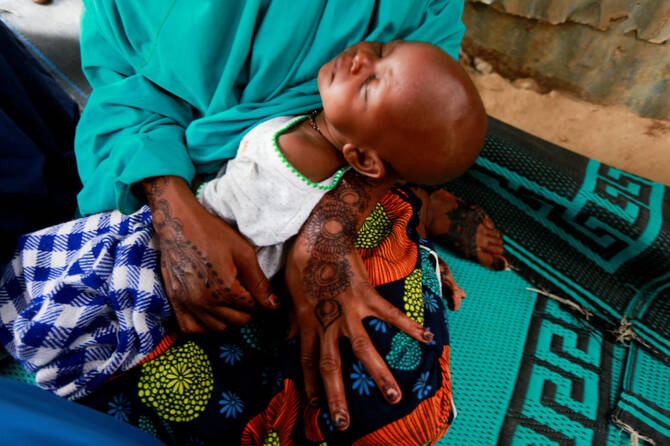
A mother carries her sleeping baby at the Gubio camp in Maiduguri, Nigeria. (AFP/File)
Short Url
Updated 29 April 2025
Follow

UAE and Gates Foundation launch $500m maternal health fund for Africa

  • Beginnings Fund will help save lives of newborn babies and mothers in sub-Saharan Africa
  • Mohamed Bin Zayed Foundation for Humanity launches the fund in Abu Dhabi

LONDON: A group of philanthropies including the Gates Foundation has set up a fund backed with nearly $500 million to help save the lives of newborn babies and mothers in sub-Saharan Africa, standing out against a bleak global health funding landscape.
The Beginnings Fund was launched on Tuesday in Abu Dhabi, the home of another key backer — the United Arab Emirates’ recently established Mohamed Bin Zayed Foundation for Humanity. The project has been in the works for at least a year. But its role has become more important as governments worldwide follow the US in pulling back from international aid, its chief executive Alice Kang’ethe told Reuters in an interview.
“It is an opportune moment,” she said earlier this month, stressing that the fund aimed to work alongside African governments, experts and organizations rather than parachuting in experts or technologies, an approach she said differed from many traditional donor programs.
“Two generations ago... women in the UAE used to die during childbirth. More than half of children did not survive past childhood,” said Tala Al Ramahi at the Mohamed Bin Zayed Foundation, saying the lessons learned in what worked to change those outcomes would help inform the effort.
The Beginnings Fund aims to save the lives of 300,000 mothers and newborn babies by 2030, and expand quality care for 34 million mothers and babies.
The partners also pledged $100 million in direct investments in maternal and child health, separate to the fund.
It plans to operate in Ethiopia, Ghana, Kenya, Malawi, Lesotho, Nigeria, Rwanda, Tanzania, Uganda, and Zimbabwe, focusing on low-cost interventions and personnel in high-burden hospitals. The work will track and target the key reasons babies and mothers die, including infection, severe bleeding for mothers, and respiratory distress for infants. The world has made major progress in reducing newborn and maternal deaths, halving the neonatal mortality rate between 1990 and 2022. But that progress has stagnated or even reversed in nearly all regions in the last few years, according to the World Health Organization, which has warned that aid cuts could make this worse.
“Mothers and newborns should not be dying from causes we know how to prevent,” said Dr. Mekdes Daba, minister of health for Ethiopia, stressing that the majority of deaths are avoidable.
Kang’ethe said the Beginnings Fund, like other philanthropies, was getting calls to fill gaps in global aid funding, but remained focused on its long-term aim of changing the trajectory of mother and newborn survival.
The fund is also backed by the Children’s Investment Fund Foundation, Delta Philanthropies and the ELMA Foundation, among others. It will be led from Nairobi, Kenya.


Sudan’s prime minister takes his peace plan to the UN, but US urges humanitarian truce now

Updated 57 min 20 sec ago
Follow

Sudan’s prime minister takes his peace plan to the UN, but US urges humanitarian truce now

  • Sudan’s prime minister is proposing a wide-ranging peace initiative to end a nearly 1,000-day war with a rival paramilitary force
  • It seems unlikely the RSF would support the proposal, which would essentially give government forces a victory and take away their military power

UNITED NATIONS: Sudan’s prime minister on Monday proposed a wide-ranging peace initiative to end a nearly 1,000-day war with a rival paramilitary force, but the United States urged both sides to accept the Trump administration’s call for an immediate humanitarian truce.
Kamil Idris, who heads Sudan’s transitional civilian government, told the Security Council his plan calls for a ceasefire monitored by the United Nations, African Union and Arab League, and the withdrawal of paramilitary forces from all areas they occupy, their placement in supervised camps and their disarmament.
Sudan plunged into chaos in April 2023 when a power struggle between the military and the powerful paramilitary Rapid Support Forces exploded into open fighting, with widespread mass killings and rapes, and ethnically motivated violence. This has amounted to war crimes and crimes against humanity, according to the UN and international rights groups.
It seemed highly unlikely the RSF would support the prime minister’s proposal, which would essentially give government forces a victory and take away their military power.
In an indirect reference to the truce supported by the US and key mediators Saudi Arabia, Egypt and the United Arab Emirates, known as the Quad, Idris stressed to the UN Security Council that the government’s proposal is “homemade — not imposed on us.”
In early November, the Rapid Support Forces agreed to a humanitarian truce. At that time, a Sudanese military official told The Associated Press the army welcomed the Quad’s proposal but would only agree to a truce when the RSF completely withdraws from civilian areas and gives up their weapons — key provisions in the plan Idris put forward on Monday.
Idris said unless the paramilitary forces were confined to camps, a truce had “no chance for success.” He challenged the 15 members of the Security Council to back his proposal.
“This initiative can mark the moment when Sudan steps back from the edge and the international community — You! You! — stood on the right side of history,” the Sudanese prime minister said. He said the council should “be remembered not as a witness to collapse, but as a partner in recovery.”
US deputy ambassador Jeffrey Bartos, who spoke to the council before Idris, said the Trump administration has offered a humanitarian truce as a way forward and “We urge both belligerents to accept this plan without preconditions immediately.”
Bartos said the Trump administration strongly condemns the horrific violence across Darfur and the Kordofan region — and the atrocities committed by both the Sudanese Armed Forces and the Rapid Support Forces, who must be held accountable.
UAE Ambassador Mohamed Abushahab, a member of the Quad, said there is an immediate opportunity to implement the humanitarian truce and get aid to Sudanese civilians in desperate need.
“Lessons of history and present realities make it clear that unilateral efforts by either of the warring parties are not sustainable and will only prolong the war,” he warned.
Abushahab said a humanitarian truce must be followed by a permanent ceasefire “and a pathway toward civilian rule independent of the warring parties.”
UN Assistant Secretary-General for political affairs Khaled Khiari reflected escalating council concerns about the Sudan war, which has been fueled by the continuing supply of increasingly sophisticated weapons.
He criticized unnamed countries that refuse to stop supplying weapons, and both government and paramilitary forces for remaining unwilling to compromise or de-escalate.
“While they were able to stop fighting to preserve oil revenues, they have so far failed to do the same to protect their population,” Khiari said. “The backers of both sides must use their influence to help stop the slaughter, not to cause further devastation.”
The devastating war in Sudan has killed more than 40,000 people according to UN figures, but aid groups say the true number could be many times higher. The conflict has created the world’s largest humanitarian crisis, with over 14 million people displaced, disease outbreaks and famine spreading in parts of the country.