ISLAMABAD: Pakistan’s Deputy Prime Minister Ishaq Dar said on Tuesday Islamabad would not be the first to strike India despite heightened tensions following a deadly attack in Indian-administered Kashmir, though it would respond forcefully to any escalatory move by its eastern neighbor.
India has blamed Pakistan for the April 22 assault in the Pahalgam area of the disputed Himalayan region that left 26 tourists dead, an allegation Islamabad has categorically rejected.
In the aftermath, New Delhi suspended the Indus Waters Treaty (IWT) and expelled Pakistani diplomats. The latter move was reciprocated by the administration in Islamabad, though it also called for a “neutral” international investigation into the Pahalgam incident.
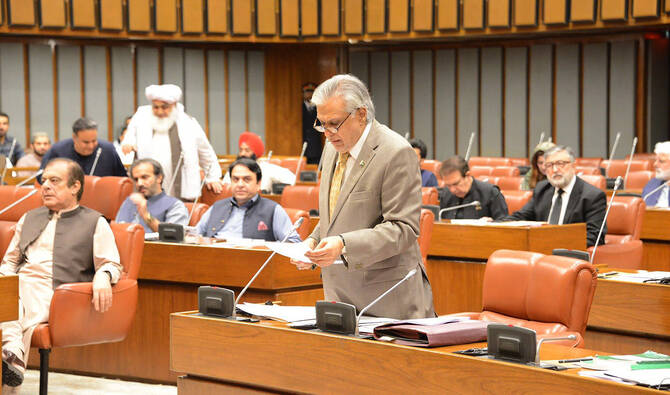
Dar, who also serves as his country’s foreign minister, shared the details of Pakistan’s diplomatic outreach while addressing the Senate earlier today.
“As of now, we’ve spoken to the foreign ministers of Saudi Arabia, the United Arab Emirates, Qatar, China, the United Kingdom, Türkiye, Azerbaijan, Kuwait, Bahrain, and Hungary — except in the case of Qatar, where I spoke directly to the prime minister,” Dar told lawmakers.
“I walked them through what happened — India’s psyche, its history and our concerns about what intentions it may have in light of that history,” he continued.
Dar said Pakistan’s intelligence indicated that India was contemplating some form of escalation.
“We will not be the first one [to strike],” he said. “But if India does it, then this time there will be no tit-for-tat. Our response will be stronger than the Indian action.”
Referring to the 2019 Pulwama attack that killed 40 Indian paramilitary personnel and was blamed on a Pakistan-based militant group, the Pakistani deputy prime minister noted that New Delhi had used the incident as a pretext to revoke Article 370 of its constitution, which granted special status to Jammu and Kashmir.
The region was subsequently absorbed into India’s union territory framework, a move Pakistan has repeatedly condemned.
Dar also claimed that India had been attempting to alter the 1960 Indus Water Treaty, which determines the river water sharing mechanism between both countries, for the past two years, citing changing circumstances.
“I have my doubt, much like other people, that this drama was staged to suspend this treaty,” he said while referring to the Pahalgam attack.
“We obviously don’t have evidence that they have staged this drama,” he continued. “What we do say with full confidence is that Pakistan has nothing to do with this [attack].”
Dar also applauded China and Türkiye for expressing clear support for Pakistan since the crisis began.


![]()

Pakistan won’t strike first but will respond forcefully to Indian escalation — deputy PM
Short Url
https://arab.news/5hpu6
Pakistan won’t strike first but will respond forcefully to Indian escalation — deputy PM
- Ishaq Dar says Pakistan shared its concerns with countries like Saudi Arabia following tensions with India
- The deputy PM says he suspects India may have staged tourist shootings to suspend the Indus Waters Treaty
Latest updates


© 2026 SAUDI RESEARCH & PUBLISHING COMPANY, All Rights Reserved And subject to Terms of Use Agreement.