In Asia’s Catholic heartland, Filipinos remember ‘compassionate’ Pope who renewed their faith

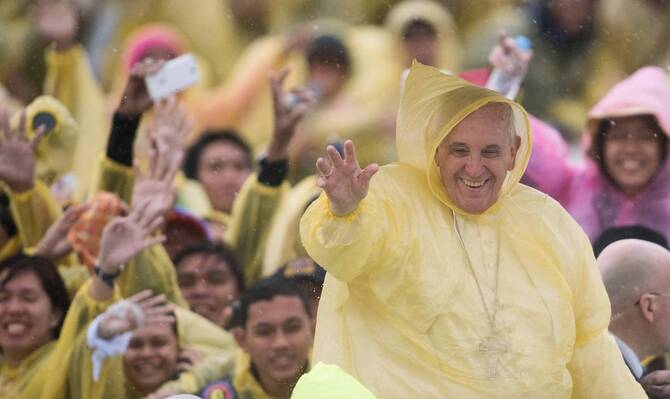
Pope Francis wears a plastic poncho as he waves to well wishers after a mass in Tacloban on Jan. 17, 2015. (AFP)
Short Url
Updated 29 April 2025
Follow

In Asia’s Catholic heartland, Filipinos remember ‘compassionate’ Pope who renewed their faith

  • Pontiff visited Philippines in 2015, in aftermath of deadly Super Typhoon Haiyan
  • His Manila mass that drew more than 6 million people was largest papal gathering in history

MANILA: The death of Pope Francis has stirred an outpouring of grief across the Philippines, as many remember his compassionate leadership during one of the nation’s darkest times.

The Argentine pontiff, leader of the Catholic Church since March 2013, died at his residence, Casa Santa Marta, in the Vatican on April 21. He was 88 years old.

In the Philippines, home to Asia’s largest Catholic population, the pope is adoringly referred to as “Lolo Kiko,” or Grandpa Kiko.

He left an indelible mark in the country after a historic four-day visit in January 2015, when he celebrated an open-air mass in Manila that drew more than 6 million devotees, making it the largest papal gathering in history.

But many among the Philippines’ 85 million Catholics were deeply moved by his visit to Tacloban City in central Philippines during the same trip, braving heavy rain to conduct a mass in memory of the more than 6,000 people who perished in Super Typhoon Haiyan in 2013.

“When he visited Manila and Tacloban, especially after the devastation of (the) typhoon, it deeply touched the hearts of so many. He didn’t come as a distant leader, but as a father who wanted to personally console and strengthen us,” Alfredo Navarro III, a seminarian from the diocese of Balanga, told Arab News.

“Filipinos love Lolo Kiko so much because he has shown real concern for us. Not just in words, but in action. He has made it clear that he understands our struggles and is familiar with our culture.”

For Navarro, Pope Francis was a beacon of hope “in a world where it sometimes feels like God is absent because of wars, conflicts and so many struggles.”

“Watching Pope Francis live out the Gospel in such a simple yet powerful way made me realize even more deeply that God is truly present, even in the most broken parts of our world. Through him, I felt God’s love reaching out to me and to everyone,” he said.

“Because of Pope Francis, I feel a stronger calling to be a sign of that same love — to be more present to others, especially to those who are last, the least and the lost.”

World leaders and hundreds of thousands of people bade farewell to Pope Francis in a funeral at the Vatican on Saturday, where he was eulogized as a pope of the people.

Many young Filipinos took to social media to mourn his passing, honoring him as an inspiration and a figure who renewed their faith.

“I do not claim to be a model Catholic. I never was and I do not think I will ever be. But his words, his actions, the way he saw Christ in the last, the least and the lost was fuel to my faith. It was grace made real, alive and living,” Marion Bais Guerrero wrote on Facebook.

Filipino sociologist Athena Charanne Presto said on X that Pope Francis “made being Catholic less morally suffocating, less burdened by contradiction.”

“This is heartbreaking news for the faithful and for those like me who only slowly found their way to faith because someone at the helm reminded us that the Church could also be a place to breathe.”

In Pope Francis, Raymond Zabala saw a leader who touched the lives of many, even those who are not Catholics.

“He respects all people regardless of their religion or status and in the same manner people from other religions respect him as well. I know of some friends who are non-practicing Catholics who are deeply saddened by his passing,” he told Arab News.

“His passing reminded us of the values of kindness and compassion.”


Pakistan killed over 80 militants in strikes on TTP camps in Afghanistan — official

Updated 5 sec ago
Follow

Pakistan killed over 80 militants in strikes on TTP camps in Afghanistan — official

  • Saturday’s airstrikes followed a series of attacks inside Pakistan amid a surge in militancy
  • The Afghan Taliban authorities accuse Pakistani forces of killing civilians in the airstrikes

ISLAMABAD: Pakistan’s airstrikes in Afghanistan destroyed seven Tehreek-e-Taliban Pakistan (TTP) camps and killed over 80 militants, a Pakistani security official said on Sunday, with the Afghan Taliban accusing Pakistani forces of killing civilians in the assault.

Saturday’s airstrikes followed a series of attacks inside Pakistan amid a surge in militancy. Authorities say the attacks, particularly in Khyber Pakhtunkhwa province and the Pakistani capital of Islamabad, were carried out by the TTP and allied groups that Islamabad alleges are operating from sanctuaries in Afghanistan. Kabul denies this.

According to Pakistan’s information ministry, recent incidents included a suicide bombing at a Shiite mosque in Islamabad, separate attacks in Bajaur and Bannu, and another recent incident in Bannu during the holy month of Ramadan, which started earlier this week. The government said it had “conclusive evidence” linking the attacks to militants directed by leadership based in Afghanistan.

“Last night, Pakistan’s intelligence-based air strikes destroyed seven centers of Fitna Al-Khawarij TTP in three provinces of Nangarhar, Paktika and Khost, in which more than eighty Khawarij (TTP militants) have been confirmed killed, while more are expected,” a Pakistani security official, who spoke on condition of anonymity, told Arab News.

An earlier statement from Pakistan’s information ministry said the targets included a camp of a Daesh regional affiliate, the Islamic State Khorasan Province (ISKP), which claimed a suicide bombing at an Islamabad Shiite mosque that killed 32 people this month.

In an X post, Afghan government spokesperson Zabihullah Mujahid said Pakistani forces had violated Afghan territory.

“Pakistani special military circles have once again trespassed into Afghan territory,” Mujahid said. “Last night, they bombed our civilian compatriots in Nangarhar and Paktika provinces, martyring and wounding dozens of people, including women and children.”

 The Afghan Taliban’s claims of civilian casualties could not be independently verified. Pakistan did not immediately comment on the allegation that civilians had been killed in the strikes.

In a post on X, Afghanistan’s foreign ministry said it had summoned Pakistan’s charge d’affaires to Afghanistan Ubaid-ur-Rehman Nizamani and lodged protest through a formal démarche in response to the Pakistani military strikes.

“IEA-MoFA (The Islamic Emirate of Afghanistan’s Ministry of Foreign Affairs) vehemently condemns the violation of Afghanistan’s airspace and the targeting of civilians, describing it as a flagrant breach of Afghanistan’s territorial integrity & a provocative action,” it said in a statement.

“The Pakistani side was also categorically informed that safeguarding Afghanistan’s territorial integrity is the religious responsibility of the Islamic Emirate of Afghanistan; henceforth, the responsibility for any adverse consequences of such actions will rest with the opposing side.”

Tensions between Islamabad and Kabul have escalated since the Afghan Taliban returned to power in 2021. Pakistan says cross-border militant attacks have increased since then and has accused the Taliban of failing to honor commitments under the 2020 Doha Agreement to prevent Afghan soil from being used for attacks against other countries. The Taliban deny allowing such activity and have previously rejected similar accusations.

Saturday’s exchange of accusations marks one of the most direct confrontations between the two neighbors in recent months and risks further straining already fragile ties along the volatile border.