

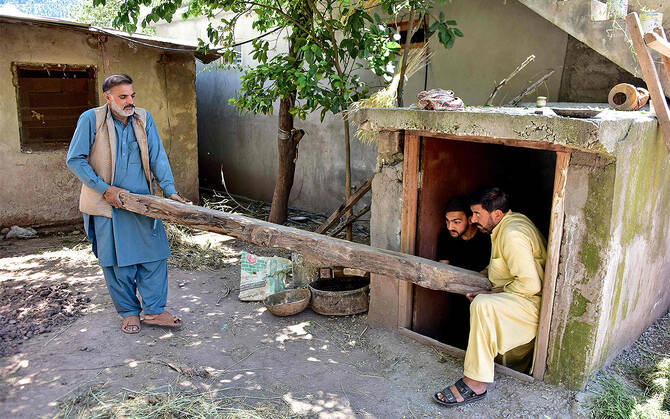

CHAKOTHI, Pakistan: Pulling logs and dusty building materials from a storage bunker outside his home in Kashmir, Riaz Awan readied the underground space to house his family as they braced for clashes between Pakistan and India to reach their border village.
Kashmiris living on both sides of the de facto border — the Line of Control — have been caught in the barrage of shells and bullets for decades as the nuclear-armed archrivals fight over the disputed region.
The long history of clashes has pushed many residents to build bunkers for shelter should their homes be caught in the crossfire.
“We’ve endured cross-border firing, which has been a tough experience, and we don’t want our children to go through the same,” Awan, a 51-year-old farmer, told AFP as he and his children cleared the bunker that had until recently stored straw.
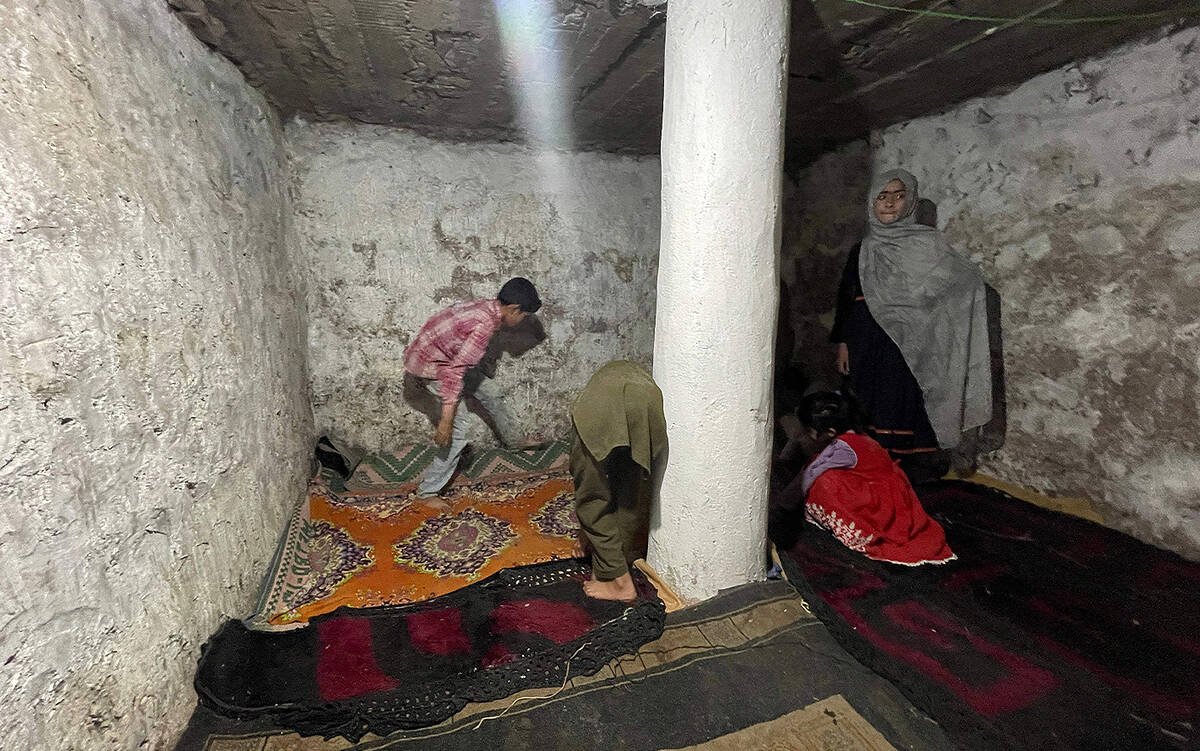
This photograph taken on April 27, 2025 shows a family laying carpets inside an underground bunker in the Chakothi village of Azad Kashmir, about 3kms from the Line of Control (LoC). (AFP)
In Chakothi village, around three kilometers (two miles) from the Line of Control, there are around 30 bunkers for a community of 60 families overlooked by Indian army check posts atop the surrounding green mountains.
Awan and his cousin Shabbir share the bunker they built in 2017, which cost them 300,000 Pakistani rupees ($1,000) — a substantial amount in their impoverished village.
But they pulled together the funds to pay for safety.
A militant attack last week killed 26 people in Indian-administrated Kashmir, the worst attack on civilians in a Muslim-majority region in a quarter of a century.
India blamed the attack on Pakistan and accused it of “cross-border terrorism,” a charge Islamabad vehemently denied.
In response, New Delhi and Islamabad downgraded diplomatic ties, withdrew visas and announced the closure of the main land border. India has also suspended the 1960 Indus Waters Treaty that governs the sharing of river water between the two nations.
India says that its army has been exchanging fire with the Pakistani army for the past five days as both countries remain on edge, bracing for a potential military confrontation.
“Every day, India makes various threats, saying they will do this and that,” said 52-year-old retired soldier Shabbir Awan.
“That is why we are cleaning these bunkers today, so that if needed, we can use them and make our lives safer.”
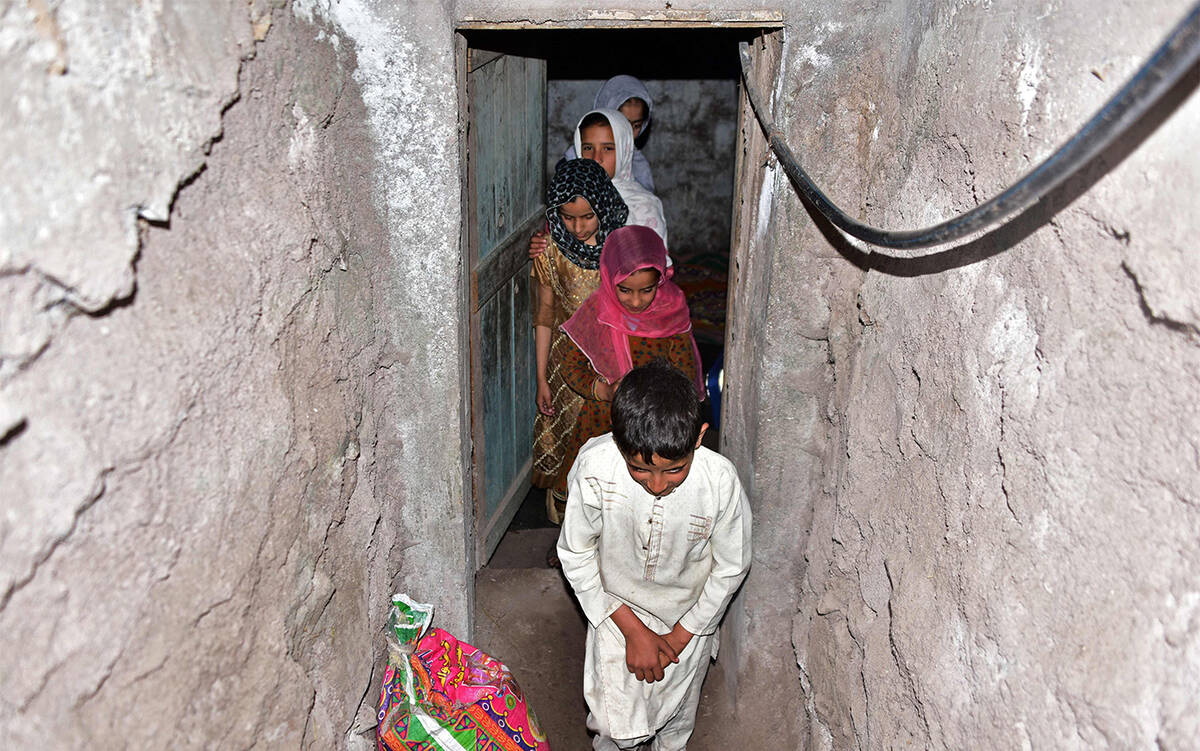
This photograph taken on April 27, 2025 shows a family walking out an underground bunker in the Chakothi village of Azad Kashmir, about 3kms from the Line of Control (LoC). (AFP)
“NO PROPER SHELTER”
Kashmir has been divided between India and Pakistan since their independence from British rule in 1947. Both claim the territory in full but govern separate portions of it.
Rebel groups have waged an insurgency in Indian-controlled Kashmir since 1989, demanding independence or a merger with Pakistan
Ridges and valleys intersected by the Line of Control host tens of thousands of heavily armed troops, with some rival outposts just a few dozen meters apart.
The Pakistan military says about 1.5 million residents live along the ceasefire line, long relying on a network of community bunkers and homemade shelters to weather the perennial bouts of unrest.
An average underground bunker is around 2.5 meters deep, 3.5 meters wide and 3.5 meters long. Those who can afford it reinforce all four sides with concrete, while others simply use mud walls.
“Our main concern is the safety of our children, protecting them is our biggest priority,” said Saleema Bibi, a 40-year-old mother of four.
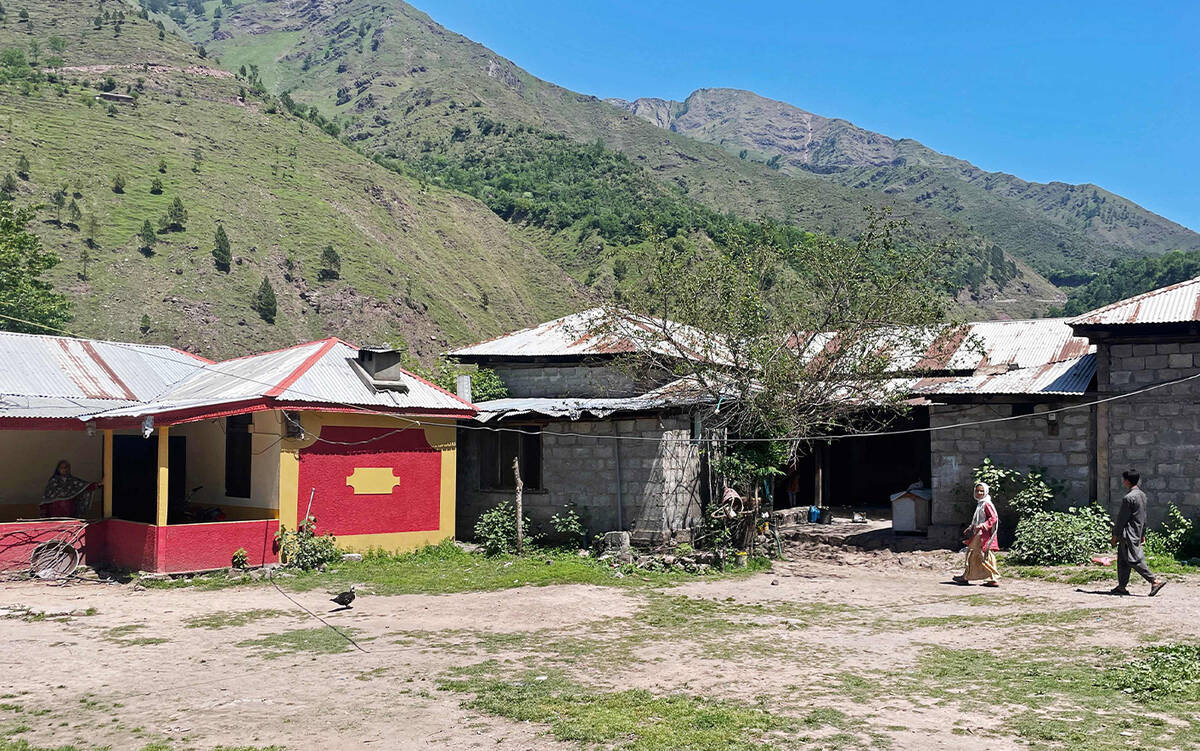
This photograph taken on April 27, 2025 shows local children walking past their houses that comprise of underground bunkers in the Chakothi village of Azad Kashmir, about 3kms from the Line of Control (LoC). (AFP)
In 2017, “they even hit directly on top of our houses,” she told AFP.
“We have no proper shelter or protection. We are living here — where else can we go?” she said.
Naseema Bibi, a 46-year-old mother of four, owns a cow and two buffalos, making it hard for her to leave.
“We have livestock. We can’t move anywhere,” she said. So she is also working to clear a bunker.
“We are around eight families and it is difficult to adjust in one bunker,” she told AFP.
“But children get panicked so we are concerned because of them.”


