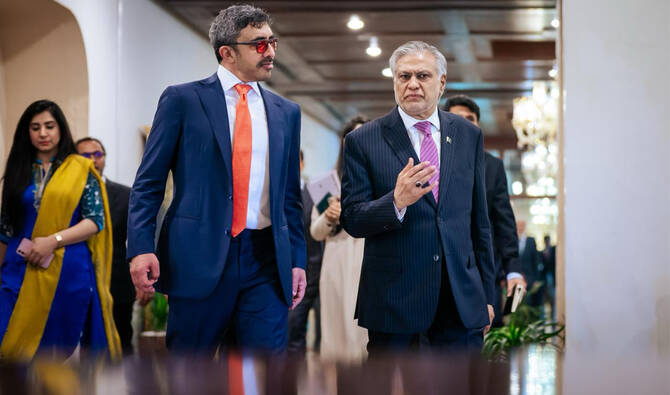

ISLAMABAD: Pakistan’s Deputy Prime Minister and Foreign Minister Ishaq Dar has spoken with his UAE counterpart Sheikh Abdullah bin Zayed Al-Nahyan, the foreign office said on Tuesday, as Islamabad approaches friendly countries amid surging tensions with nuclear-armed neighbor India.
The two nations downgraded diplomatic ties in the aftermath of a deadly militant attack on tourists in India-administered Kashmir last week that new Delhi says Pakistan was involved in. Islamabad denies official complicity.
The attack killed 26 people and triggered outrage in India along with calls for action against Pakistan. India has long accused Pakistan of backing militancy in Kashmir, a region both nations claim and have fought two wars over. Islamabad says it only provides diplomatic and moral support to Kashmiris in their struggle for self-determination.
Tensions continued to boil this week, with border forces trading fire for a fifth night in a row at the Line of Control (LoC) that divides Kashmir territory between India and Pakistan, the Indian Army said on Tuesday.
Pakistan meanwhile is reaching out to top officials in China, Saudi Arabia, Iran, Egypt and other nations amid mounting concerns over a military escalation with experts and officials both speaking of the possibility of limited airstrikes by India or special forces raids near the border.
“The two leaders discussed recent regional situation and matters of mutual concern,” the foreign ministry said after Dar’s telephone conversation with Al-Nayhan, adding that he briefed him about Pakistan’s response to India’s “unfounded allegations, inflammatory rhetoric, and unilateral actions.”
India and Pakistan have both announced a flurry of punitive measures to downgrade ties since last Tuesday’s attack, with India suspending a key water-sharing treaty and Pakistan closing its airspace to Indian planes. Both have also halted a special visa program, asked defense advisers to return home and reduced staff at embassies.
According to the Pakistani statement, the UAE dignitary “emphasized the importance of upholding regional stability, promoting dialogue, exercising restraint and peaceful resolution of disputes.”
“Both leaders committed to maintaining close coordination & consultations in light of evolving regional situation,” the statement concluded.
In an interview to Reuters on Monday, Defense Minister Khawaja Asif said Islamabad had approached friendly countries, including Gulf states and China, and also briefed Britain, the United States and others on the situation.
“Some of our friends in the Arabian Gulf have talked to both sides,” Asif said, without naming the countries.
China said on Monday it hoped for restraint and welcomed all measures to cool down the situation. Asif said the United States was thus far “staying away” from intervening in the matter.
Riyadh and Tehran have also offered to mediate and help in de-escalation.
The last time India conducted an aerial strike against Pakistan was in 2019, when it retaliated for a suicide bombing in Pulwama in Indian-administered Kashmir in which at least 40 Indian paramilitary police were killed. Pakistan had denied complicity in that assault and the Indian strikes were followed by Pakistan’s downing of an Indian fighter jet and capturing of an Indian pilot, bringing the two neighbors to the brink of an all-out war.
In the past, New Delhi has accused Islamabad of backing militants who carried out the 2008 Mumbai attacks, which killed more than 166 people, including foreigners. Pakistan denies the accusations.
Diplomatic relations between Pakistan and India were weak even before the latest conflict as Pakistan had expelled India’s envoy and not posted its own ambassador in New Delhi after India revoked the semi-autonomous status of Kashmir in 2019.