Pakistan’s average inflation to remain between 5.5-7.5% during FY25— central bank

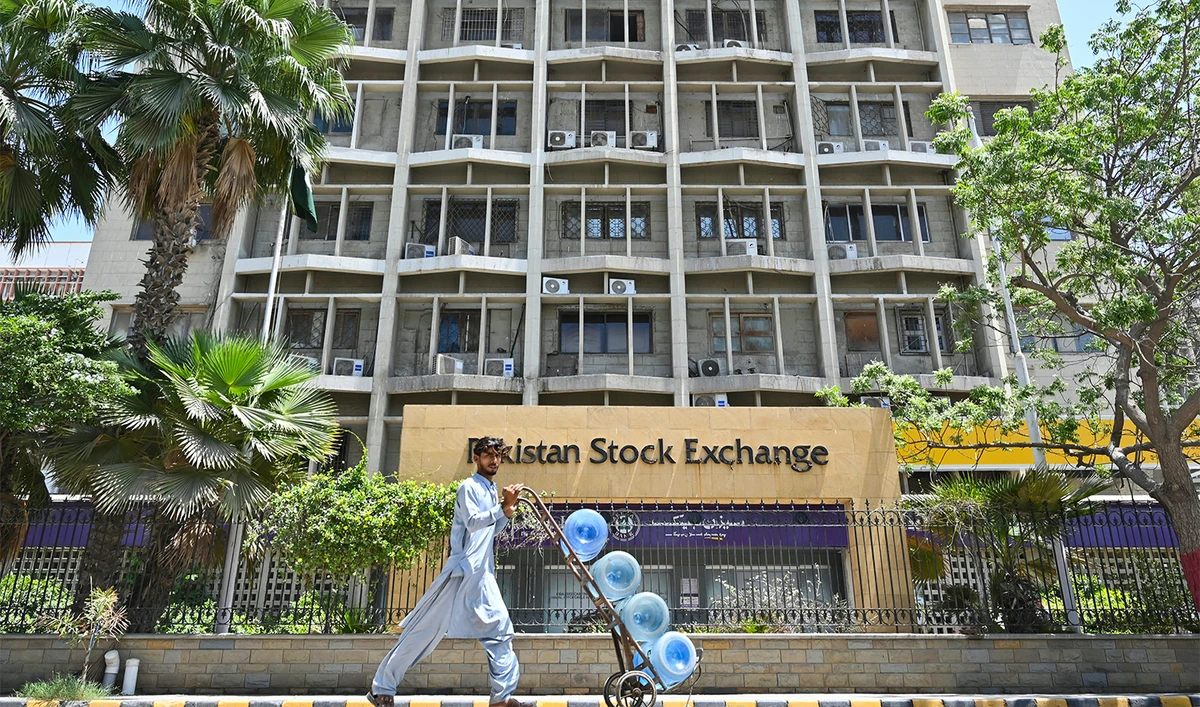
A labour carries water bottles on a hand cart past the Pakistan Stock Exchange (PSX) building as index plummeted amid a global market crash, in Karachi on April 7, 2025. (AFP)
Short Url
Updated 29 April 2025
Follow

Pakistan’s average inflation to remain between 5.5-7.5% during FY25— central bank

  • Pakistan’s real GDP growth rate expected to hover between 2.5-3.5%, says State Bank of Pakistan 
  • Central bank says “strong momentum” in remittances, exports to continue outpacing increase in imports 

ISLAMABAD: Pakistan’s average inflation is expected to remain in the 5.5-7.5% range in the fiscal year ending June 2025, the country’s central bank said in its half-yearly economic report this week, stating that its real GDP growth is expected to hover between 2.5-3.5%.

Pakistan’s economy has improved in recent months, supported by declining inflation, which caused the central bank to reduce its policy rate to 12% after a series of cuts totaling 1,000 basis points since June 2024.

In a report titled “The State of Pakistan’s Economy, Half Year Report FY25” released on Monday, the State Bank of Pakistan (SBP) noted that inflationary pressures have receded notably, with headline inflation reaching a multi-decade low of 0.7% by March 2025.

“In view of steeper-than-anticipated disinflation, combined with an adequately tight monetary policy stance, continued fiscal consolidation and an ease in global commodity prices, the SBP projects average inflation for FY25 to fall in the range of 5.5–7.5 percent,” the SBP said in a press release.

Pakistan’s inflation rate rose to a record high of 38% in May 2023 on account of surging food and fuel costs. This was caused by Islamabad’s move to withdraw energy and fuel subsidies under a deal agreed with the International Monetary Fund in exchange for a financial bailout package.

The report said Pakistan’s current account balance is projected to remain in the range of -0.5 to 0.5 percent of the GDP. The central bank said it expects a “strong momentum” in foreign remittances and exports to continue outpacing the increase in imports. 

“This is expected to cushion against lower financial inflows and help strengthen external buffers,” the report said. “The SBP’s projection for real GDP growth remains unchanged in the range of 2.5–3.5 percent.”

The report highlighted downside risks in the form of additional fiscal consolidation and less-than-expected wheat harvests. It pointed out risks to the medium-term outlook, largely stemming from global trade disruptions and related commodity price volatility in light of Washington’s tariffs, changing geo-political situations, adjustments in administered energy prices and spillover of movements in international currencies on the local currency. 

Pakistan’s OGDC ramps up unconventional gas plans

Updated 05 December 2025
Follow

Pakistan’s OGDC ramps up unconventional gas plans

  • Pakistan has long been viewed as having potential in tight and shale gas but commercial output has yet to be proved
  • OGDC says has tripled tight-gas study area to 4,500 square km after new seismic, reservoir analysis indicates potential

ISLAMABAD: Pakistan’s state-run Oil & Gas Development Company is planning a major expansion of unconventional gas developments from early next year, aiming to boost production and reduce reliance on imported liquefied natural gas.

Pakistan has long been viewed as having potential in both tight and shale gas, which are trapped in rock and can only be released with specialized drilling, but commercial output has yet to be proved.

Managing Director Ahmed Lak told Reuters that OGDC had tripled its tight-gas study area to 4,500 square kilometers (1,737 square miles) after new seismic and reservoir analysis indicated larger potential. Phase two of a technical evaluation will finish by end-January, followed by full development plans.

The renewed push comes after US President Donald Trump said Pakistan held “massive” oil reserves in July, a statement analysts said lacked credible geological evidence, but which prompted Islamabad to underscore that it is pursuing its own efforts to unlock unconventional resources.

“We started with 85 wells, but the footprint has expanded massively,” Lak said, adding that OGDC’s next five-year plan would look “drastically different.”

Early results point to a “significant” resource across parts of Sindh and Balochistan, where multiple reservoirs show tight-gas characteristics, he said.

SHALE PILOT RAMPS UP

OGDC is also fast-tracking its shale program, shifting from a single test well to a five- to six-well plan in 2026–27, with expected flows of 3–4 million standard cubic feet per day (mmcfd) per well.

If successful, the development could scale to hundreds or even more than 1,000 wells, Lak said.

He said shale alone could eventually add 600 mmcfd to 1 billion standard cubic feet per day of incremental supply, though partners would be needed if the pilot proves viable.

The company is open to partners “on a reciprocal basis,” potentially exchanging acreage abroad for participation in Pakistan, he said.

A 2015 US Energy Information Administration study estimated Pakistan had 9.1 billion barrels of technically recoverable shale oil, the largest such resource outside China and the United States.

A 2022 assessment found parts of the Indus Basin geologically comparable to North American shale plays, though analysts say commercial viability still hinges on better geomechanical data, expanded fracking capacity and water availability.

OGDC plans to begin drilling a deep-water offshore well in the Indus Basin, known as the Deepal prospect, in the fourth quarter of 2026, Lak said. In October, Turkiye’s TPAO with PPL and its consortium partners, including OGDC, were awarded a block for offshore exploration.

A combination of weak gas demand, rising solar uptake and a rigid LNG import schedule has created a surplus of gas that forced OGDC to curb output and pushed Pakistan to divert cargoes from Italy’s ENI and seek revised terms with Qatar.