Pakistan’s average inflation to remain between 5.5-7.5% during FY25— central bank

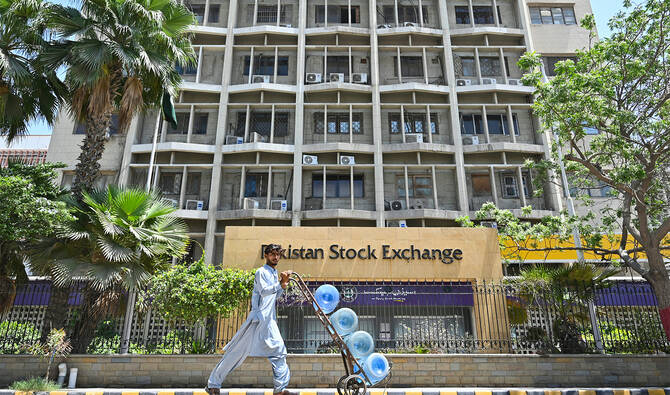
A labour carries water bottles on a hand cart past the Pakistan Stock Exchange (PSX) building as index plummeted amid a global market crash, in Karachi on April 7, 2025. (AFP)
Short Url
Updated 29 April 2025
Follow

Pakistan’s average inflation to remain between 5.5-7.5% during FY25— central bank

  • Pakistan’s real GDP growth rate expected to hover between 2.5-3.5%, says State Bank of Pakistan 
  • Central bank says “strong momentum” in remittances, exports to continue outpacing increase in imports 

ISLAMABAD: Pakistan’s average inflation is expected to remain in the 5.5-7.5% range in the fiscal year ending June 2025, the country’s central bank said in its half-yearly economic report this week, stating that its real GDP growth is expected to hover between 2.5-3.5%.

Pakistan’s economy has improved in recent months, supported by declining inflation, which caused the central bank to reduce its policy rate to 12% after a series of cuts totaling 1,000 basis points since June 2024.

In a report titled “The State of Pakistan’s Economy, Half Year Report FY25” released on Monday, the State Bank of Pakistan (SBP) noted that inflationary pressures have receded notably, with headline inflation reaching a multi-decade low of 0.7% by March 2025.

“In view of steeper-than-anticipated disinflation, combined with an adequately tight monetary policy stance, continued fiscal consolidation and an ease in global commodity prices, the SBP projects average inflation for FY25 to fall in the range of 5.5–7.5 percent,” the SBP said in a press release.

Pakistan’s inflation rate rose to a record high of 38% in May 2023 on account of surging food and fuel costs. This was caused by Islamabad’s move to withdraw energy and fuel subsidies under a deal agreed with the International Monetary Fund in exchange for a financial bailout package.

The report said Pakistan’s current account balance is projected to remain in the range of -0.5 to 0.5 percent of the GDP. The central bank said it expects a “strong momentum” in foreign remittances and exports to continue outpacing the increase in imports. 

“This is expected to cushion against lower financial inflows and help strengthen external buffers,” the report said. “The SBP’s projection for real GDP growth remains unchanged in the range of 2.5–3.5 percent.”

The report highlighted downside risks in the form of additional fiscal consolidation and less-than-expected wheat harvests. It pointed out risks to the medium-term outlook, largely stemming from global trade disruptions and related commodity price volatility in light of Washington’s tariffs, changing geo-political situations, adjustments in administered energy prices and spillover of movements in international currencies on the local currency. 


Pakistan eyes ‘heavy’ Chinese investments in 10 key sectors at Islamabad agriculture summit

Updated 4 sec ago
Follow

Pakistan eyes ‘heavy’ Chinese investments in 10 key sectors at Islamabad agriculture summit

  • More than 300 Chinese and Pakistani firms attended the event focusing on fertilizers, seeds, smart farming and irrigation techniques
  • Islamabad expects the conference to lead to investments in agriculture, food processing, livestock, farm machinery and renewable energy

KARACHI: Pakistan is expecting “heavy” Chinese investments across 10 key sectors, including agriculture, renewable energy and technology, the Pakistani food security minister said on Monday, as officials and business leaders from both countries gathered for a major agriculture investment summit in Islamabad.
The Pakistan-China Agriculture Investment Conference was billed by Pakistan as a platform for deepening bilateral agricultural ties and supporting broader economic engagement between the two countries.
Around 120 Chinese companies and over 190 Pakistani firms participated in the event that focused on fertilizers, seed varieties, machinery, precision farming and smart irrigation systems, according to the organizers.
Speaking at the event, National Food Security Minister Rana Tanveer Hussain said the conference’s objective was to project Pakistan as a place where Chinese enterprises could grow, innovate and succeed alongside Pakistani partners.
“Heavy investments worth millions of dollars are expected, with multiple MoUs [memorandums of understanding] likely to be finalized by the end of the day across 10 key sectors, including agriculture, food processing, livestock, fisheries, agri-inputs, farm machinery, renewable energy, logistics, technology and value-added exports,” Hussain said on Monday evening.
Pakistan’s exports to China reached approximately $2.38 billion in Fiscal Year 2024–25 that ended in June, while imports stood at $16.3 billion, reflecting growing demand on both sides despite global economic headwinds, according to the minister.
This performance demonstrated resilience and expanding opportunities under the China–Pakistan Free Trade Agreement (CPFTA) framework.
Hussain said Islamabad was committed to supporting Chinese investors from regulatory processes to seamless coordination with all government departments and institutions.
“Together, Pakistan and China can push the boundaries of innovation, transform agri-technology, strengthen food security and reshape the economic landscape of the region,” he said.
The completion of the China-Pakistan Economic Corridor (CPEC) Phase I and the launch of CPEC Phase II marked a decisive shift toward industrialization, technology transfer, renewable energy and people-centric development, according to Hussain.
Both sides had signed over 40 MoUs in Sept. 2025, covering modern farming, livestock, fisheries, farm mechanization and advanced technology transfer.
“These initiatives are not just projects; they are lifelines of growth, confidence and mutual trust,” he said, adding that they aim to enhance productivity, expand exports, strengthen food security and ensure sustainable and inclusive economic growth.
Pakistan and China have been expanding cooperation in agriculture under the CPEC framework. Officials say stronger agricultural ties could help Pakistan boost exports, ensure food security and create jobs, while offering Chinese companies access to a large farming market and new investment opportunities.
Addressing the conference, Prime Minister Shehbaz Sharif urged Pakistani and Chinese agriculturists and experts to strengthen their existing partnership, saying that their sustained hard work and productivity gains could turn Pakistan into a surplus agricultural economy.
“Chinese experts are there to assist us and support us all the way to achieve this wonderful target [of becoming a surplus agricultural economy],” he said. “Now it’s up to us to generate this trade surplus through higher yields, comparative cost and, of course, highest quality.”
The prime minister noted that Pakistan’s policy rate was down to 10.5 percent down from 22 percent two years ago, exports were gradually increasing and macroeconomic indicators were stable.
“Now we have to move toward growth,” he said. “But then it requires solid, hard work, untiring efforts, blood and sweat. Without that, you will not be able to achieve your targets.”