MADRID: The cause of Spain and Portugal’s widespread blackouts remained a mystery on Tuesday, with some isolated disruption remaining after power was largely restored to both countries.
One of Europe’s most severe blackouts grounded flights, paralyzed metro systems, disrupted mobile communications and shut down ATMs across the Iberian Peninsula on Monday.
By 7 a.m. on Tuesday more than 99 percent of energy demand in Spain had been restored, the country’s electricity operator Red Eléctrica said. Portuguese grid operator REN said all 89 power substations were back online and power had been restored to all 6.4 million customers.
As life began to return to normal — with schools and offices reopening, traffic easing and public transport restarting — the authorities in Spain have yet to provide further explanations for what caused one of the most serious blackouts to ever take place in Europe.
The Southern European nation of 49 million people lost 15 gigawatts — equivalent to 60 percent of its national demand — in just five seconds.
On Tuesday, Prime Minister Pedro Sánchez said that the government’s priorities were twofold: restoring Spain’s electrical system and finding the causes of the blackout so that a similar event “never takes place again.”
Cause remains a mystery
Such widespread electric failure has little precedent on the Iberian Peninsula or in Europe.
Eduardo Prieto, director of services for system operations at Spain’s electricity operator, noted two steep, back-to-back “disconnection events” before Monday’s blackout. Speaking at a new conference on Tuesday, he said that more investigation was needed to understand why they took place.
Spain’s meteorological agency, AEMET, said that it hadn’t detected any “unusual meteorological or atmospheric phenomena” on Monday, and no sudden temperature fluctuations were recorded at their weather stations.
Portugal’s National Cybersecurity Center on Monday dismissed speculation about foul play, saying that there was no sign that the outage resulted from a cyberattack.
European Council President António Costa also said that there were “no indications of any cyberattack,” while Teresa Ribera, an executive vice president of the European Commission, also ruled out sabotage. Nonetheless, the outage “is one of the most serious episodes recorded in Europe in recent times,” she said.
Madrid Open resumes
At Spain’s largest train stations, droves of travelers waited Tuesday morning to board trains, or to rebook tickets for journeys that were canceled or disrupted.
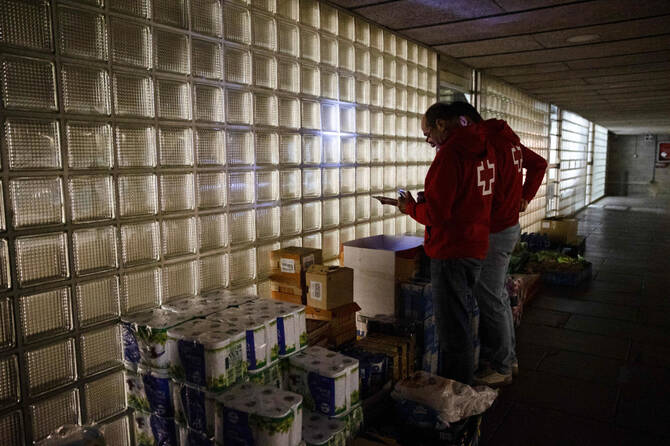
At Madrid’s Atocha station, hundreds of people stood near screens waiting for updates. Many had spent the night at the station, wrapped in blankets provided by the Red Cross. Similar scenes played out at Barcelona’s Sants station.
The Madrid Open tennis tournament resumed after the blackout caused 22 matches to be postponed on Monday. A packed schedule Tuesday included second-ranked Iga Swiatek advancing to the quarterfinals.
Mainline trains still disrupted
By 11 a.m. Tuesday, service on Madrid’s cubway system was fully restored. In Barcelona, the system was operating normally, but commuter trains were suspended because of “electrical instability,” the company that runs the service, Rodalies Catalunya, said on X.
In some parts of the country, commuter and mid-distance services were still suspended or running at reduced capacity.
Emergency workers in Spain said they had rescued around 35,000 passengers on Monday stranded along railways and underground. The blackout was especially disruptive on transit systems, turning sports centers, train stations and airports into makeshift overnight refuges.
Rubén Carión was stranded on a commuter train outside Madrid but managed to open a window and walk to the nearest transit station. He and a friend later spent the night in Atocha station after their train back to Barcelona was canceled.
The 24-year-old Carión said that he chose to wait at the station instead of a hotel, so he could stay updated on when he could buy a new ticket home. Sleeping on the floor “hungry, thirsty and tired,” Cairón described his experience in two words: “pure chaos.”

Spain and Portugal focus on the cause of the huge blackout after power is almost fully restored
https://arab.news/r92sv
Spain and Portugal focus on the cause of the huge blackout after power is almost fully restored
- Authorities in Spain have yet to provide further explanations for what caused one of the most serious blackouts to ever take place in Europe
- Portugal’s National Cybersecurity Center on Monday dismissed speculation about foul play
African Union rejects ‘any recognition of Somaliland’ after Israel declaration
- Egypt’s foreign ministry said its top diplomat had spoken with his counterparts from Turkiye, Somalia and Djibouti, who together condemned the move and emphasized “their full support for the unity, sovereignty and territorial integrity of Somalia”
- Israel repeatedly hit targets in Yemen after the Gaza war broke out in October 2023, in response to Houthi attacks on Israel that the rebels said were in solidarity with Palestinians in the Gaza Strip
NAIROBI: The African Union on Friday said it “rejects any recognition of Somaliland” after Israel declared it viewed the breakaway Somali territory as a sovereign state.
In a statement issued by its head, Mahamoud Ali Youssouf, the AU called for African borders to be respected and said: “Any attempt to undermine the unity, sovereignty, and territorial integrity of Somalia... risks setting a dangerous precedent with far-reaching implications for peace and stability across the continent.”
The chief of the pan-African body, which counts Somalia as a member, said he “firmly rejects any initiative or action aimed at recognizing Somaliland as an independent entity” and stating that Somaliland “remains an integral part of the Federal Republic of Somalia.”
While, Somalia reacted angrily on Friday after Israel formally recognized its northern region of Somaliland as an “independent and sovereign state” — the first country to do so.
Somaliland, which declared independence from Somalia in 1991, has for decades pushed for international recognition, which has been the key priority for president Abdirahman Mohamed Abdullahi since he took office last year.
But a Somali foreign ministry statement warned that the decision was “deliberate attack” on its sovereignty that would undermine peace in the region. Several other countries also condemned Israel’s decision.
Israeli Prime Minister Benjamin Netanyahu’s office said he announced “the official recognition of the Republic of Somaliland as an independent and sovereign state,” making Israel the first country to do so.
“The declaration is in the spirit of the Abraham Accords,” Netanyahu’s office said, referring to several agreements between Israel and Arab countries brokered by US President Donald Trump during his first presidency to normalize ties with Israel.
It said Netanyahu had invited Abdullahi to visit.
Hailing Israel’s decision, Abdullahi said in a post on X that it marked the beginning of a “strategic partnership.”
“This is a historic moment as we warmly welcome” he said, affirming “Somaliland’s readiness to join the Abraham Accords,” he added.
In Hargeisa, the capital of Somaliland, crowds of people took to the streets to celebrate, many carrying the flag of the breakaway state, said sources.
- ‘Illegitimate actions’ -
Somalia’s foreign ministry said: “Illegitimate actions of this nature seriously undermine regional peace and stability, exacerbate political and security tensions, in the Horn of Africa, the Red Sea and Gulf of Aden, the Middle East and the wider region.”
Turkiye, a close ally of Somalia, also condemned the move.
“This initiative by Israel, which aligns with its expansionist policy... constitutes overt interference in Somalia’s domestic affairs,” it said in a foreign ministry statement.
Egypt’s foreign ministry said its top diplomat had spoken with his counterparts from Turkiye, Somalia and Djibouti, who together condemned the move and emphasized “their full support for the unity, sovereignty and territorial integrity of Somalia.”
In video showing Netanyahu speaking to Abdullahi by telephone, the Israeli leader said: “I want you to know that I am signing now as we speak Israel’s official recognition of the Somaliland,” adding that the new relationship would offer economic opportunities.
“I am very, very happy and I am very proud of this day and I want to wish you and the people of Somaliland the very, very best,” he said.
Netanyahu also said that he would communicate to Trump Abdullahi’s “willingness and desire to join the Abraham accords.”
A self-proclaimed republic, Somaliland enjoys a strategic position on the Gulf of Aden, has its own money, passports and army. But since its unilateral declaration of independence in 1991, it has grappled with decades of isolation.
- Strategic -
Analysts say matters of strategy were behind Israel’s drive to recognize Somaliland.
“Israel requires allies in the Red Sea region for many strategic reasons, among them the possibility of a future campaign against the Houthis,” said the Institute for National Security Studies in a paper last month, referring to Yemen’s Iran-backed rebels.
“Somaliland is an ideal candidate for such cooperation as it could offer Israel potential access to an operational area close to the conflict zone,” it said, adding there were also economic motives.
Israel repeatedly hit targets in Yemen after the Gaza war broke out in October 2023, in response to Houthi attacks on Israel that the rebels said were in solidarity with Palestinians in the Gaza Strip.
The Houthis have halted their attacks since a fragile truce began in Gaza in October.
Somaliland’s lack of international recognition has hampered access to foreign loans, aid and investment, and the territory remains deeply impoverished.
A deal between landlocked Ethiopia and Somaliland last year to lease a stretch of coastline for a port and military base enraged Somalia.
Israel has been trying to bolster relations with countries in the Middle East and Africa.
Historic agreements struck late in Trump’s first term in 2020 saw several countries including Muslim-majority United Arab Emirates and Morocco normalize relations with Israel, but wars that have stoked Arab anger, particularly in Gaza, have hampered recent efforts.


