

Pakistan says next few days ‘crucial’ amid specter of military incursion by India

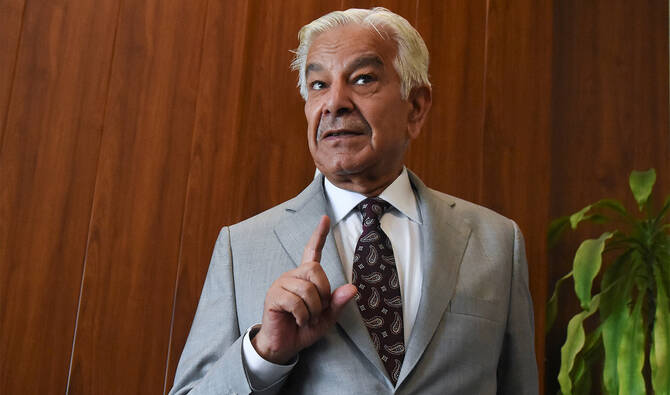
Pakistan’s Defence Minister Khawaja Muhammad Asif gestures on the day of an interview with Reuters in Islamabad, Pakistan, on April 28, 2025. (REUTERS)
Short Url
Updated 29 April 2025
Follow

Pakistan says next few days ‘crucial’ amid specter of military incursion by India

  • “If something has to happen, will occur in next two to four days, otherwise immediate danger will pass,” defense minister says
  • Pakistan and India have downgraded ties since last week’s attack in Indian-administered Kashmir that killed 26 tourists 

ISLAMABAD: Pakistan’s Defense Minister Khawaja Asif said on Monday the next few days were “crucial” with regards to a possible Indian military incursion, as tensions surged between the two countries over an attack in Indian-administered Kashmir last week.

The attack killed 26 people and triggered outrage in India along with calls for action against Pakistan, whom it says is involved, accusations Islamabad has denied. India has long accused Pakistan of backing militancy in Kashmir, a region both nations claim and have fought two wars over. Islamabad says it only provides diplomatic and moral support to Kashmiris in their struggle for self-determination.

Tensions between the two nuclear-armed nations continued to boil on Monday, and experts and officials in Islamabad both raised the specter of limited airstrikes or special forces raids near the border with Pakistan.

Following a report by Reuters quoting Defense Minister Khawaja Asif as saying an Indian military excursion was “imminent,” he told a local news channel that he had said only that the next few days were “crucial.”

“The threat [of Indian attacks] is there, there is absolutely no doubt about it, but I have not suggested anything about its inevitability,” Asif told Geo News on Monday night. 

“If something has to happen, then it will occur in the next two to four days … otherwise the immediate danger will pass.”

He added that if “war” was imposed on Pakistan, it was prepared for a “full response”:

“Our armed forces have 100 percent preparation, be it in our waters, air or soil. No one should have a doubt about this.”

Asif’s remarks followed a key meeting presided over by Pakistan’s deputy prime minister and foreign minister Ishaq Dar to discuss India’s suspension of the Indus Waters Treaty, which was one of the punitive measures it announced to downgrade ties with Islamabad following Tuesday’s attack. The treaty splits the Indus River Basin and its tributaries between Pakistan and India and ensures water for 80 percent of Pakistani farms.

“Pakistan will take all appropriate steps to safeguard its due share of water, guaranteed by the Indus Waters Treaty,” the Pakistani foreign ministry said in a statement after the meeting, quoting Dar.

“Pakistan will continue to advocate for the full implementation of the Treaty to ensure the protection of its water rights and the well-being of its people.”

The statement said India’s “unilateral and illegal” move to hold the treaty in abeyance contravened established norms of inter-state relations, international law, and the treaty’s own provisions.

“Noting that the waters of the Indus River System remain a lifeline for Pakistan’s 240 million people, he [Dar] deplored the Indian attempts to weaponize water,” the ministry added.

Earlier on Monday, Asif told Reuters Islamabad had approached friendly countries, including Gulf states and China, and also briefed Britain, the United States and others on the situation.

“Some of our friends in the Arabian Gulf have talked to both sides,” Asif said, without naming the countries.

China said on Monday it hoped for restraint and welcomed all measures to cool down the situation. Asif said the United States was thus far “staying away” from intervening in the matter.

Riyadh and Tehran have also both offered to mediate the crisis.

Pakistan and India have fought multiple wars, including two over the disputed region of Kashmir, since their independence from British rule in 1947. 

In the past, New Delhi has accused Islamabad of backing militants who carried out the 2008 Mumbai attacks, which killed more than 166 people, including foreigners. Pakistan denies the accusations.

Diplomatic relations between Pakistan and India were weak even before the latest conflict as Pakistan had expelled India’s envoy and not posted its own ambassador in New Delhi after India revoked the semi-autonomous status of Kashmir in 2019.


Crowds worldwide rage or celebrate after Iran strikes, 23 killed in Pakistan

Updated 5 sec ago
Follow

Crowds worldwide rage or celebrate after Iran strikes, 23 killed in Pakistan

  • At least 10 were killed in Karachi, 11 in northern city of Skardu and two in Islamabad during violent clashes between protesters and law enforcers
  • In other parts of the world, such as Paris, Iranian exiles take to the streets to celebrate the killing of Supreme Leader Ayatollah Ali Khamenei

KARACHI, Pakistan/BAGHDAD: Demonstrations against the US-Israeli bombing campaign in Iran turned violent in Pakistan and ​Iraq on Sunday, while in other parts of the world Iranian exiles took to the streets to celebrate the death of Supreme Leader Ayatollah Ali Khamenei.

At least 23 protesters were killed in clashes in Pakistan, including 10 in the port of Karachi where security guards at the US consulate fired on demonstrators who breached the outer wall, 11 in the northern city of Skardu where the crowd torched a UN office, and two in Islamabad.

In Iraq, police fired tear gas and stun grenades to scatter hundreds of pro-Iranian protesters who had gathered outside the Green Zone diplomatic compound in the capital Baghdad, where the US embassy is located.

But in Paris, a joyous crowd of thousands turned out to celebrate, waving flags of Iran’s pre-revolutionary monarchy, some carrying ‌red roses and ‌bottles of champagne.

Iran’s neighbors to the east and west, Pakistan and Iraq have the ​world’s ‌largest ⁠Shia Muslim ​populations ⁠after Iran, and were the scenes of some of the worst unrest from crowds angry at the US-Israeli attacks.

Protesters in Karachi chanted “Death to America! Death to Israel!” at the consulate, where Reuters reporters heard gunfire and saw tear gas fired in surrounding streets.

Consulate security staff opened fire at a crowd who were pushed back after breaching the outer security layer, said Sukhdev Assardas Hemnani, a local government spokesman. The demonstrators also set a vehicle ablaze outside the main gate and clashed with police, he said.

“We are in constant touch with consulate officials. They are all safe,” Hemnani added.

The US Embassy in Islamabad said in a post on X it was monitoring reports of ⁠demonstrations and advised US citizens to observe good personal security practices. The consulate in Karachi and ‌embassy in Islamabad did not respond to Reuters requests for further comment.

Thirty-four people ‌were injured, police said. Karachi’s Civil Hospital said all those killed and injured ​were hit with gunshots. The provincial government of Sindh ordered ‌an inquiry.

UN OFFICE SET ON FIRE

Skardu, where the UN building was set ablaze, is in Gilgit Baltistan in the ‌north, the only region administered by Pakistan where Shias are the plurality.

“A large number of protesters have gathered outside the UN office and burned down the building,” local government spokesperson Shabbir Mir told Reuters. The figure of 11 killed was provided by a government official and an intelligence official, both on condition of anonymity.

Protesters also took to the streets in other parts of Pakistan, carrying black flags and chanting “Down with America!” and anti-Israel slogans. In the ‌central city of Lahore, police said hundreds gathered outside the US consulate. There were some small-scale clashes with police, who fired tear gas.

Interior Minister Mohsin Naqvi urged protesters to ⁠remain peaceful. “We stand with you,” he ⁠said, adding that every Pakistani was as grief-stricken as the people of Iran.

In the capital Islamabad, all roads leading to the Red Zone, which houses diplomatic missions were blocked to traffic, police said. Police fired tear gas and live bullets when thousands of protesters tried to march toward the diplomatic enclave, killing two and injuring nearly 10, two officials said on condition of anonymity.

Elsewhere, protests took place in countries where Iran has influence. In Kano, a part of Nigeria with a sizable Shia Muslim minority, thousands marched peacefully, waving Iranian flags and pictures of Khamenei.

But in Western countries and other areas with large populations of Iranian exiles, many came out to celebrate.

In the crowd in Paris, some people held aloft portraits of loved ones killed under decades of Iran’s clerical rule. Others waved flags of Israel, the United States and France.

In Lisbon, exiled Iranians gathered outside the Iranian embassy.

“We had a party last night, up to 3 a.m. We danced, we chanted, we sang and sang, and that was ​really amazing,” said Maximilien Jazani, 57. Iranians “want to go to ​vote and to choose the kind of government they want.”