ISLAMABAD: China has called for measures to lower heightened tensions between Pakistan and India over a recent attack in India-administered Kashmir, while several other countries, including Saudi Arabia and Iran, have offered Islamabad assistance in resolving the crisis.
New Delhi has accused Pakistan of backing the deadliest attack in Indian-administered Kashmir since 2000 that killed 26 tourists on April 22. Islamabad denies the claim and has offered to participate in a credible international probe.
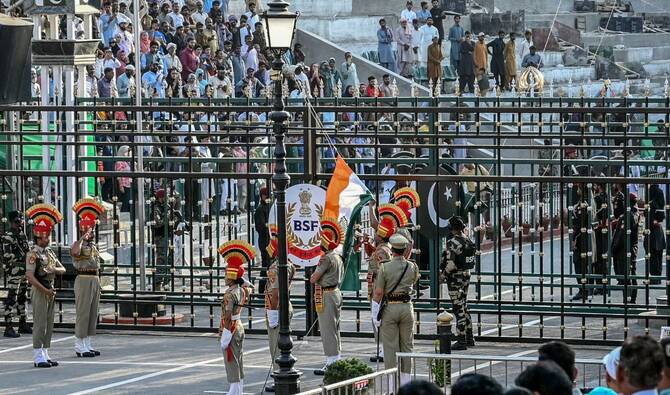
The two nuclear-armed neighbors have since exchanged gunfire, diplomatic barbs, expelled each other’s citizens and shut border in a series of punitive measures against each other.
Top Pakistani leaders have reached out to senior officials in China, Saudi Arabia, Iran and Egypt and other countries amid fears that India’s possible actions over the attack may lead to a wider conflict in the region.
“China welcomes all measures that will help cool down the current situation and supports carrying out fair and just investigations at an early date,” Guo Jiakun, a Chinese foreign ministry spokesman, said at a press briefing on Monday, hoping Pakistan and India would uphold regional peace.
“As the neighbor of both India and Pakistan, China hopes that India and Pakistan will exercise restraint, work in the same direction, handle relevant differences properly through dialogue and consultation, and jointly uphold peace and stability in the region.”
The statement came as New Delhi said India had signed a contract to purchase 26 Rafale fighter jets from France, amid fears that India may carry out limited airstrikes or special forces raids near the border with Pakistan.
The last time India conducted such strikes against Pakistan was in 2019, when it retaliated for a suicide bombing in Pulwama in Indian-administered Kashmir in which at least 40 Indian paramilitary police were killed. Pakistan had denied complicity in that assault and the Indian strikes were followed by Pakistan’s downing of an Indian fighter jet and capturing of an Indian pilot, bring the two neighbors to the brink of an all-out war.
On Monday, India said it had responded to ‘unprovoked’ small arms firing from Pakistan along the de facto border in Kashmir for the fourth consecutive night. There was no immediate comment from the Pakistani side.
Several regional countries have urged bilateral consultation and dialogue between the two countries to prevent tensions from escalating any further.
Late last week, Pakistan’s Deputy Prime Minister Ishaq Dar, who also serves as foreign minister, briefed his Saudi counterpart, Prince Faisal bin Farhan, on Islamabad’s response to India’s retaliatory moves, saying his country would respond firmly to any external aggression.
“Both leaders agreed to continue consultations and coordination on the evolving regional situation,” the Pakistani foreign ministry said.
Iranian Foreign Minister Abbas Araghchi on Friday offered to mediate the crisis between the two South Asian nations.
“India and Pakistan are brotherly neighbors of Iran, enjoying relations rooted in centuries-old cultural and civilizational ties. Like other neighbors, we consider them our foremost priority,” he said on X.
“Tehran stands ready to use its good offices in Islamabad and New Delhi to forge greater understanding at this difficult time.”
Pakistan and India have fought multiple wars, including two of them over the disputed region of Kashmir, since their independence from British rule in 1947. Both rule the region in part but claim it in full.
New Delhi routinely accuses Pakistan of supporting armed separatist militants in Kashmir. Islamabad denies the allegations and says it supports the Kashmiri people diplomatically and politically.


![]()

China urges restraint, Riyadh and Tehran offer help to mediate Pakistan-India conflict
Short Url
https://arab.news/4ubkd
China urges restraint, Riyadh and Tehran offer help to mediate Pakistan-India conflict
- The development comes amid fears India may carry out limited airstrikes or raids near the border with Pakistan over attack in Pahalgam
- The two neighbors have exchanged gunfire, diplomatic barbs, expelled each other’s citizens after the attack that killed 26 tourists
Latest updates




Recommended


© 2026 SAUDI RESEARCH & PUBLISHING COMPANY, All Rights Reserved And subject to Terms of Use Agreement.