

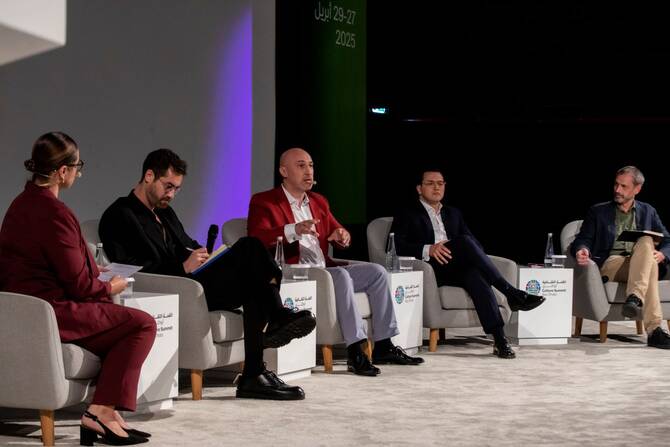

ABU DHABI: Industry leaders gathered at the 7th Culture Summit Abu Dhabi on Monday to discuss the rise of artificial intelligence in creative industries — and what it means for the future.
Panelists at the event, held at Abu Dhabi’s Manarat Al-Saadiyat, included Riyad Joucka, founder and principal architect at the Middle East Architecture Network, a practice based in Dubai.
Others included Stephen King, senior lecturer at Middlesex University Dubai; Imad Mesdoua, director of government affairs for the Middle East and Africa at Spotify; and Dr. Patrick Noack, executive director at the Dubai Future Foundation.
The panel examined AI’s impact across multiple creative fields, exploring the opportunities AI presents as well as the challenges that arise when employing machine intelligence.
Joucka was keen to emphasize the importance of using AI as a tool to “extend human creativity,” rather than replace it.
“I see technology as an important tool to extend human creativity and knowledge, and not necessarily as a substitute for the human touch in design,” he said, adding that human-AI collaboration was the ideal creative journey from ideation to finished product.
Mesdoua echoed the importance of the human touch at Spotify, saying “there are two ingredients to the Spotify secret sauce, one is personalization … and the other one is discovery.
“Personalization is to a large extent driven by AI and technologies and algorithmic advances … it makes sure that your app fits you like a glove. The other ingredient to the secret sauce is what we call discoverability.
“And what that means is every now and then on your Spotify app, you will get a suggestion for a song or an artist or genre that you might not have typically listened to, and that’s largely the work, not solely, but largely the work of human editors.”

The panel examined AI’s impact across multiple creative fields, exploring the opportunities AI presents as well as the challenges that arise when employing machine intelligence.
(AN Photo by Mohamed Fawzy)
That is “very important, particularly for diversity,” Mesdoua noted, adding “a big part of the work that the editors are doing to make sure that up-and-coming genres are being spotlighted and playlisted to global audiences in a unique way.
“So AI can reflect the user, but editors can help recommend new things to users.”
While human curators are key to promoting international music to global audiences, Mesdoua did note the importance of AI in the music industry, saying one of the most important positives is lowering the barriers to entry.
“If you think back to 70 years ago or 80 years ago, becoming a really established musician required you overcoming a ton of barriers and hurdles, particularly on the infrastructure side of things.
“You had to have an expensive studio at your disposal … now you can be all by yourself in your room with amazing AI software and amplify whatever creative spark you have in your mind and really go from ideation to production super-fast.”
It is something Noack was more cautious about, though, with the executive director at the Dubai Future Foundation saying “a barrier to entry is not necessarily a bad thing.”
“I think a lot of people come into space that is not necessarily their calling or (they do not have a) high level of skill and suddenly they know how to do something and they’re the expert in this space.”
A litmus test for good AI, he added, is “whether it can be switched off or rolled back.”
Taking into account differences between various creative fields, the panelists took a nuanced approach and discussed whether AI’s influence was similar across sectors.
There was one warning repeated across various creative fields — including architecture, marketing, education and music — panelists warned that practitioners need to “know when to stop and when to bring the human element back into creativity,” as per Joucka.
Running until April 29 and organized by the Abu Dhabi Department of Culture and Tourism, the three-day summit includes policymakers, artists, scholars, and innovators.
The theme is “Culture for Humanity and Beyond,” focusing on the intersection of culture, technology and global governance.


