Pakistan army says 71 militants killed in three days of operations in northwest

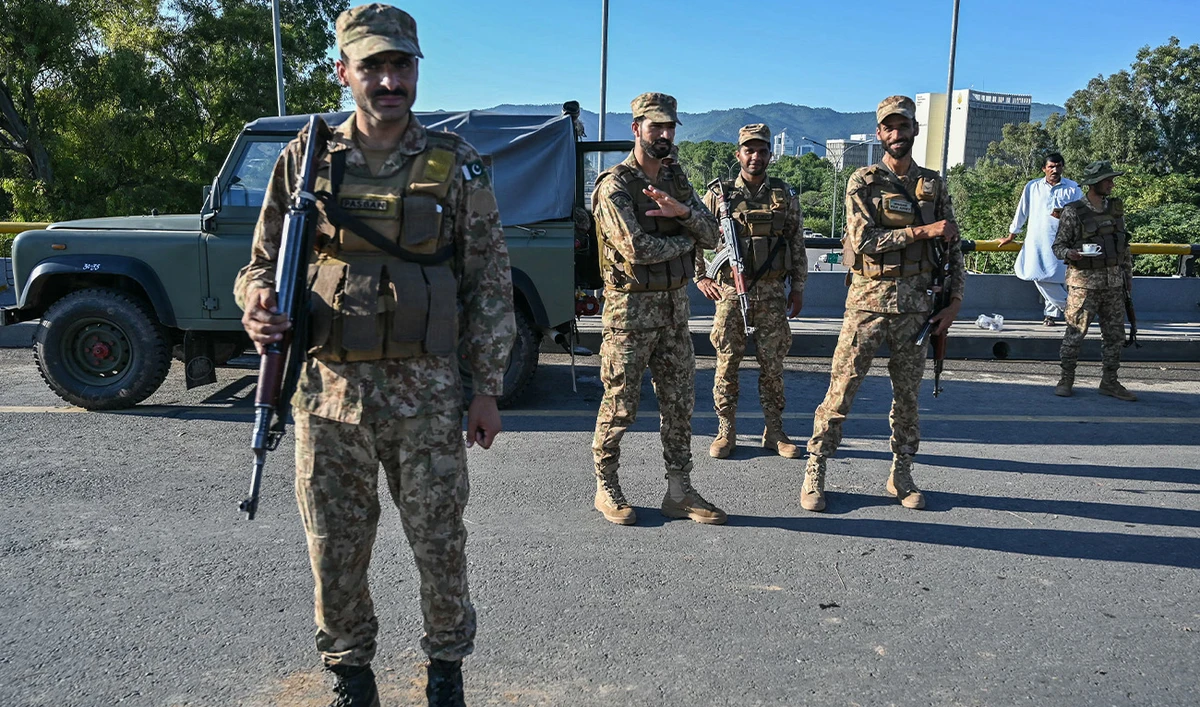
Pakistan Army soldiers stand guard in anticipation of a protest in Islamabad, Pakistan on October 6, 2024. (AFP/File)
Short Url
Updated 28 April 2025
Follow

Pakistan army says 71 militants killed in three days of operations in northwest

  • The 71 deaths reported are an usually high number in Pakistan’s battle against militancy along its border with Afghanistan
  • Latest operations highlight the challenges Pakistani forces face on multiple fronts as tensions with India also rise rapidly

ISLAMABAD: The Pakistan army said on Monday 71 militants had been killed in three days of armed operations in the country’s northwestern regions bordering Afghanistan where the military has been battling a surge in militancy.

On Sunday, the army said it had killed 54 militants trying to infiltrate the country from Afghanistan, highlighting the challenges its forces face on multiple fronts as tensions with India also rise rapidly.

In a fresh statement on Monday, the army said it had carried out a “sanitization operation” in the North Waziristan district in Khyber Pakhtunkhwa province on the night of Apr. 27-28 following Sunday’s campaigns. 

“During the conduct of the operation, seventeen more khwarij [militants] who were operating on behest of their foreign masters were hunted down and successfully neutralized,” the army said in a statement.

“The number of khwarij killed in three days operation has risen to seventy one.”

The 71 deaths reported are an usually high number in Pakistan’s battle against militancy and instability along its border with Afghanistan during the nearly four years since the United States withdrew its military support from the country and the Taliban took over Kabul.

The banned group Tehrik-e-Taliban Pakistan, or TTP, has intensified attacks on Pakistani security forces, straining ties between Pakistan’s leaders and the Taliban in Afghanistan. Pakistan accuses the Afghan Taliban of harboring and supporting TTP fighters, an allegation they deny.

Pakistan is also facing an intensifying separatist insurgency in the southwestern Balochistan province. The possibility of conventional skirmishes with nuclear-armed neighbor India to the east have also risen since last week when 26 tourists were killed in Indian-administered Kashmir. New Delhi has blamed Islamabad, which has denied involvement. 

The Muslim-majority Himalayan region is claimed by both the nuclear states, and has been the site of multiple wars, insurgencies and diplomatic standoffs.

Pakistan to discuss regional issues, economic ties at UAE summit this week

Updated 12 December 2025
Follow

Pakistan to discuss regional issues, economic ties at UAE summit this week

  • Deputy PM Ishaq Dar to attend Sir Bani Yas Forum from Dec. 12-14, says Pakistan foreign office
  • Senior statemen, policymakers expected to discuss security and economic cooperation at summit

ISLAMABAD: Pakistan’s Deputy Prime Minister Ishaq Dar will attend the Sir Bani Yas Forum in the UAE from Dec. 12-14 to discuss regional issues with world leaders and explore economic partnerships, the foreign ministry said on Friday. 

The three-day summit features senior statesmen, policymakers and global experts from around the world with discussions likely to revolve around key regional and international issues such as peace, security and economic cooperation.

Dar, who is also Pakistan’s foreign minister, attended the 15th edition of the Bani Yas Forum last year. He is attending this year’s summit at the invitation of his UAE counterpart, Sheikh Abdullah bin Zayed Al Nahyan, the foreign office said. 

“During the Forum, the Deputy Prime Minister/Foreign Minister will engage with international leaders and experts on matters related to regional stability, sustainable development, and the expansion of economic partnerships,” the statement said. 

“He will also present Pakistan’s perspectives on promoting dialogue, addressing regional challenges, and fostering enhanced opportunities for economic cooperation.”

The Forum is expected to feature important discussions on Israel’s war in Gaza and the fragile ceasefire in the Middle East. 

Pakistan has consistently criticized Israel for violating the ceasefire in Gaza and has called on the international community to intervene and ensure the fragile agreement does not collapse. 

Islamabad has also been eyeing economic partnerships with regional allies, particularly Gulf countries, at such global summits in recent months. 

It has entered into economic, defense, trade and investment agreements with traditional allies such as China, Saudi Arabia, UAE, Qatar and Central Asian states in recent months.