WASHINGTON: The United States has hit more than 800 targets in Yemen since mid-March, killing hundreds of Houthi rebel fighters, including members of the group’s leadership, the US military said Sunday.
Washington’s forces have hammered the Houthis with near-daily air strikes since March 15 in an operation dubbed “Rough Rider,” seeking to end the threat they pose to vessels in the Red Sea and Gulf of Aden and reestablish US regional “deterrence.”
“Since the start of Operation Rough Rider, USCENTCOM has struck over 800 targets. These strikes have killed hundreds of Houthi fighters and numerous Houthi leaders,” the military command responsible for the Middle East said in a statement that provided its most detailed accounting of the operation so far.
“The strikes have destroyed multiple command-and-control facilities, air defense systems, advanced weapons manufacturing facilities, and advanced weapons storage locations,” CENTCOM said.
Despite the strikes, the Houthis — who control large swaths of Yemen and have been at war with a Saudi-led coalition backing the internationally recognized government since 2015 — have continued to claim attacks against both US vessels and Israel.
CENTCOM said that “while the Houthis have continued to attack our vessels, our operations have degraded the pace and effectiveness of their attacks. Ballistic missile launches have dropped by 69 percent. Additionally, attacks from one-way attack drones have decreased by 55 percent.”
“Iran undoubtedly continues to provide support to the Houthis. The Houthis can only continue to attack our forces with the backing of the Iranian regime,” the military command said.
“We will continue to ratchet up the pressure until the objective is met, which remains the restoration of freedom of navigation and American deterrence in the region,” it added.
As the United States announced details on the latest round of its campaign against the Houthis, the rebel-controlled Al-Masirah TV reported that US strikes on the Yemeni capital Sanaa had killed at least eight people and wounded others.
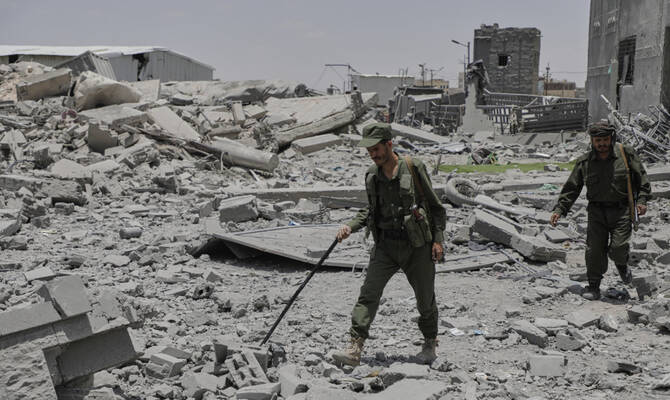
Al-Masirah TV also broadcast footage of the rubble of destroyed homes and cars, as well as blood stains on the ground, while rescuers collected what appeared to be human remains in white cloth.
Earlier Sunday, Houthi media said overnight strikes on Sanaa had killed two people and wounded several more.
The latest strikes brings the death toll since March 15 to 228, according to an AFP tally based on Houthi announcements.
The Houthi rebels began targeting shipping in late 2023, claiming solidarity with Palestinians in the Gaza Strip, which has been devastated by a military campaign launched by Israel after a shock Hamas attack in October of that year.
Houthi attacks have prevented ships from passing through the Suez Canal — a vital route that normally carries about 12 percent of the world’s shipping traffic — forcing many companies into a costly detour around the tip of southern Africa.
The United States first began conducting strikes against the Houthis under the Biden administration, and President Donald Trump has vowed that military action against the rebels will continue until they are no longer a threat to shipping.
The Trump administration has been forced onto the political defensive during the Yemen campaign by scandals stemming from senior officials’ use of commercial messaging app Signal to discuss strikes that took place on March 15.
Last month, The Atlantic magazine revealed that its editor-in-chief was mistakenly included in a Signal chat in which officials, including Defense Secretary Pete Hegseth and National Security Adviser Mike Waltz, discussed the strikes.
US media outlets then reported earlier this month that Hegseth had shared information on the same strikes in a second Signal group chat with various people who would not normally be involved in such discussions, including his wife.


US says it struck 800 targets in Yemen, killed 100s of Houthis since March 15
https://arab.news/jjuh8
US says it struck 800 targets in Yemen, killed 100s of Houthis since March 15

- Washington’s forces have hammered the Houthis with air strikes since March 15, seeking to end the threat they pose to vessels in the Red Sea and Gulf of Aden


US and Mideast countries seek Kyiv’s drone expertise as Russia-Ukraine talks put on ice
KYIV, Ukraine: The United States and its allies in the Middle East are seeking Ukraine's expertise in countering Iran's Shahed drones, according to Ukrainian President Volodymyr Zelenskyy.
Various countries, including the United States, have approached Ukraine for help in defending against the Iranian drones, Zelenskyy said late Wednesday. He said he has spoken in recent days with the leaders of the United Arab Emirates, Qatar, Bahrain, Jordan and Kuwait about possible cooperation.
Russia has fired tens of thousands of Shaheds at Ukraine since it invaded its neighbor just over four years ago, launching a swarm of more than 800 drones and decoys in its biggest nighttime barrage. Iran has responded to joint U.S.-Israeli strikes by launching the same type of drones at countries in the Middle East.
Ukrainian assistance in countering Iranian drones will be provided only if it does not weaken Ukraine's own defenses, and if it adds leverage to Kyiv's diplomatic efforts to stop the Russian invasion, according to the Ukrainian leader.
"We help to defend from war those who help us, Ukraine, bring a just end to the war" with Russia, Zelenskyy said. Later Thursday, Zelenskyy said he had received a U.S. request for support to defend against the drones in the Middle East and had given the order for equipment to be provided along with Ukrainian experts without providing further details.
"Ukraine helps partners who help our security and the protection of our people's lives," he added in a social media post.
Trump, in an interview Thursday with Reuters, said, "Certainly I'll take, you know, any assistance from any country."
Ukraine has battle-tested drone defenses
Ukraine has pioneered the development of cut-price drone killers that cost as little as $1,000, rewriting the air defense rule book and making other countries take notice.
European countries got a wake-up call last September on the changed nature of air defense when Poland scrambled multimillion-dollar military assets, including F-35 and F-16 fighter jets and Black Hawk helicopters, in response to airspace violations by cheap drones.
Ukrainian manufacturers have developed low-cost interceptor drones specifically designed to hunt and destroy Shaheds, and its rapidly expanding drone industry is producing excess capacity.
Zelenskyy announced earlier this year that Ukraine would begin exporting the battle-tested systems.
The European Union's top diplomat, Kaja Kallas, said before chairing a meeting of EU and Gulf foreign ministers via video link Thursday that the talks would look at how Ukraine's experience can help countries counter Iranian drones.
Middle East war delays Russia-Ukraine talks
The Iran war, now in its sixth day, has drawn international attention away from Europe's biggest conflict since World War II, and forced the postponement of a new round of U. S-brokered talks between Russia and Ukraine planned for this week, Zelenskyy said.
Western governments and analysts say the Russia-Ukraine war has killed hundreds of thousands of people, while there is no sign that yearlong U.S.-led peace efforts will stop the fighting any time soon.
"Right now, because of the situation around Iran, there are not yet the necessary signals for a trilateral meeting," Zelenskyy said. "But as soon as the security situation and the overall political context allow us to resume that trilateral diplomatic work, it will be done."
Zelenskyy thanked the United States for the return from Russia on Thursday of 200 Ukrainian prisoners of war. Russia's Defense Ministry also said it received the same number of prisoners from Ukraine and thanked the U.S. and United Arab Emirates for mediating.
Prisoner swaps have been one of the few tangible results of the talks. Vladimir Medinsky, a Russian negotiator, said on social media that a total of 500 prisoners from each side would be exchanged between Thursday and Friday.
Oleksandr Merezhko, the head of Ukraine's parliamentary foreign affairs committee, said Russian President Vladimir Putin is trying to drag out the negotiations so that he can press on with Russia's invasion while escaping further U.S. sanctions.
He urged the U.S. administration to look at the Russia-Ukraine war and the war in the Middle East as linked.
"In reality, Russia and Iran are close allies that act in concert — Iran supplies weapons and Russia helps Iran develop its defense industry. These are interconnected conflicts," Merezhko told The Associated Press.
Ukraine's army has recently pushed back Russian forces at some points along the roughly 1,250-kilometer (750-mile) front line, according to the Institute for the Study of War.
Localized Ukrainian counterattacks liberated more territory than Ukrainian forces lost in the last two weeks of February, the Washington-based think tank said this week, estimating the recovered land at about 257 square kilometers (100 square miles) since Jan. 1.


