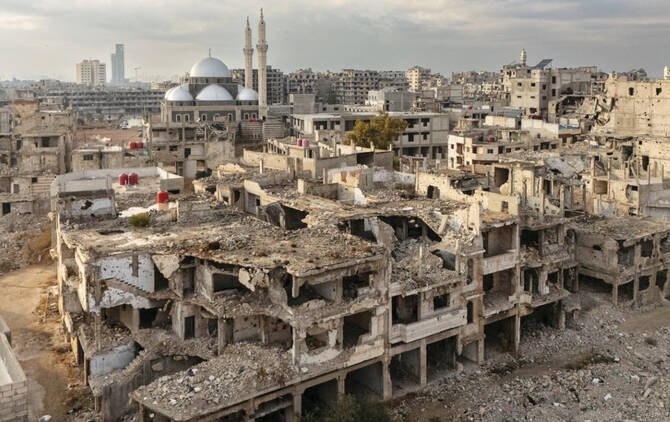

LONDON: After 14 years of civil war, Syria’s largest province, Homs, has emerged from the conflict with its health system in tatters. Now, as families begin to return from displacement, diaspora doctors are stepping in to help revive damaged and long-neglected services.
Among them are more than 30 physicians and civic leaders from Chicago. The Syrian American delegation, led by Dr. Zaher Sahloul of the US-based nonprofit MedGlobal, conducted workshops in early April as part of the Homs Healthcare Recovery Initiative.

Over two days, Syrian experts from around the world came together to launch the Homs Healthcare Recovery Conference, organized by MedGlobal Organization International, in partnership with the Homs Doctors Syndicate, and under the auspices of the Health Ministry.
(Source: MedGlobal)

The Syrian American delegation led by Dr. Zaher Sahloul of the US-based nonprofit MedGlobal conducted workshops in early April as part of the Homs Healthcare Recovery Initiative. (Source: MedGlobal)
Sahloul said the scale of the crisis is staggering. “During the conflict, many physicians, subspecialists and allied health professionals left Homs,” he told Arab News. “The main hospital in Homs City, Al-Watani, was completely destroyed.”
The exodus of medical professionals left a “huge shortage of specialists, hospital beds and primary health centers,” highlighting “deep inequality in the distribution of healthcare, especially between the city and rural areas,” said Sahloul.

A handout picture released by the Syrian opposition's Shaam News Network shows destruction in the Juret al-Shiyah and the National hospital districts of Homs on April 17, 2012. (AFP file)
Outdated technology and a lack of medical supplies, equipment and medications have further hindered care.
Once dubbed the “capital of the revolution,” Homs was a key battleground in the uprising against Bashar Assad that began in 2011. Years of fighting devastated the province’s infrastructure, leaving hospitals in ruins and severely limiting access to basic services.
“Half of Homs city has been destroyed, and several other cities were heavily damaged, shelled, or under siege — including Palmyra, Al-Qaryatayn and Al-Qusayr,” said Sahloul. “A huge number of people fled Homs and became refugees or internally displaced.”

An image released by the Syrian opposition Shaam News Network on July 23, 2012 shows doctors treating a wounded man allegedly injured by Syrian government forces shelling at a field hospital in the city of Qusayr, 15 km from Homs, on July 14, 2012. (AFP)
By December 2013, almost half the governorate’s population had been displaced, according to UN figures. In the city of Homs alone, 60 percent of residents fled their homes.
Homs is not alone in experiencing such devastation. Today, only 57 percent of hospitals and 37 percent of primary healthcare centers across Syria are fully operational, according to the World Health Organization.
Insecurity and violence since the fall of Assad in December continue to disrupt health services, endangering both patients and medical staff.
Since March, surging violence in Alawite areas — particularly in Syria’s coastal region and the Homs and Hama governorates — has damaged six major hospitals and several ambulances, according to the UN Population Fund.

Homs suffered heavy damage during the early years of the uprising against President Bashar Assad, which left hospitals and basic services crippled. (AFP)
More than 1,000 civilians — including many medical students — have been killed in sectarian attacks, the UN children’s agency UNICEF said in early March. The hostilities have also triggered a fresh wave of displacement.

In this photo taken on October 29, 2015, hundreds of health workers participate in a "die-in" and demonstration organized by Physicians for Human Rights near the United Nations in New York City to draw attention to health workers killed in Syria. (AFP/File)
“The escalation reportedly caused additional civilian casualties and injuries, the displacement of thousands of families and damage to critical infrastructure,” Edouard Beigbeder, UNICEF’s regional director for the Middle East, said in a statement on March 9.
Within Homs, the healthcare system is particularly strained. According to a February WHO report, just seven of the province’s 17 hospitals and 58 of its 227 public health facilities are fully functional. Another four hospitals and 124 facilities are operating only partially.
Patients with chronic conditions face serious barriers to care. Cancer patients in Homs “have to go to Damascus to receive their treatment,” said Sahloul. “Patients with chronic diseases cannot afford their medications due to the economic situation.
IN NUMBERS
• 7 of 17 Hospitals in Homs that are fully functional.
• 58 of 227 Public health facilities that are fully operational.
(Source: WHO)
“Some patients on dialysis occasionally miss their treatments due to a shortage of dialysis kits. These kits are expensive, with each session costing around $20 to $25.”
The humanitarian crisis is compounded by economic hardship and continued sanctions. With monthly wages ranging from just $15 to $50 and about 90 percent of the population living below the poverty line, many cannot afford basic care.
Mass layoffs affecting about 250,000 public-sector workers have further strained the system.
The UN estimates that 15.8 million people will require humanitarian health assistance in 2025, even as funding continues to decline.
Mental health needs are also immense. “There are large numbers of war victims, including those displaced by violence and people who have lost family members,” said Sahloul, adding that torture survivors and former detainees are “deeply traumatized.”
He said: “As IDPs and refugees begin to return, the burden on mental health services grows.”

The UN refugee agency, UNHCR, estimates that at least 1.4 million Syrians have returned home since the fall of the Assad regime. It projects that as many as 3.5 million refugees and IDPs could return by the end of the year.
“This means a growing number of people are coming back to areas with limited or no access to essential services like education, housing and healthcare,” said Sahloul. “All of this creates a situation that is nearly catastrophic.”
Given the scale of the crisis, Syria’s Ministry of Health cannot meet all needs alone. Sahloul highlighted the urgent need for support from NGOs and foreign governments to help sustain as well as rebuild the healthcare system.

Over two days, Syrian experts from around the world came together to launch the Homs Healthcare Recovery Conference, organized by MedGlobal Organization International, in partnership with the Homs Doctors Syndicate, and under the auspices of the Health Ministry.
(Source: MedGlobal)
Aid agencies are stepping in. The UN Office for Project Services, in partnership with the government of Japan, is working to rehabilitate Homs Grand Hospital to restore critical services.
Similarly, the American Syrian Homs Healthcare Recovery mission, led by MedGlobal, has provided emergency supplies, performed critical surgeries and trained local healthcare workers in collaboration with Syrian communities.
Highlighting the initiative’s impact, Sahloul said: “Some teams began filling gaps in the healthcare system by donating funds for essential medical equipment, including a cardiac catheterization machine for Al-Waleed Hospital, an eye echo machine for Al-Harith Hospital, a stress echo machine for a public hospital, neurosurgical equipment for the university hospital and more.”
The mission, which began with a small team and quickly grew to include 650 expatriate physicians, has focused on three urgent priorities: Supporting dialysis patients, sustaining cardiac catheterization centers and addressing mental health.
“As part of the initiative, we provided dialysis kits across three different centers,” said Sahloul.
“Non-communicable diseases, not war-related injuries, are the primary health threat,” he added, citing high rates of smoking, hypertension, diabetes and fast food consumption.
The Ministry of Health has also inaugurated the Homs Center for Mental Health Support to assist survivors of torture and war.
However, Sahloul said that improving healthcare requires more than equipment and supplies — it demands addressing longstanding inequities between urban and rural areas, and among different communities.
“One of MedGlobal’s main missions is to reduce these disparities by identifying and filling gaps in healthcare access,” he said. “Historically, Syria has faced significant inequities between rural and urban areas, as well as within different neighborhoods based on their demographics.
“There are also disparities between major urban centers like Damascus and Aleppo, and the rest of the country. The eastern part of Syria, Hauran and the central regions were historically marginalized.
“By targeting these disparities, there is hope to ease tensions and begin healing a fractured society.”
Despite growing rehabilitation efforts and the commitment of local and international organizations, the scale of need still far exceeds available resources. As instability continues across Syria, both patients and health workers face daily risks.
The path to recovery is long and uncertain. Without sustained support, aid agencies warn, the country’s most vulnerable will remain at risk.