

Saudi Arabia’s international tourism revenue soars by 148%, leading G20 nations 

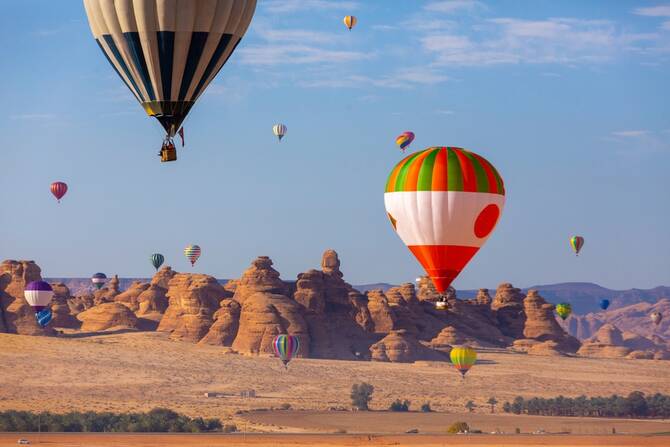
In 2024, international tourist arrivals surged to 29.7 million, up from 18.04 million in 2016, while domestic travelers nearly doubled to 86.2 million during the same period.  Shutterstock
Short Url
Updated 09 May 2025
Follow

Saudi Arabia’s international tourism revenue soars by 148%, leading G20 nations 

RIYADH: Saudi Arabia’s tourism sector achieved a historic milestone in 2024, with international tourism revenue surging 148 percent compared to 2019 — the highest growth rate among G20 nations. 

This achievement reflects the success of Vision 2030, which has firmly positioned the Kingdom as a global leader in tourism, entertainment, and innovation.  

The 2024 annual performance report highlighted record-breaking pilgrim numbers, cultural milestones, and major international events, all driven by strategic investments, regulatory reforms, and transformative mega-projects.   

Tourism boom 

Vision 2030 unlocked Saudi Arabia’s vast tourism potential, establishing it as one of the fastest-growing global destinations. 

In 2024, international tourist arrivals surged to 29.7 million, up from 18.04 million in 2016, while domestic travelers nearly doubled to 86.2 million during the same period.  

Surpassing its target of 100 million visitors seven years ahead of schedule, the Kingdom has now set a bold new goal of attracting 150 million annual tourists by 2030. 

Saudi Arabia’s tourism strategy is driven by mega-projects aiming to transform the travel and hospitality industry.  

Pioneering projects like The Red Sea — home to carbon-neutral resorts including Shebara, St. Regis, and Ritz-Carlton Nujuma — are redefining sustainable luxury tourism. The adjacent Red Sea International Airport, the region’s first carbon-neutral terminal, strategically connects over 250 million people within a three-hour flight radius. 

In Diriyah, the birthplace of the first Saudi state, 3 million visitors experienced a seamless blend of heritage and hospitality, with developments like the Bab Samhan Hotel offering modern luxury rooted in history. 

Meanwhile, at Qiddiya, major entertainment attractions are nearing completion, with Aquarabia Park 81 percent finished and Six Flags Park 87 percent completed. 

The Kingdom’s global tourism profile continues to rise, with accolades including AlUla being named Best Cultural Tourism Project in the Middle East, Madinah ranking among the world’s top 100 destinations, and the Asir region earning four awards for excellence in culinary and cultural storytelling. 

To enhance accessibility, the Kingdom expanded its e-visa program to 66 countries by 2024, simplifying entry for millions of travelers.  

Additionally, Saudi Arabia has emerged as a global leader in safety, ranking highest among G20 nations in security indicators, further solidifying its reputation as a welcoming and secure destination for international visitors. 

Pilgrimage services 

Serving pilgrims remains a cornerstone of Saudi Arabia’s responsibilities. Vision 2030 has transformed the Hajj and Umrah experience into a model of efficiency, accessibility, and safety. 

In 2024, the Kingdom welcomed 16.9 million foreign Umrah pilgrims and 1.61 million foreign Hajj pilgrims, reflecting significant growth from 2016 levels. 

Innovations like the Makkah Route Initiative, which fast-tracks visa issuance and pre-clearance in eight countries, served 322,900 pilgrims in 2024 — a rise from just 1,700 in 2017. 

The Nusuk platform played a key role in improving pilgrimage planning, helping achieve an 81 percent satisfaction rate on the Pilgrim Experience Index. Transportation infrastructure, including the Haramain High-Speed Railway, the Makkah Bus Network, and the Al-Mashaer Metro Line, facilitated the movement of 69.5 million passengers between holy sites. 

The Kingdom’s commitment to pilgrims’ well-being is evident in its healthcare services. In 2024, 390,000 pilgrims received medical care, and 40,000 medical staff were mobilized. Adding to that, 189 hospitals, centers, and mobile clinics were deployed, and 28 open-heart surgeries and 720 cardiac catheterizations were performed. 

About 153,000 volunteers supported pilgrimage operations in 2024, up from just 3,352 in 2021, showcasing the growing culture of community service.  

Hosting mega-events  

Saudi Arabia’s global influence expanded across sports, esports, and entertainment in 2024. 

The Kingdom secured the rights to host the 2034 FIFA World Cup, which will feature 48 national teams competing across 15 stadiums in Riyadh, Jeddah, NEOM, Al Khobar, and Abha. 

The tournament will be backed by 134 training facilities and 230,000 hotel units, contributing to infrastructure development, job creation, and long-term economic impact. 

In the digital realm, Saudi Arabia hosted the inaugural Esports World Cup, the largest tournament of its kind, featuring 1,500 professional players, 500 elite clubs, and 22 competitions. Team Falcons emerged as champions, and the Kingdom further solidified its leadership by winning hosting rights for the Olympic Esports Games.  

Meanwhile, Riyadh Season 2024 drew 19 million visitors, with a total attendance of 76.9 million across 423 entertainment attractions. 

The festival featured top-tier performances, immersive themed zones, and vibrant cultural displays, reinforcing its reputation as a global entertainment event. 

Cultural renaissance 

Vision 2030 has revitalized Saudi Arabia’s cultural identity, merging ancient heritage with modern creativity. 

The Kingdom now boasts eight UNESCO World Heritage Sites, including the newly listed Al-Faw Archaeological Site, and 16 UNESCO Intangible Cultural Heritage elements celebrating traditions like Arabic calligraphy, Saudi coffee, and falconry.  

Groundbreaking discoveries such as the Bronze Age Village of Al-Natah in AlUla have further illuminated the region’s rich history. 

In arts and entertainment, the critically acclaimed film "Norah" became the first Saudi production selected for the Cannes Film Festival’s official lineup, while the Kingdom’s first Arabic opera, Zarqa Al Yamama, premiered to acclaim.  

The King Salman Global Academy for Arabic Language trained 782 international students, promoting Arabic language and culture across three continents.  

Economic impact 

Tourism is a major driver of Saudi Arabia’s economic diversification, with sector employment reaching 966,500 workers in 2024, up from 683,000 in 2020. Women now play a critical role, with 112,000 Saudi women employed in tourism, marking a 67 percent increase. 

Investment in the sector has surged from $314.67 million in 2021 to $3.95 billion by the third quarter of 2024, fueling massive infrastructure expansion, including the Kingdom’s hospitality capacity growing to 475,900 hotel rooms. 


Vision 2030 propelling Saudi Arabia’s global reputation

Updated 13 December 2025
Follow

Vision 2030 propelling Saudi Arabia’s global reputation

  • Bold initiatives are positioning the Kingdom as a regional trailblazer in sustainability

RIYADH: Saudi Arabia’s Vision 2030 program, aimed at revolutionizing the Kingdom’s economic and social landscape, has propelled the nation’s global reputation on a large scale, experts told Arab News. 

Launched in 2016, the program is a comprehensive guide to position Saudi Arabia as a powerhouse of business, tourism and non-oil activities, both regionally and globally. 

Speaking to Arab News, Thomas Kuruvilla, managing partner of Arthur D. Little Middle East & India, said that Saudi Arabia’s Vision 2030 is the cornerstone of the Kingdom’s transformation driving diversification, investment in non-oil sectors, and reshaping its global reputation. 

“Vision 2030 is not an end point but a launchpad. The foundations being laid today from renewable energy, automotive, and tourism to digital infrastructure and advanced industries are designed to endure and evolve well beyond 2030. The Kingdom’s leadership has already signaled that future frameworks will build on this momentum, ensuring that transformation continues into the decades ahead,” said Kuruvilla. 

He added: “Vision 2030 has firmly established Saudi Arabia as a reforming nation on the world stage. Saudi Arabia is creating an economic and social model that looks past 2030, one that aims to deliver sustainable growth, global competitiveness, and opportunity for generations to come.” 

Elie Farhat, chief of external affairs for Georgetown University’s McDonough School of Business espoused similar views and said Saudi Arabia has actively courted foreign investment, tourism, and partnerships with global universities and businesses. 

“Saudi Arabia has become a market and society that is perceived as both investable and engaging. International organizations are setting up regional headquarters in Riyadh, universities are establishing partnerships, and businesses now openly discuss Saudi Arabia as a gateway to the future of the Middle East,” said Farhat. 

In October, Saudi Arabia’s Investment Minister Khalid Al-Falih, while speaking at the Fortune Global Forum Conference in Riyadh, said the Vision 2030 program is progressing steadily, with 85 percent of the targets outlined in the initiative completed or on track by the end of 2024. 

Al-Falih also added that the number of international firms licensed to establish their regional headquarters in Riyadh has reached 675.

The regional HQ program offers a 30-year corporate tax exemption, withholding tax relief, and regulatory support, reflecting efforts to position the Kingdom as a regional business hub and attract multinational corporations to the capital.

Some of the noted firms that have established regional bases in Riyadh include Northern Trust, IHG Hotels & Resorts, PwC, and Deloitte. Laura Hernandez Gonzalez, managing director of Globant for the Middle East and North Africa, said Vision 2030 has turned diversification from an aspiration into a reality, adding that programs like the regional HQ initiative and the transformation of Riyadh into a true financial hub are convincing multinationals to set up real operations, not just representative offices.

“From the technology side, the Kingdom’s commitment to AI, cloud, and sovereign digital infrastructure is equally important. It signals not only ambition, but the capacity to build future-ready capabilities at scale,” said Gonzalez. 

She added: “This is how the Kingdom is changing global perceptions: from an energy powerhouse to a hub of innovation, capital and talent.” 

Earlier in December, Rachid Boulaouine, Middle East and Saudi Arabia director at Business France, told Al-Eqtisadiah that French companies operating in Saudi Arabia are expected to increase by 30 percent to 40 percent as more small and medium-sized enterprises move to establish a presence in the Kingdom. 

The changing global image

Kuruvilla said that Saudi Arabia’s pivot toward renewable energy and sustainability is not just symbolic, but it represents a decisive strategic shift in the Kingdom’s development model. 

Bolstering renewable energy capacity is critical for Saudi Arabia as it aims to generate 130 gigawatts of clean energy by 2030 and achieve net-zero emissions by 2060.

Kuruvilla said that flagship projects such as Neom — a futuristic city designed to run entirely on renewable energy — and the world’s largest green hydrogen plant highlight Saudi Arabia’s determination to lead in climate innovation. 

This is how the Kingdom is changing global perceptions: from an energy powerhouse to a hub of innovation, capital and talent.

Laura Hernandez Gonzalez, managing director of Globant for the Middle East and North Africa

“These initiatives are positioning the Kingdom as a regional trailblazer in sustainability and earning recognition as a nation “at the forefront of the clean-energy revolution,” with few global peers matching its scale and ambition,” said the Arthur D. Little official. 

He added: “Such bold moves are strengthening Saudi Arabia’s standing among international partners that prioritize climate action, demonstrating alignment with global sustainability imperatives rather than resistance.” 

According to Farhat, it is the young generation in Saudi Arabia guided by Vision who are playing a crucial role in elevating the Kingdom’s global reputation. 

“Saudis — particularly younger generations — have opened up to the world with a readiness to learn, build, and lead for 2030. The world, in turn, has opened up to Saudi Arabia, seeing it as a dynamic partner to invest in,” said Farhat. 

Saudi Arabia’s tourism growth

Gonzalez said that the global narrative about Saudi Arabia has shifted decisively, with international travelers increasingly considering the Kingdom as a favorite destination. 

She added that the growth in tourism numbers is one of the clearest proof points that Vision 2030 is delivering, also indicating the Kingdom’s growing appeal among the international public. 

“Ranking among the top three globally for growth in international tourist arrivals, surpassing 100 million visits in 2023, and contributing over 10 percent of the gross domestic product in 2025 are extraordinary achievements in such a short period,” said Gonzalez. 

She added: “Today, when I speak with investors, partners, or peers, Saudi Arabia is framed around opportunity, innovation, and delivery.” 

Kuruvilla said that the growth in tourism has signaled to the world that Saudi Arabia is no longer just an oil-rich nation, but a fast-emerging must-visit destination. 

HIGHLIGHT

The regional HQ program offers a 30-year corporate tax exemption, withholding tax relief, and regulatory support, reflecting efforts to position the Kingdom as a regional business hub and attract multinational corporations to the capital.

The Arthur D. Little official added that media coverage has reinforced this narrative, with tourism and entertainment mentions up 60 percent in 2024, underscoring the Kingdom’s growing appeal to global travelers. 

“International surveys echo this sentiment: a recent multi-country poll found 59 percent of respondents were interested in visiting Saudi Arabia — a figure unimaginable only a decade ago,” said Kuruvilla. 

Saudi Arabia passed its 2030 target of 100 million visitors in 2023, and the following year it welcomed 115.9 million tourists.

Having already reached its goal, the Kingdom raised its target to 150 million annual visitors by 2030.

In November, the Saudi Conventions and Exhibitions General Authority announced record growth in the Kingdom’s business events infrastructure, reporting a 32 percent year-on-year increase in capacity across 923 accredited venues.

The authority added that this expansion reflects significant investment aligned with Vision 2030’s tourism and event sector priorities, driving a 320 percent increase in exhibition space since 2018 to a total of 300,520 sq. meters.

Sports and technology

According to Kuruvilla, Saudi Arabia is cultivating an image as a global hub for business, technology, and innovation by hosting high-profile international events like the Future Investment Initiative, the LEAP tech conference, and the World Defense Show. 

He said that these events draw thousands of investors, entrepreneurs, and industry leaders to the Kingdom, showcasing opportunities beyond oil. 

“The cumulative effect of these marquee gatherings and the establishment of such innovation-driving entities is a narrative that Saudi Arabia is open for business and eager to lead in future industries – a notable departure from its old image of insularity,” said Kuruvilla. 

He added: “These gatherings are translating into tangible partnerships and long-term investment opportunities, solidifying Saudi Arabia’s reputation as a hub for innovation and global business exchange.” 

According to Gonzalez, events like FII and LEAP in Saudi Arabia prove the Kingdom’s execution capacity, as well as showing the nation’s capability to “convene the world, compress partnership cycles, and set the agenda on innovation, defense, and finance.” 

Highlighting the importance of sporting events, Kuruvilla told Arab News that sports have become a cornerstone of Saudi Arabia’s effort to bolster its global reputation. 

“From hosting Formula 1 races and high-profile boxing matches to purchasing stakes in English Premier League football clubs, the Kingdom has invested heavily in sports as an avenue for soft power. The pinnacle of this strategy is Saudi Arabia securing the rights to host the 2034 FIFA World Cup — a coup that instantly thrusts the country into the international spotlight,” said Kuruvilla. 

Adding to this momentum, Saudi Arabia has also positioned itself at the forefront of digital sports by hosting the Esports World Cup in Riyadh in 2024 and 2025, with record-breaking prize pools and participation from the world’s top gaming titles. 

“By associating with beloved sports and athletes, Saudi Arabia is effectively rebranding itself, especially to younger global audiences, as a vibrant and welcoming destination. Superstars like Cristiano Ronaldo playing for Saudi clubs – and posting about life in the Kingdom – further humanize Saudi Arabia’s image abroad,” added the Arthur D. Little official.