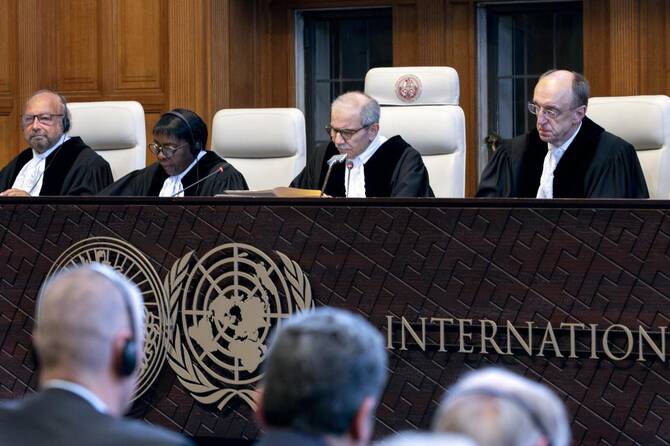
THE HAGUE: The top United Nations court on Monday will begin hearing from 40 countries on what Israel must do to provide desperately needed humanitarian assistance to Palestinians in Gaza and the occupied West Bank.
Last year, the UN General Assembly asked the International Court of Justice to weigh in on Israel’s legal obligations after the country effectively banned the UN agency for Palestinian refugees, the main provider of aid to Gaza, from operating. The United States, Israel’s closest ally, voted against the resolution.
Israel over a month ago again cut off all aid to Gaza and its over 2 million people. Israel has disputed that there is a shortage of aid in Gaza, and says it is entitled to block the aid because it says Hamas seizes it for its own use.
The Hague-based court has been asked to give an advisory opinion, a non-binding but legally definitive answer, in the latest judicial proceedings involving Israel and the 18-month war in Gaza. That is expected to take several months.
What is the International Court of Justice?
Set up in the aftermath of World War II, the ICJ is an organ of the UN and adjudicates disputes between countries. Certain UN bodies, including the General Assembly, can request advisory opinions from the court’s 15 judges.
All 193 UN member states are members of the ICJ, though not all of them automatically recognize its jurisdiction.
Last year, the court issued an unprecedented and sweeping condemnation of Israel’s rule over the occupied Palestinian territories, finding Israel’s presence unlawful and calling for it to end. The UN General Assembly sought the opinion after a Palestinian request. The ICJ said Israel had no right to sovereignty in the territories, was violating international laws against acquiring territory by force and was impeding Palestinians’ right to self-determination.
Two decades ago, the court in another advisory opinion held that Israel was violating international law by constructing a barrier between Israel and the West Bank. That opinion, also requested by the UN General Assembly, dismissed Israeli arguments that the wall was needed for security.
Israel has not participated in previous advisory opinion hearings but has submitted written statements.
What is the genocide case that Israel is facing at the ICJ?
South Africa went to the court last year to accuse Israel of genocide over its actions in the war in Gaza, which began when Hamas-led militants attacked southern Israel on Oct. 7, 2023, killing about 1,200 people, mostly civilians, and abducting 251.
Israel’s retaliatory offensive has killed over 51,000 Palestinians, according to Gaza’s Health Ministry, which does not say how many are civilians or combatants. The offensive has reduced much of Gaza to rubble, and most of its people remain homeless.
Israel rejects South Africa’s claim and accuses it of providing political cover for Hamas.
South Africa also asked judges to make nine urgent orders known as provisional measures. They are aimed at protecting civilians in Gaza while the court considers the legal arguments.
The court has ruled several times on that request, including ordering Israel to do all it can to prevent death, destruction and any acts of genocide in Gaza. The proceedings are ongoing and likely to take years to reach a conclusion.
How is the ICJ different from the International Criminal Court?
The International Criminal Court was established in 2002 as the court of last resort to prosecute those responsible for the world’s most heinous atrocities: war crimes, crimes against humanity, genocide and the crime of aggression.
While the ICJ deals with disputes between two or more countries, the ICC seeks to hold individuals criminally responsible.
In November, a three-judge panel issued arrest warrants for Israeli Prime Minister Benjamin Netanyahu, former Defense Minister Yoav Gallant and Hamas’ military chief, Mohammed Deif, accusing them of crimes against humanity in connection with the war in Gaza.
The warrants said there was reason to believe Netanyahu and Gallant have used “starvation as a method of warfare” by restricting humanitarian aid and intentionally targeted civilians in Israel’s campaign against Hamas, charges Israeli officials deny.
The warrant marked the first time a sitting leader of a major Western ally has been accused of war crimes and crimes against humanity by the global court of justice and has sparked major pushback from supporters of Israel, including the US
Israel and its top ally, the United States, are not members of the court. However, Palestine is, and judges ruled in 2021 that the court had jurisdiction over crimes committed on Palestinian territory.

What is the International Court of Justice and why is it weighing in on humanitarian aid in Gaza?
Short Url
https://arab.news/pz5dk
What is the International Court of Justice and why is it weighing in on humanitarian aid in Gaza?
- Israel’s retaliatory offensive has killed over 51,000 Palestinians, according to Gaza’s Health Ministry
- The International Criminal Court was established in 2002 as the court of last resort to prosecute those responsible for the world’s most heinous atrocities
Gazans long for reopening of ‘lifeline’ Rafah crossing
- The border crossing between Gaza and Egypt is the Palestinian territory’s only gateway to the outside world
- If Rafah opens in coming days, residents of the territory are hoping to reunite with family, or are looking to leave themselves
GAZA CITY: With Gaza’s vital Rafah border crossing expected to soon reopen, residents of the war-shattered territory are hoping to reunite with family members, or are looking to leave themselves.
The Rafah crossing between Gaza and Egypt is the Palestinian territory’s only gateway to the outside world that does not lead to Israel and is a key entry point for both people and goods.
It has been closed since Israeli forces took control of it in May 2024, except for a limited reopening in early 2025, and other bids to reopen failed to materialize.
Following a US-brokered ceasefire that took effect in October, Rafah is expected to reopen for pedestrians, after visiting US envoys reportedly pressed Israeli officials to reopen the crossing.
“Opening the Rafah crossing means opening the door to life for me. I haven’t seen my wife and children for two years since they left at the beginning of the war and I was prevented from traveling,” said 48-year-old Mahmud Al-Natour, who hails from Gaza City.
“My children are growing up far away from me, and the years are passing by as if we are cut off from the world and life itself,” he told AFP.
Randa Samih, 48, also called the crossing “the lifeline of Gaza,” but is worried about whether she would be able to leave.
She had applied for an exit permit to get treatment for her injured back, which she fears might not be serious enough to be allowed out.
“There are tens of thousands of injuries in Gaza, most of them more serious than mine,” she said.
“We’ll die or our health will decline before we get to travel.”
- ‘Limited reopening’ -
Gaza, a tiny territory surrounded by Israel, Egypt and the Mediterranean Sea, has been under Israeli blockade even before Hamas’s attack sparked the war.
Palestinian militants took 251 people hostage on October 7, 2023, in an attack that killed 1,221 others, most of them civilians.
Israel’s retaliatory offensive has killed at least 71,662 Palestinians, according to figures from the health ministry in Hamas-run Gaza that the United Nations considers reliable. The ministry does not say how many of the dead were fighters, though its data shows that more than half were women and children.
Ali Shaath heads the National Committee for the Administration of Gaza (NCAG), created as part of the ceasefire agreement. He announced last week that Rafah would reopen in both directions.
Israel said it would only allow pedestrians to travel through the crossing as part of its “limited reopening” once it had recovered the remains of the last hostage, Ran Gvili.
His remains were brought back to Israel later on Monday.
A Palestinian official told AFP on condition of anonymity that “estimates indicate that the Rafah crossing could be opened in both directions by the end of this week or early next week.”
A member of the NCAG told AFP that the technocratic committee would be responsible for sending lists of travelers’ names to the Israeli authorities for approval.
Outward travel will intially be limited to patients, the injured, students with university admission and visas, and holders of Egyptian citizenship or other nationalities and residency permits, the source said.
- ‘Burning with anticipation’ -
Gharam Al-Jamla, a displaced Palestinian living in a tent in southern Gaza, told AFP she counted on the crossing’s opening for her future.
“My dreams lie beyond the Rafah crossing. I applied for several scholarships to study journalism in English at universities in Turkiye. I received initial acceptance from two universities there,” the 18-year-old said.
She added she would then want to return to Gaza “to be one of its voices to convey the truth to the world.”
Gaza’s civil defense agency spokesman, Mahmud Bassal, appealed for the full reopening of Rafah to allow the entry of unlimited aid and equipment for reconstruction.
“There are thousands of bodies under the rubble, including children, women and people with disabilities, which have not been recovered since the beginning of the war,” he said.
The civil defense is a rescue force operating under Hamas authority.
Mohammed Khaled, 18, said he wanted to move on from the war.
“I’m burning with anticipation,” he told AFP.
“I haven’t seen my mother and sisters for two years. My mother traveled for medical treatment, and they only allowed my sisters to accompany her.”
Khaled said he also hoped to be able to travel to have surgery for a shrapnel injury sustained during the war.
The Rafah crossing between Gaza and Egypt is the Palestinian territory’s only gateway to the outside world that does not lead to Israel and is a key entry point for both people and goods.
It has been closed since Israeli forces took control of it in May 2024, except for a limited reopening in early 2025, and other bids to reopen failed to materialize.
Following a US-brokered ceasefire that took effect in October, Rafah is expected to reopen for pedestrians, after visiting US envoys reportedly pressed Israeli officials to reopen the crossing.
“Opening the Rafah crossing means opening the door to life for me. I haven’t seen my wife and children for two years since they left at the beginning of the war and I was prevented from traveling,” said 48-year-old Mahmud Al-Natour, who hails from Gaza City.
“My children are growing up far away from me, and the years are passing by as if we are cut off from the world and life itself,” he told AFP.
Randa Samih, 48, also called the crossing “the lifeline of Gaza,” but is worried about whether she would be able to leave.
She had applied for an exit permit to get treatment for her injured back, which she fears might not be serious enough to be allowed out.
“There are tens of thousands of injuries in Gaza, most of them more serious than mine,” she said.
“We’ll die or our health will decline before we get to travel.”
- ‘Limited reopening’ -
Gaza, a tiny territory surrounded by Israel, Egypt and the Mediterranean Sea, has been under Israeli blockade even before Hamas’s attack sparked the war.
Palestinian militants took 251 people hostage on October 7, 2023, in an attack that killed 1,221 others, most of them civilians.
Israel’s retaliatory offensive has killed at least 71,662 Palestinians, according to figures from the health ministry in Hamas-run Gaza that the United Nations considers reliable. The ministry does not say how many of the dead were fighters, though its data shows that more than half were women and children.
Ali Shaath heads the National Committee for the Administration of Gaza (NCAG), created as part of the ceasefire agreement. He announced last week that Rafah would reopen in both directions.
Israel said it would only allow pedestrians to travel through the crossing as part of its “limited reopening” once it had recovered the remains of the last hostage, Ran Gvili.
His remains were brought back to Israel later on Monday.
A Palestinian official told AFP on condition of anonymity that “estimates indicate that the Rafah crossing could be opened in both directions by the end of this week or early next week.”
A member of the NCAG told AFP that the technocratic committee would be responsible for sending lists of travelers’ names to the Israeli authorities for approval.
Outward travel will intially be limited to patients, the injured, students with university admission and visas, and holders of Egyptian citizenship or other nationalities and residency permits, the source said.
- ‘Burning with anticipation’ -
Gharam Al-Jamla, a displaced Palestinian living in a tent in southern Gaza, told AFP she counted on the crossing’s opening for her future.
“My dreams lie beyond the Rafah crossing. I applied for several scholarships to study journalism in English at universities in Turkiye. I received initial acceptance from two universities there,” the 18-year-old said.
She added she would then want to return to Gaza “to be one of its voices to convey the truth to the world.”
Gaza’s civil defense agency spokesman, Mahmud Bassal, appealed for the full reopening of Rafah to allow the entry of unlimited aid and equipment for reconstruction.
“There are thousands of bodies under the rubble, including children, women and people with disabilities, which have not been recovered since the beginning of the war,” he said.
The civil defense is a rescue force operating under Hamas authority.
Mohammed Khaled, 18, said he wanted to move on from the war.
“I’m burning with anticipation,” he told AFP.
“I haven’t seen my mother and sisters for two years. My mother traveled for medical treatment, and they only allowed my sisters to accompany her.”
Khaled said he also hoped to be able to travel to have surgery for a shrapnel injury sustained during the war.
© 2026 SAUDI RESEARCH & PUBLISHING COMPANY, All Rights Reserved And subject to Terms of Use Agreement.