

No handshake at muted India-Pakistan border ceremony

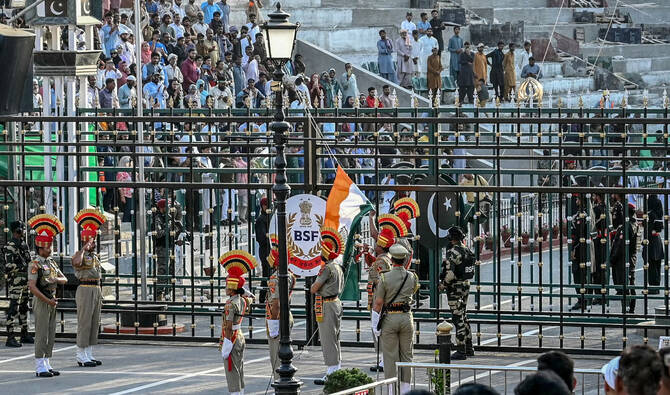
Indian Border Security Force personnel (brown uniform) and Pakistani Rangers (black uniform) take part in the beating retreat ceremony at the border gates of India and Pakistan at the Wagah border post, on April 25, 2025. (AFP)
Short Url
Updated 27 April 2025
Follow

No handshake at muted India-Pakistan border ceremony

  • Relations between Pakistan, India have soured after Apr. 22 attack on tourists in Indian-administered Kashmir
  • For years, Attari-Wagah border in Punjab separating India from Pakistan has been a hugely popular tourist attraction

ATTARI: With swaggering soldiers giving high kicks set to booming patriotic music cheered on by crowds, it was the usual daily border ceremony between nuclear-armed arch-rivals India and Pakistan.

But there was one key thing at the show that was missing — the usual symbol of cooperation, a handshake between the opposing soldiers, did not take place.

Relations have plummeted after New Delhi accused Islamabad of backing an attack targeting tourists on April 22 — the deadliest attack on civilians in Indian-administered Kashmir for years.

Islamabad rejects the claims, and the countries have since exchanged gunfire, diplomatic barbs, expelled citizens — and ordered the border to be shut.

The iron gates that separate the two sides remain locked.

“It just fills you with passion and patriotic pride,” said Simarjeet Singh, 17, from the nearby Indian city of Amritsar, his face painted with the national tricolor flag.

Many fear the risk of a military escalation in the coming days.

For years, the Attari-Wagah border in Punjab has been a hugely popular tourist attraction.

Visitors from both sides come to cheer on soldiers goose-stepping in a chest-puffing theatrical show of pageantry.

Numbers were muted at the sunset show on Saturday, but thousands of Indians still came to show their loyalty to their nation.

“There were people from all over who looked and dressed different but were cheering and screaming at the same time — for our country and the soldiers,” Singh said, who came with his friends from college.

Cheering crowds still filled the stadium-like space around the gates with noise, at least on the Indian side, where on Saturday some 5,000 people — about a fifth of full capacity — watched.

There was only a small fraction of the support on the Pakistani side.

Enthusiastic spectators sang in chorus, waving flags and chanting “India Zindabad,” or “Long live India.”

The frontier was a colonial creation at the violent end of British rule in 1947 which sliced the sub-continent into Hindu-majority India and Muslim-majority Pakistan.

The daily border ritual has largely endured over the decades, surviving innumerable diplomatic flare-ups and military skirmishes.

Reena Devi, 54, and PK Nath, 70, tourists from Tezpur in India’s northeastern state of Assam, are part of a tour of the country.

“We are just so excited to be here,” Devi said. “We just wanted to see this ceremony and experience being at the border with Pakistan.”

Nath said she and her group planned to visit a Hindu site in Jammu and Kashmir.

“Some of us are now a little apprehensive about the security there,” she said.

Nath said he “totally supported” New Delhi’s decision to expel Pakistani citizens and to shut down the border.

“You can’t send people to kill here and still not expect any response,” Nath said.

“We don’t know what will happen next but we are sure that the government would do the right thing,” he added.

As the energetic masters of the ceremony goaded the crowd, the Indian soldiers in red-fanned hats stomped up to the locked gate, kicking their legs up — with Pakistanis doing the same on the other side.

Aside from the ceremony, Indian and Pakistani citizens have been crossing the border since both sides canceled visas before India’s April 29 deadline to leave — tearing apart families with relations in both nations.

“There is obvious anxiety right now,” said Harpal Singh, an Amritsar-based taxi driver who regularly brings visitors to the ceremony, insisting the spectacle was still worth coming to see.

“There was no one who didn’t come back impressed and excited,” he said.

KT Ramesh, 57, from Kozhikode in the southern state of Kerala, said that even the scaled-down ceremony “was worth it.”

“There was no shortage of passion among our people,” Ramesh said.

He said that he’d “seen anger” about the attack in Kashmir “in whoever I spoke with, from our hotel staff to the taxi driver and other tourists here.”

“Everyone was talking about it,” he said. “We don’t like a war but this time we must teach them a lesson.”


Imran Khan’s party, government trade claims over ex-PM’s health and jail access

Updated 28 January 2026
Follow

Imran Khan’s party, government trade claims over ex-PM’s health and jail access

  • Khan’s party cites eye ailment media reports, demands family access, medical details
  • Government says health of all prisoners a priority, accuses PTI of politicizing issue

ISLAMABAD: Pakistan’s opposition party led by jailed former prime minister Imran Khan on Wednesday raised fresh concerns over his health and jail access, saying his family had been kept uninformed about a reported medical condition, while the government rejected the allegations and accused the party of politicizing a routine prison matter.

The dispute comes amid heightened scrutiny of Khan’s incarceration, which has become a central fault line in Pakistan’s polarized politics. Khan, a popular leader who was prime minister from 2018-22, has been in prison since August 2023 following a series of convictions he and his party say are politically motivated. His detention has repeatedly triggered legal challenges, protests and claims of mistreatment, all of which the government denies.

On Tuesday, Khan’s Pakistan Tehreek-e-Insaf (PTI) party said on social media platform X it had "credible" reports that he had been diagnosed with central retinal vein occlusion in his right eye, which it described as “a dangerous blockage in the retinal vein.” Quoting medical experts who had examined him in prison, the party warned the condition could lead to permanent damage to his eyesight if not treated properly.

Pakistan’s leading English-language daily Dawn reported on Wednesday that Khan had been taken from Rawalpindi’s Adiala Jail to the Pakistan Institute of Medical Sciences (PIMS), a major public hospital in Islamabad, late Saturday night and returned to prison on Sunday.PTI leaders said neither Khan’s family nor the party had been informed of the alleged hospital visit or his medical condition.

“We were not even informed whether he was taken outside the jail or not, what was his illness and what was done and who examined him,” PTI Chairman Barrister Gohar Ali Khan told Arab News after a press conference in Islamabad.

“That is really a serious matter for all of us.”

He demanded that authorities immediately facilitate a family meeting with Khan and provide full details of his treatment.

PTI Secretary General Salman Akram Raja said Khan’s family had been denied access to him for nearly two months.

“So Mr. Imran Khan is being kept in isolation for long periods of time,” he alleged.

Concerns over Khan’s health are not new. In November last year, his sisters publicly raised alarm over rumors that he had died in custody, claims the government dismissed at the time. Khan’s sisters last met him in December.

Responding to the latest claims, Pakistan’s Minister of State for Law and Justice Aqeel Malik neither confirmed nor denied that Khan had been taken to PIMS, but said the health of all prisoners was a government priority.

“The majority of health facilities are available at the jail hospital while some others may not be available,” Malik told Arab News.

“In such cases, prisoners can be treated outside the jail and this is a routine matter.”

He said Khan was entitled to all facilities under prison rules and, as a “superior-class” inmate, was examined daily by medical staff.

Addressing PTI’s demand that Khan’s family should have been informed of any hospital visit, Malik said prison authorities were responsible for medical decisions.

“The family does not need to be informed unless it is a life-threatening situation,” he said, adding that Khan was “generally in good health for his age.”

Malik accused PTI of using Khan’s health as a political tool, alleging the party routinely violated Islamabad High Court orders by speaking to the media after jail meetings and creating security concerns outside prison premises.

“Why do they not comply with court orders? Why do they always speak to the media outside the jail and create law and order situations?” he asked.

Khan, who was ousted from the PM's office through a parliamentary vote in April 2022, has since accused Pakistan’s powerful military of colluding with his political rivals to remove him from power and keep him imprisoned. The military denies the allegations and says it does not interfere in politics.

Khan’s health and access dispute comes against a backdrop of multiple high-profile convictions. 

In December 2025, a special court in Rawalpindi sentenced Khan and his wife Bushra Bibi to 17 years’ imprisonment each in the Toshakhana-2 corruption case, involving alleged fraud over state gifts received from foreign dignitaries, with fines also imposed on both.  

Earlier in January 2025, an accountability court convicted Khan and Bibi in the £190 million Al-Qadir Trust land corruption case, sentencing him to 14 years and her to seven years after finding that the trust was used to acquire land and funds in exchange for alleged favors.  

Khan and his allies deny wrongdoing in all cases, saying they are politically motivated, and legal appeals are ongoing.