


SRINAGAR: Troops from Pakistan and India exchanged fire in disputed Kashmir for a third night in a row, officials said Sunday, as relations between the nuclear-armed rivals plunged to their lowest level in years.
India has accused Pakistan of supporting “cross-border terrorism” after gunmen carried out the worst attack on civilians in contested Muslim-majority Kashmir for a quarter of a century.
Islamabad has denied any involvement, calling attempts to link Pakistan to the attack “frivolous” and vowing to respond to any Indian action.
Indian security forces have launched a massive manhunt for those responsible for killing 26 men at a tourist hotspot in Pahalgam on April 22.
The Indian military said on Sunday there had been “unprovoked” firing of small arms “initiated by Pakistan” along the Line of Control that separates the two countries.
“(Our) own troops responded effectively with appropriate small arms fire,” it added.
Pakistan has not yet confirmed the latest exchange of fire.
Indian police have issued wanted posters for three men — two Pakistanis and an Indian — who they say are members of the Pakistan-based Lashkar-e-Taiba group, a UN-designated terrorist organization.
India’s federal home ministry handed over the attack probe to the National Investigation Agency, which focuses on counter-terrorism.
The agency was examining eyewitnesses, scrutinizing entry and exit points, besides collecting forensic evidence.
“The eyewitnesses are being questioned in minute detail to piece together the sequence of events that led to one of the worst terror attacks in Kashmir,” it said in a statement.
Kashmir has been divided between India and Pakistan since their independence in 1947. Both claim the territory in full but govern separate portions of it.
Rebel groups have waged an insurgency in Indian-controlled Kashmir since 1989, demanding independence or a merger with Pakistan.
On Saturday, soldiers in Indian-administered Kashmir bombed the family home of one of the Pahalgam suspects.
The house of Farooq Ahmad Tadwa was destroyed by authorities in Kupwara district, one of a series of demolitions targeting houses of alleged militants.
So far nine houses belonging to militants have been bombed since the Pahalgam attack, a police official told AFP on Sunday on condition of anonymity.
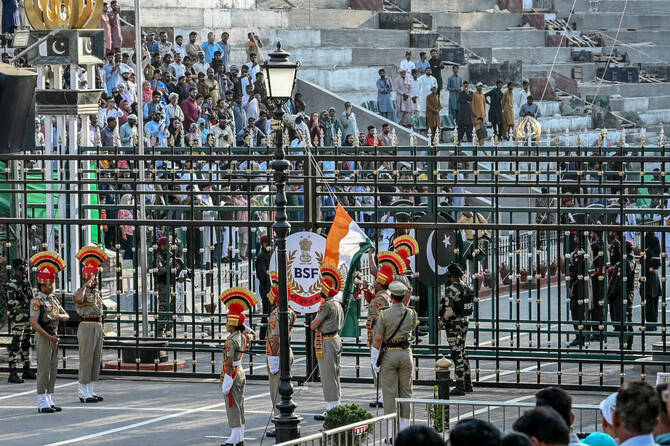
In the aftermath of the Kashmir attack, New Delhi suspended a water-sharing treaty, announced the closure of the main land border crossing with Pakistan, downgraded diplomatic ties, and withdrew visas for Pakistanis.
In response, Islamabad has ordered the expulsion of Indian diplomats and military advisers, canceling visas for Indian nationals — with the exception of Sikh pilgrims — and closing the main border crossing from its side.
The United Nations has urged the arch-rivals to show “maximum restraint” so that issues can be “resolved peacefully through meaningful mutual engagement.”
Pahalgam marks a dramatic shift in recent Kashmiri rebel attacks, which typically target Indian security forces.
Analysts say that an Indian military response may still be in the pipeline.
“There will be military retaliation and we are prepared. We are discussing the nature of the strike,” the Indian Express newspaper quoted a top government source as saying on Sunday.
In 2019, a suicide attack killed 41 Indian troops in Kashmir and triggered Indian air strikes inside Pakistan, bringing the countries to the brink of all-out war.


