

India and Pakistan troops exchange fire in Kashmir

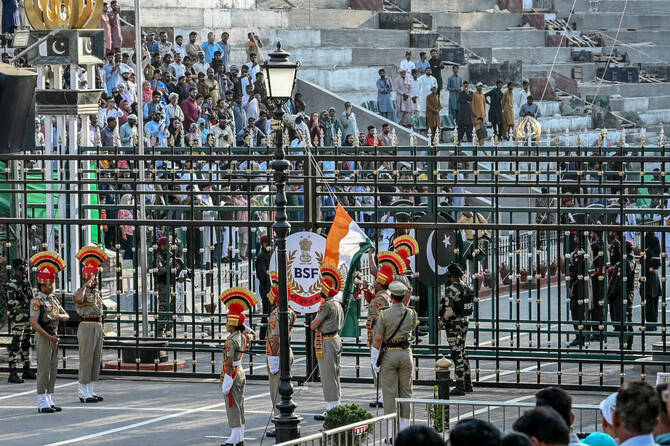
Indian Border Security Force personnel (brown) and Pakistani Rangers (black) take part in the beating retreat ceremony (File/AFP)
Short Url
Updated 27 April 2025
Follow

India and Pakistan troops exchange fire in Kashmir

  • Indian doctor Vikram Udasi, 37, said he and his Pakistani wife both rushed to reach the border crossing when the closure was announced, but arrived just too late
  • On Saturday, a steady trickle of cars and rickshaws brought those leaving to the border

SRINAGAR: Troops from Pakistan and India exchanged fire in disputed Kashmir for a third night in a row, officials said Sunday, as relations between the nuclear-armed rivals plunged to their lowest level in years.
India has accused Pakistan of supporting “cross-border terrorism” after gunmen carried out the worst attack on civilians in contested Muslim-majority Kashmir for a quarter of a century.
Islamabad has denied any involvement, calling attempts to link Pakistan to the attack “frivolous” and vowing to respond to any Indian action.
Indian security forces have launched a massive manhunt for those responsible for killing 26 men at a tourist hotspot in Pahalgam on April 22.
The Indian military said on Sunday there had been “unprovoked” firing of small arms “initiated by Pakistan” along the Line of Control that separates the two countries.
“(Our) own troops responded effectively with appropriate small arms fire,” it added.
Pakistan has not yet confirmed the latest exchange of fire.
Indian police have issued wanted posters for three men — two Pakistanis and an Indian — who they say are members of the Pakistan-based Lashkar-e-Taiba group, a UN-designated terrorist organization.
India’s federal home ministry handed over the attack probe to the National Investigation Agency, which focuses on counter-terrorism.
The agency was examining eyewitnesses, scrutinizing entry and exit points, besides collecting forensic evidence.
“The eyewitnesses are being questioned in minute detail to piece together the sequence of events that led to one of the worst terror attacks in Kashmir,” it said in a statement.

Kashmir has been divided between India and Pakistan since their independence in 1947. Both claim the territory in full but govern separate portions of it.
Rebel groups have waged an insurgency in Indian-controlled Kashmir since 1989, demanding independence or a merger with Pakistan.
On Saturday, soldiers in Indian-administered Kashmir bombed the family home of one of the Pahalgam suspects.
The house of Farooq Ahmad Tadwa was destroyed by authorities in Kupwara district, one of a series of demolitions targeting houses of alleged militants.
So far nine houses belonging to militants have been bombed since the Pahalgam attack, a police official told AFP on Sunday on condition of anonymity.
In the aftermath of the Kashmir attack, New Delhi suspended a water-sharing treaty, announced the closure of the main land border crossing with Pakistan, downgraded diplomatic ties, and withdrew visas for Pakistanis.
In response, Islamabad has ordered the expulsion of Indian diplomats and military advisers, canceling visas for Indian nationals — with the exception of Sikh pilgrims — and closing the main border crossing from its side.
The United Nations has urged the arch-rivals to show “maximum restraint” so that issues can be “resolved peacefully through meaningful mutual engagement.”
Pahalgam marks a dramatic shift in recent Kashmiri rebel attacks, which typically target Indian security forces.
Analysts say that an Indian military response may still be in the pipeline.
“There will be military retaliation and we are prepared. We are discussing the nature of the strike,” the Indian Express newspaper quoted a top government source as saying on Sunday.
In 2019, a suicide attack killed 41 Indian troops in Kashmir and triggered Indian air strikes inside Pakistan, bringing the countries to the brink of all-out war.


Tarique Rahman-led BNP set to form Bangladesh’s next government after major election win

Updated 5 sec ago
Follow

Tarique Rahman-led BNP set to form Bangladesh’s next government after major election win

  • Jamaat-e-Islami, banned during Hasina’s government, won 68 seats
  • Majority of Bangladeshis endorsed sweeping reforms in national referendum

DHAKA: The Bangladesh Nationalist Party, led by Tarique Rahman, is set to form the country’s next government after securing a more than two-thirds majority in the first elections since a student-led uprising in 2024 ousted ex-prime minister, Sheikh Hasina.

The BNP has won at least 209 seats out of the 299 contested, according to the latest election results released by the Election Commission on Friday, paving the way for Rahman to become the country’s next prime minister.

Jamaat-e-Islami, banned during Hasina’s 15 years in power, has registered its best performance yet, winning at least 68 seats and emerging as the main opposition party.

The National Citizen Party, which was born out of the 2024 protests, was in third place with six seats, including for its leader Nahid Islam, while Hasina’s Awami League was barred from participating in the elections.

The majority of Bangladeshis also reportedly voted “yes” in a national referendum on the “July National Charter” that was held alongside the general vote on Thursday.

Named after the month when the uprising that toppled Hasina began, the charter is aimed at achieving sweeping democratic reforms to prevent authoritarian administrations, including term limits for premiers, stronger presidential powers and greater judicial independence, while also proposing increased representation of women in parliament.

The BNP-led government is likely to follow the commitments made under the charter, said Prof. A.S.M. Amanullah, vice chancellor of the National University in Dhaka, adding that the implementation of the July charter was also included in the party’s election manifesto that covers reform of the state and rebuilding of the economy.

“Mr. Tarique Rahman is a highly trained politician, highly sensitive politician, and he takes decisions based on facts. I believe he prepared himself to run this country locally and play a role internationally,” Amanullah told Arab News.

Rahman is the son of former Prime Minister Khaleda Zia and former President Ziaur Rahman. He returned to Bangladesh late last year after nearly two decades of self-imposed exile in the UK, and assumed BNP’s leadership days later, following his mother’s death from a prolonged illness.

In an interview with Arab News earlier this week, the 60-year-old pledged to pursue accountability for the former leadership and meet the political and economic expectations of the youth movement that brought about the change.

The new government is likely to be a mix of young and old politicians, Amanullah said, with Jemaat-e-Islami set to balance out the BNP’s rule.

“This is a very good size of opposition to press the issues or to challenge the government on different issues, different policies and decisions of the government. I’m hopeful about Jemaat,” he said.

“The way the people voted for these major two parties, the BNP and Jemaat, I think if they could work jointly, Bangladesh should see a stable political situation in the near future.”

Mohiuddin Ahmad, a political analyst and researcher, described Jemaat-e-Islami as “the most organized party” in Bangladesh and that it would therefore play an “instrumental” role as the opposition party.

Voter turnout averaged 59.44 percent, the EC said, with many Bangladeshis considering this week’s vote as their first “free and fair” election after more than 17 years.

“Such a result of an election we haven’t actually experienced before,” Muhiuddin Iqbal, a history student at Dhaka University, told Arab News.

“The festive feeling has not gone yet, so we’re very much excited about it and hopeful for the future.”