ROME: President Donald Trump will be among more than 50 heads of state and other dignitaries attending Saturday’s funeral for Pope Francis, where he’ll personally pay his respects to the Roman Catholic leader who pointedly disagreed with him on a variety of issues.
Trump told reporters he was going to the funeral “out of respect” for the pontiff, who died Monday after suffering a stroke at the age of 88.
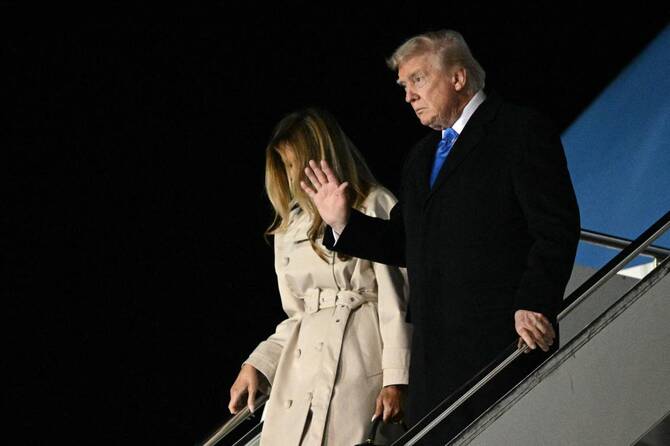
The president and first lady Melania Trump arrived in Rome late Friday for the service at St. Peter’s Basilica in Vatican City on Saturday morning. Francis will be laid to rest during a private burial at St. Mary Major Basilica outside the Vatican’s walls.
Francis sharply disagreed with Trump’s approach on issues including immigration, the treatment of migrants and climate change. The Argentine pontiff and the American president sparred early in their relationship over immigration. In 2016, Francis, alluding to then-candidate Trump and his campaign slogan of “Build the wall,” called anyone who builds a wall to keep out migrants ” not Christian.” Trump said the comment was “disgraceful.”
But after Francis’ death, the Republican president praised him as a “good man” who “worked hard” and “loved the world.” Trump also directed that US flags be flown at half-staff in Francis’ honor.
Trump had said on a couple of occasions before leaving Washington that he would have “a lot” of meetings with counterparts on the sidelines of the funeral. But he seemed to back away from that as he flew to Rome.
“Frankly, it’s a little disrespectful to have meetings when you’re at the funeral of a pope,” the president told reporters accompanying him aboard Air Force One. Nonetheless, Trump said: “I’ll be talking to people. I’ll be seeing a lot of people.”
The leaders of France, the United Kingdom, Spain, Hungary and Argentina are among those expected to attend.
One person Trump didn’t expect to interact with is former President Joe Biden, who planned to attend the funeral with his wife, Jill. Trump said he wasn’t aware his Democratic predecessor would be at the funeral. Asked if they’d meet, Trump said: “It’s not high on my list. It’s really not.”
The pope’s funeral will not be one of those occasions that bring together the current and former US presidents. Former Presidents Barack Obama and George W. Bush are not attending, their offices said. A spokesperson for former President Bill Clinton did not respond to an inquiry about his plans.
Trump didn’t elaborate when asked if he’d just be meeting leaders in passing or holding more in-depth talks. He suggested he might have meetings at Villa Taverna, the US ambassador’s residence, where he spent the night.
“It’s a little tough because we don’t have much time,” Trump said, noting his late arrival in Rome. He was scheduled to head back to the United States immediately after the funeral.
“I think that we’re going to try and see a couple of people that are important in what we’re doing,” said Trump, who is trying to broker a ceasefire between Russia and Ukraine and negotiate trade agreements with multiple countries.
He posted on Truth Social shortly after arriving in Rome that Ukraine and Russia should meet for “very high level talks” on ending the bloody three-year war sparked by Russia’s invasion. His envoy, Steve Witkoff, met with Russian President Vladimir Putin earlier Friday, and Trump said both sides were “very close to a deal.”
Ukrainian President Volodymyr Zelensky arrived in Rome on Saturday to attend the funeral, his press office confirmed, joining first lady Olena Zelenska. Putin is not attending.


![]()

Trump will pay his respects to a pope who publicly and pointedly disagreed with him on some issues
Short Url
https://arab.news/85u2n
Trump will pay his respects to a pope who publicly and pointedly disagreed with him on some issues
- The president and first lady Melania Trump arrived in Rome late Friday for the service at St. Peter’s Basilica
- The leaders of France, the United Kingdom, Spain, Hungary and Argentina are among those expected to attend


Latest updates


Recommended


© 2026 SAUDI RESEARCH & PUBLISHING COMPANY, All Rights Reserved And subject to Terms of Use Agreement.