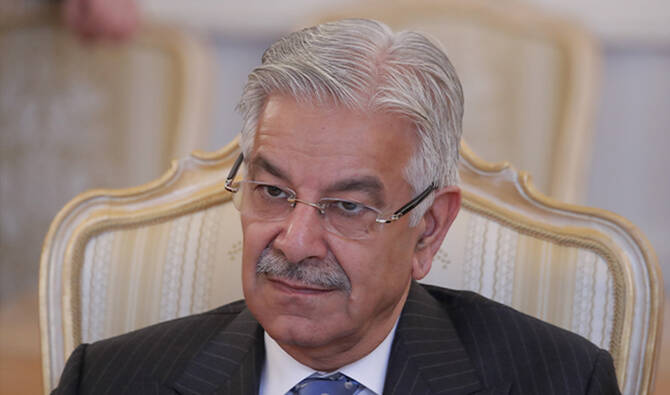
ISLAMABAD: Pakistan Defense Minister Khawaja Muhammad Asif has said that Islamabad will respond “in kind” to any Indian incursion on the pretext of a militant attack in Indian-administered Kashmir that killed over two dozen tourists this week.
India has said there were Pakistani elements in Tuesday’s attack, when militants shot dead 26 men in a meadow in the Pahalgam area. Islamabad has denied any involvement and described Indian allegations as “frivolous.”
The nuclear-armed nations have unleashed a raft of measures against each other, with India keeping a critical river water-sharing treaty in abeyance and Pakistan closing its airspace to Indian airlines, among other steps.
Indian Prime Minister Narendra Modi on Thursday vowed to chase the perpetrators of the Pahalgam attack to “the ends of the earth” after Indian police identified two of the three fugitive gunmen as Pakistani. India has not shared any proof to support its claims.
“If there is incursion from Indian side, Pakistan will meet that incursion in kind and [with] full force,” Asif said in an international media interview shared on Friday.
“We cannot allow this incursion of our soil, of our country. This is something which is very fundamental for the Pakistanis.”
Both Pakistan and India claim Muslim-majority Kashmir in full but rule it in part and have fought two of their three wars over the disputed region. India has long accused Pakistan of aiding separatists who have battled security forces in the part of the territory it controls, accusations Islamabad denies.
Since Tuesday’s attack, there have been calls for and fears that India could conduct a military strike in Pakistani territory as it did in 2019 in retaliation for a suicide bombing in Pulwama in Indian-administered Kashmir that killed at least 40 Indian paramilitary police. Several leaders of Modi’s Hindu nationalist Bharatiya Janata Party have called for military action against Pakistan.
Last week, Pakistan’s Army Chief General Asim Munir also voiced his support for the Kashmiri people, reiterating that Kashmir is the "jugular vein" of Pakistan.
“Our stance on Kashmir is absolutely clear. It was our jugular vein and it is our jugular vein,” he said at a convention of Overseas Pakistanis. "We will not forget it and we will not leave our Kashmiri brethren in their heroic struggle against the Indian occupation."
Indian officials and media have also criticized recent comments by the Pakistan army chief in support of Kashmiris’ right to self-determination, and linked it with the Pahalgam attack.
Asif said there was “absolutely no linkage” between Gen. Munir’s remarks and what happened in Pahalgam, adding that they suspected Tuesday’s attack to be a “false-flag operation.”
“There is absolutely no linkage. We make these speeches and, sort of, reiterate our commitment to Kashmir, which is a very fundamental commitment. It is something which goes with our existence as a state,” he said.
“We suspect, very strongly suspect, this was a false-flag operation and Pulwama, the last time, you are talking about 2019, ultimately proved to be a hoax. It was admitted by the India media that it was a hoax created or orchestrated to, you know, blame Pakistan for something which was never connected to Pakistan, and ultimately they were humiliated.”
As both India and Pakistan teeter on the brink of another conflict, there have been calls by the United Nations (UN) for both nuclear-armed rivals to show “maximum restraint,” while the United States (US) has said it is “closely” monitoring the situation.


![]()

Pakistan to respond to any Indian incursion ‘in kind,’ defense minister says
Short Url
https://arab.news/5tt22
Pakistan to respond to any Indian incursion ‘in kind,’ defense minister says
- The statement comes after an attack in Indian-administered Kashmir’s Pahalgam which has brought India, Pakistan to the brink of another war
- Pakistan Defense Minister Khawaja Asif says they strongly suspect the Pahalgam attack, which killed 26 tourists, to be a ‘false-flag operation’


Latest updates


© 2026 SAUDI RESEARCH & PUBLISHING COMPANY, All Rights Reserved And subject to Terms of Use Agreement.