


‘The Holy Mosque at Makkah’

With a foreword by former Saudi Minister of Finance Sheikh Mohammed Abalkhail and images by the award-winning African photojournalist Mohamed Amin, this “sumptuous production” tracks the quarter century of restoration of the Sacred Mosque and Holy Kaaba in Makkah in the mid-20th century. “The text contains a historical description of the Holy Kaaba, Masjid al-Haram, a summary of recent construction in the Saudi era, and architectural notes, with the rest of the volume dedicated to Amin’s photographs, presenting detailed views of the diverse and extensive developments,” the book dealer’s notes state. Amin was “the first photographer to be given access to document the Hajj and among the first to photograph sections of the Holy Mosques of Makkah and Madinah. Over three years during the 1970s, he travelled by camel, helicopter, car and on foot to Madinah, Arafat, and Makkah.”
Confidential reports from the First and Third Arab Petroleum congresses

The historical global significance of the first Arab Petroleum Congress in 1959 cannot be understated. It was here that the idea of an oil-producing organization (an idea that eventually turned into OPEC) was introduced. “During proceedings, the influential oil journalist Wanda Jablonski introduced Saudi Arabia’s Abdullah Tariki to Venezuela’s Juan Pablo Perez Alfonzo, both of whom were upset by recent price cuts. They rallied delegates to sign the secret Maadi Pact, suggesting a Petroleum Consultation Commission to coordinate producer responses. This laid the groundwork for the 1960 Baghdad Conference, at which OPEC was officially formed,” the book dealer’s notes state. This grouping of documents contains in-house reports from Aramco on that congress, and the Third Arab Petroleum Congress in Dec. 1961, as well as other Aramco-produced materials from 1956-1961.
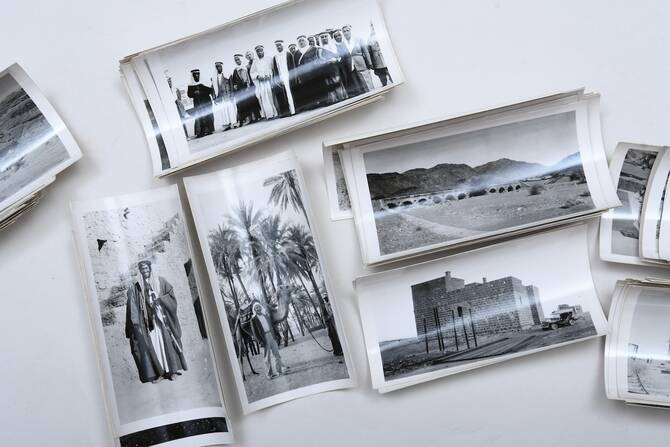
Photographic archive and reports from the recommissioning of the Hejaz Railway

The book dealer describes this collection as “a unique archive relating to the earliest post-war attempt to reconstruct the Hejaz railway and link Damascus with Madinah.” The last train to travel the full length of the railway was reportedly in 1925, after which “the line south of Mudawwara was washed away, and the conflicts that led to the creation of Saudi Arabia in 1932 dampened collective efforts at reconstruction.” The archive includes previously unpublished photos and original reports issued by the International Resources Engineering and Exploration Group, which was awarded to contract to design the project in 1956. “Coverage is particularly detailed for central and northern Saudi Arabia, especially the area around Mada’in Salih and Khur Himar,” the dealer states, and includes images of the party meeting with local officials including the rulers of AlUla and Tabuk.
A collection of magic lantern slides by Harry St John Bridger Philby & Alec Horace Edward Litton Holt

The British intelligence officer Philby — who served as an advisor to Saudi Arabia’s founder, King Abdulaziz Ibn Saud — and the engineer and explorer Holt travelled 600 miles together in 1922 through the desert via Al-Jawf province in Saudi Arabia “at the height of increasing tensions between Ibn Saud and the Hashemites.” These 23 slides were, the book dealer believes, likely used to illustrate the presentation the pair gave about their journey before the Royal Geographic Society in the UK on Feb. 12, 1923. “The collection shows Holt and Philby in Arab dress; Ford cars and aeroplanes at Jidd, desert scenes, a Ford condenser, and ploughing for landing fields, among others.”
Aramco educational PR pack

In an attempt to attract US students and graduates in the Sixties and Seventies, Aramco produced several collections of promotional material that included posters much like this one, which it distributed to schools and universities in the States. “The lively posters explore the history of Saudi Arabia and the company’s operations, each illustrated with photographs of historical figures (including T. E. Lawrence), company personnel and oil wells, and Saudi architecture,” the book dealer states.


