Sindh CM, Islamic Development Bank discuss housing, women empowerment projects

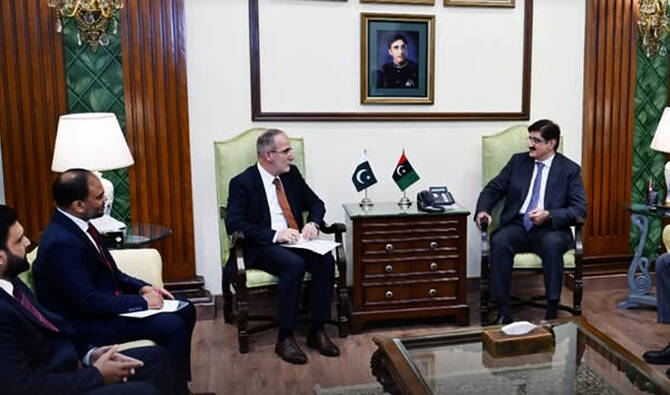
Pakistan’s Sindh Chief Minister Murad Ali Shah (right) gestures during a meeting with the Islamic Development Bank officials at the Sindh Chief Minister House in Karachi on April 24, 2025. (Photo courtesy: Handout/Sindh government)
Short Url
Updated 24 April 2025
Follow

Sindh CM, Islamic Development Bank discuss housing, women empowerment projects

  • IsDB is financing $200 million for reconstruction of houses for those affected by catastrophic 2022 floods
  • Bank agrees to provide more support for water, sanitation, and hygiene projects in Sindh, says state media

ISLAMABAD: The chief minister of Pakistan’s southern Sindh province discussed housing for flood affectees and women empowerment projects with a high-level delegation of the Islamic Development Bank (IsDB), state-run media reported on Thursday.
The IsDB is financing $200 million for the reconstruction of houses for those affected by the catastrophic 2022 floods. Torrential rains and melting glaciers triggered flash floods across the country that killed over 1,700 people and caused damages worth $33 billion, according to Pakistan’s estimates.
Sindh Chief Minister Syed Murad Ali Shah met an IsDB delegation led by its Regional Director, Dr. Walid Abdelwahab, to discuss the Sindh Flood Emergency Housing Reconstruction Project (SFEHRP) and the Sindh Integrated Health and Women Empowerment Project. Both projects involve collaboration with the World Bank, the state-run Associated Press of Pakistan (APP) said.
“The chief minister welcomed Dr. Abdelwahab and expressed gratitude for the IsDB’s support in rebuilding homes for the flood-affected population,” APP reported.
Shah said the Sindh government, in partnership with international collaborators and NGOs, is actively implementing Water, Sanitation, and Hygiene (WASH) projects in various districts to improve public health, particularly in flood-affected and underserved communities.
“In response to the chief minister’s request, the IsDB agreed to provide additional support for the WASH project,” the report said.
Shah stressed that the SFEHRP and WASH projects have been designed to enable owner-driven, multi-hazard-resilient reconstruction of core housing units following the 2022 floods.
The Sindh Integrated Health and Women Empowerment Project is a $280 million initiative that includes financing of $50 million from the IsDB, $30 million from the Sindh government, and $200 million from foreign fund assistance (FFA).
Shah explained that the project aims to enhance the utilization and quality of reproductive, maternal, newborn, child, adolescent, and nutrition (RMNCAH+N) services for poor and vulnerable populations, particularly adolescents and women, in targeted areas of the province.
“The process to hire a third-party firm to oversee the skill development of 6,000 eligible women has begun in consultation with the IsDB,” the APP said.
As part of the program, 124 government dispensaries will be rehabilitated and upgraded, with diagnostic and preliminary design reports already completed, the state-run media said.


T20 World Cup: ICC deputy chief in Lahore for talks after Pakistan boycotts India match

Updated 8 sec ago
Follow

T20 World Cup: ICC deputy chief in Lahore for talks after Pakistan boycotts India match

  • Islamabad’s boycott over Bangladesh’s exclusion has threatened the tournament’s most lucrative game
  • Bangladesh Cricket Board chief has also arrived in Pakistan and is expected to participate in meetings

ISLAMABAD: International Cricket Council (ICC) Deputy Chairman Imran Khwaja arrived in Lahore on Sunday for talks with Pakistan Cricket Board (PCB) officials, the PCB said, as the sport’s governing body strives to save a high-stakes T20 World Cup clash between arch-rivals Pakistan and India.

The development follows Islamabad’s decision to boycott the Feb. 15 Pakistan-India match in Colombo, a move to protest the ICC’s exclusion of Bangladesh from the ongoing T20 World Cup.

The controversy over Pakistan’s participation erupted after the ICC replaced Bangladesh with Scotland, following Bangladesh’s decision to not play matches in India owing to security fears.

The ICC has since requested the Pakistan Cricket Board to reconsider the decision to boycott their match against India in Colombo or they will have to forfeit the marquee game of the tournament.

“ICC Deputy Chairman Imran Khwaja arrived in Lahore,” the PCB said on Sunday, adding that he was received at the airport by the PCB chairman’s adviser, Aamir Mir.

Prior to Khwaja’s arrival in Lahore, where the PCB is headquartered, Pakistan welcomed Bangladesh Cricket Board (BCB) President Aminul Islam, who was received by PCB CEO Salman Naseer.

The two visiting officials are scheduled to meet PCB Chairman Mohsin Naqvi.

“Bangladesh Cricket Board President Aminul Islam will also take part in other meetings,” the PCB said in a statement, hinting that he will be part of the meeting with ICC’s Khwaja.

The dispute stems from the ICC’s decision to replace Bangladesh with Scotland last month after Bangladesh refused to play tournament matches in India. Dhaka’s decision followed the removal of Mustafizur Rahman from the Indian Premier League (IPL). He was bought for $1 million by the IPL’s Kolkata Knight Riders, but on Jan. 3 the Board of Control for Cricket in India (BCCI) ordered Kolkata to release Mustafizur without a public explanation but amid regional tensions.

Pakistan have boycotted the 27th match of the tournament against India, due to take place at R. Premadasa Stadium in Colombo. An India-Pakistan fixture is the sport’s most lucrative asset, generating a massive share of global broadcasting and sponsorship revenue.

The PCB has remained defiant amid reports of potential sanctions. On Saturday, the board rejected claims by Indian media that it had initiated a dialogue with the ICC to find a way out of the standoff.

“I categorically reject the claim by Indian sports journalist Vikrant Gupta that PCB approached the ICC,” PCB’s Mir said in a statement. “As usual, sections of Indian media are busy circulating fiction. A little patience and time will clearly show who actually went knocking and who didn’t.”

The standoff highlights the growing friction within the sport’s governance.

Pakistan has accused India’s cricket board of influencing the ICC’s decisions.

Defense Minister Khawaja Asif this week called for the formation of a new cricket governing body, saying the ICC, currently chaired by Jay Shah, son of India’s Home Minister Amit Shah, was being held “hostage” to “Indian political interests.”

India generates the largest share of cricket’s commercial revenue and hence enjoys considerable influence over the sport. Critics argue that this financial contribution translates into decisive leverage within the ICC.

A large part of that revenue comes from the Indian Premier League (IPL), the sport’s most lucrative T20 cricket competition, which is run by the Board of Control for Cricket in India (BCCI). Between 2024 and 2027, the IPL is projected to earn $1.15 billion, nearly 39 percent of the ICC’s total annual revenue, according to international media reports.

While the Pakistani government cleared the team to participate in the rest of the tournament, Prime Minister Shehbaz Sharif maintained that the boycott of the India game was necessary to protest the “unjust” treatment of Bangladesh.