

Bangladesh observes three days of mourning for Pope Francis

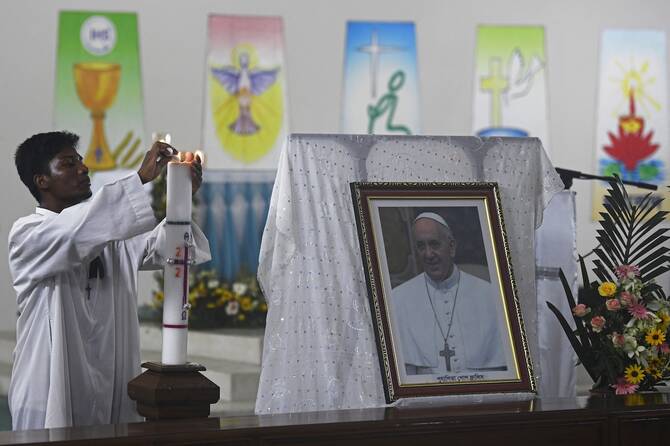
A church attendant lights a candle beside a portrait of late Pope Francis before the start of a special service at St. Mary’s Cathedral in Dhaka on April 22, 2025. (AFP)
Short Url
Updated 24 April 2025
Follow

Bangladesh observes three days of mourning for Pope Francis

  • The pontiff visited Bangladesh in 2017, at the beginning of the Rohingya refugee crisis
  • Bangladesh’s chief adviser, Muhammad Yunus, worked with Francis on poverty alleviation

DHAKA: National flags flew at half-mast in Bangladesh on Thursday as the Muslim-majority nation began three days of state mourning for Pope Francis.

The Argentine pontiff, leader of the Catholic Church since March 2013, died at his residence, Casa Santa Marta, in the Vatican on Monday. He was 88 years old.

Bangladesh’s interim administration issued a notification on Wednesday night, announcing that the government had decided to hold special prayers in memory of the pope and lower national flags to half-staff on buildings across the country, as well as at its missions abroad.

Bangladesh’s Christians account for less than 0.5 percent of its population. Most of them, about 400,000, are Catholic.

It is the first time Bangladesh is observing three days of remembrance for a Catholic leader.

“This is a great honor given to him,” Cardinal Patrick D’Rozario, former archbishop of Dhaka, told Arab News.

“Our country, Bangladesh, has decided well to mourn for three days. This is not because of the church, but because his messages were always universal, moral, and social.”


It was in the very first days of Francis’ papal service that the Rana Plaza building collapsed in Dhaka due to a structural failure, killing over 1,100 people, mostly garment factory workers.

In the aftermath of the tragedy, the pope called for prayers for the victims and their families, and urged a renewed commitment to fighting for the rights and dignity of workers, reflecting his long-standing advocacy for social justice.

He visited Dhaka in 2017, at the invitation of its government and the Catholic Church, at the beginning of the Rohingya crisis, when hundreds of thousands of members of the predominantly Muslim ethnic group were forced to flee Myanmar.

The majority of them have been sheltered by neighboring Bangladesh. Francis met with the refugees during his visit.

“He had a (heavy) heart because of the suffering of the people, and he also tried publicly to see the miseries of these people. He was deeply touched by Bangladesh’s gesture,” D’Rozario said.

Revered by millions of Catholics around the world, the pope’s message resonated in Bangladesh too.

In his final address from the balcony of St. Peter’s Basilica in the Vatican, Francis called for a ceasefire in Gaza and condemned the “deplorable humanitarian situation” caused by Israel’s ongoing deadly onslaught on the territory.

“He has been talking about the people’s suffering in Gaza ... On Easter Sunday, he spoke about four or five minutes about the Palestinians. So, there is that unity (in) support, also in Bangladesh,” D’Rozario said.

“Coming from Latin America, with a lot of suffering over there, a lot of poor people, he had a social message, a message on politics — good politics — a message on economics, message on trade and commerce, message on the international peace.”

The pope’s funeral mass will take place in St. Peter’s Square on Saturday.

Bangladesh’s chief adviser, Prof. Muhammad Yunus, who heads its interim government, is going to attend the service.

Yunus, an economist and Nobel Peace Prize laureate, worked with Francis on poverty alleviation.

“Pope Francis was a towering figure of moral clarity, humility, and compassion in our time. His lifelong dedication to justice, peace, and the dignity of every human being resonated far beyond the Catholic world,” he said in a statement on the pope’s passing.

“His leadership, rooted in the values of fraternity and service, inspired global efforts to uplift the poor, protect the vulnerable, and build a more humane and peaceful world.”


Rohingya refugees hope new leaders can pave a path home

Updated 6 sec ago
Follow

Rohingya refugees hope new leaders can pave a path home

  • Some 1.7 million Rohingya Muslims displaced in Myanmar's military crackdown live in squalid camps in Cox’s Bazar, Bangladesh

COX’S BAZAR, Bangladesh: Rohingya refugees living in squalid camps in Bangladesh have elected a leadership council, hoping it can improve conditions and revive efforts to secure their return home to Myanmar.
Spread over 8,000 acres in Cox’s Bazar in Bangladesh, the camps are home to 1.7 million members of the stateless group, many of whom fled a 2017 military crackdown that is now subject to a genocide probe at the UN court.
In July, the refugees held their first elections since their influx began eight years ago, resulting in the formation of the United Council of Rohang (UCR).
“They are working to take us home,” said Khairul Islam, 37, who back home had a thriving timber business.
The new council has brought him a glimmer of hope amid an uncertain future.
“We can hardly breathe in these cramped camp rooms... all our family members live in a single room,” he said.
“It’s unbearably hot inside. Back in Myanmar, we didn’t even need a ceiling fan. In summer, we used to sit under tall trees,” Islam said, his eyes welling up.
More than 3,000 voters from across 33 refugee camps cast their ballots to elect an executive committee and five rotating presidents to focus on human rights, education and health.
Addressing a gathering at one of the camps, UCR president Mohammad Sayed Ullah urged refugees not to forget the violence that forced the mostly Muslim group to flee Myanmar’s Rakhine state.
“Never forget that we left our parents’ graves behind. Our women died on the way here. They were tortured and killed... and some drowned at sea,” said Sayed Ullah, dressed in a white full-sleeved shirt and lungi.
“We must prepare ourselves to return home,” he said, prompting members of the audience to nod in agreement.

A seat at the table 

“UCR wants to emerge as the voice of the Rohingyas on the negotiation table,” Sayed Ullah later told AFP.
“It’s about us, yet we were nowhere as stakeholders.”
The council is not the first attempt to organize Rohingya refugees.
Several groups emerged after 2017, including the Arakan Rohingya Society for Peace and Human Rights, once led by prominent activist Mohib Ullah.
But he was murdered in 2021.
And even before that, many organizations were shut down after a major 2019 rally, when the Rohingya said they would go home only with full rights and safety guarantees.
“Some newspapers misrepresented us, claiming we wanted to stay permanently in Bangladesh,” Sayed Ullah said.
“Many organizers were detained. The hardest blow was the assassination of Mohib Ullah.”
But trust is slowly building up again among the Rohingya crammed in the camps in Cox’s Bazar.
“Of course we will return home,” said 18-year-old Mosharraf, who fled the town of Buthidaung with his family.
“UCR will negotiate for better education. If we are better educated, we can build global consensus for our return,” he told AFP.

Security threats 

Many refugees have started approaching the body with complaints against local Rohingya leaders, reflecting a slow but noticeable shift in attitudes.
On a recent sunny morning, an AFP reporter saw more than a dozen Rohingya waiting outside the UCR office with complaints.
Some said they were tortured while others reported losing small amounts of gold they had carried while fleeing their homes.
Analysts say it remains unclear whether the new council can genuinely represent the Rohingya or if it ultimately serves the interests of Bangladeshi authorities.
“The UCR ‘elections’ appear to have been closely controlled by the authorities,” said Thomas Kean, senior consultant at the International Crisis Group.
Security threats also loom large, undermining efforts to forge political dialogue.
Armed groups like the Arakan Rohingya Salvation Army and Rohingya Solidarity Organization continue to operate in the camps.
A report by campaign group Fortify Rights said at least 65 Rohingyas were killed in 2024.
“Violence and killings in the Rohingya camps need to stop, and those responsible must be held to account,” the report quoted activist John Quinley as saying.