

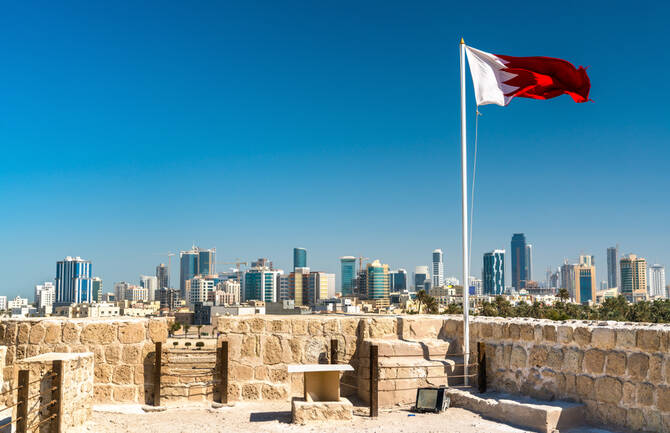
Bahrain foreign and local currency sovereign credit rating at ‘B+/B’: S&P 

Bahrain’s affirmed rating reflects continued reform but highlights greater fiscal and external vulnerabilities. Shutterstock
Short Url
Updated 24 April 2025
Follow

Bahrain foreign and local currency sovereign credit rating at ‘B+/B’: S&P 

RIYADH: Continued fiscal reform efforts, stable economic diversification, and financial support from Gulf Cooperation Council partners have led S&P Global Ratings to affirm Bahrain’s long- and short-term foreign and local currency sovereign credit ratings at “B+/B.”

The American agency also maintained the nation’s transfer and convertibility assessment at “BB-.”

The ratings affirmation reflects Bahrain’s progress in strengthening non-oil revenue, commitment to structural reforms under the Fiscal Balance Program, and ongoing investment in sectors such as manufacturing and tourism. 

S&P also pointed to the country’s improved national accounts framework and stable regional alliances as key factors underpinning its sovereign credit profile, as well as emphasizing the importance of Bahrain’s strategic regional alliances in supporting its creditworthiness. 

“Our rating on Bahrain reflects supportive relations with GCC sovereigns,” said the report.

These relationships have resulted in significant financial assistance, including a $10.2 billion support package pledged by Saudi Arabia, the UAE, and Kuwait in 2018. 

The report noted that in 2024, Saudi Arabia’s Public Investment Fund formalized a $5 billion specialized investment vehicle specifically for Bahrain to “develop tourism, transportation, infrastructure, and the environment.” 

The country’s strategy has included non-oil revenue reforms under the government’s Fiscal Balance Program 2018–2024, S&P stated. 

These measures include the introduction of a value-added tax in 2019 — doubled to 10 percent in 2022 — a 15 percent domestic minimum top-up tax for multinational enterprises, planned corporate income tax for local companies, and an expanded scope for excise taxes. 

Recent revisions to Bahrain’s national accounting methodology have improved fiscal metrics by increasing nominal gross domestic product figures, thereby improving ratios such as debt-to-GDP, S&P explained. 

Across the Gulf region, sovereign credit ratings have generally reflected strong fiscal fundamentals and progress on economic reform. 

In March, S&P upgraded Saudi Arabia’s long-term rating to “A+” from “A,” citing sustained reforms under Vision 2030. Kuwait’s ratings were affirmed at “A+/A-1” in June, supported by robust fiscal and external positions. 

Oman received an upgrade to “BBB-” in September, reflecting fiscal consolidation and a reduction in public debt. 

Qatar’s “AA/A-1+” rating was affirmed in November, underpinned by its substantial hydrocarbon reserves. 

Against this backdrop, Bahrain’s affirmed rating reflects continued reform but highlights greater fiscal and external vulnerabilities. 

Despite these supportive elements, the agency revised Bahrain’s outlook to negative from stable. 

“The negative outlook reflects increasing risks to the fiscal position and the government’s ability to service and refinance debt.”

The agency stated that fiscal reform measures “may prove insufficient to put debt to GDP on a downward path,” while noting that “Bahrain’s foreign currency reserve position remains weak.” 

S&P projects the fiscal deficit will widen to “about 7.0 percent of GDP in 2025, compared with 5.2 percent in 2024 and 4.9 percent in our previous review.” 

The agency attributes this to “lower oil prices and ongoing field maintenance at the key Abu Sa’fah oil field, risks to funding costs amid market volatility, and higher social spending.” 

It added that “we recently revised our Brent oil price assumptions down to $65 per barrel in 2025, and $70/bbl over the medium term, relative to about $80/bbl in 2024.” 

Looking ahead, S&P anticipates the deficit will tighten, stating: “We anticipate the fiscal deficit will narrow toward 4.4 percent by 2028.” 

This is expected to result from “a recovery in oil production as maintenance on the Abu Sa’fah oil field, shared with Saudi Arabia, is completed and non-oil revenue continues to grow.” 

However, Bahrain’s rising debt burden remains a concern, according to the report, which said: “High debt levels continue to constrain the government’s fiscal flexibility.” 

Gross general government debt is projected to rise from 130 percent of GDP in 2024 to 144 percent by 2028, factoring in 3 percent of GDP in off-balance-sheet spending. 

“Over the last three years, debt to GDP has risen by about 18 percentage points after including overdraft facilities from the Central Bank of Bahrain, totaling 24 percent of GDP in 2024,” said S&P, adding that debt-servicing costs have also increased to approximately 29 percent of government revenue, one of the highest levels among sovereigns rated by the agency. 

Low foreign currency reserves also weigh on Bahrain’s external profile. “The government’s foreign currency reserve account has historically been restored via external issuance and fiscal support from other GCC sovereigns,” said the report. 

Usable reserves are estimated at “about negative $15 billion–$16 billion, after deducting the monetary base and foreign currency swaps with domestic banks, which we regard as encumbered.” 

Upcoming external government debt maturities heighten refinancing risks, said S&P, adding that over the next 12 months these will total $3.6 billion, including sukuk and bond payments due between August and May 2026. 

“We anticipate Bahrain will seek to refinance these maturities to avoid a significant drop in foreign currency reserves,” said the report. 

S&P noted that it “could lower the rating over the next six to 12 months if the government is unable to significantly reduce the pace of government debt accumulation, which has been higher than anticipated in recent years.” 

The rating could also come under pressure if there were a deterioration in foreign currency reserves due to weaker market access for funding or if the agency believed additional funding support for the GCC would not be forthcoming. 

Conversely, the outlook could be stabilized with meaningful progress on fiscal reforms. 

“We would revise the outlook to stable if the government were to implement fiscal reforms to materially increase the revenue base and narrow fiscal deficits, and if we saw improving foreign currency reserves,” said S&P. 


Saudi Arabia sets global benchmark in AI modernization

Updated 15 January 2026
Follow

Saudi Arabia sets global benchmark in AI modernization

  • Executives hail the Kingdom’s robust infrastructure and strategic workforce programs

RIYADH: Saudi Arabia is emerging as a global leader in artificial intelligence, according to executives from OpenText, one of the world’s largest enterprise information management companies. 

With 22 years of international AI experience, Harald Adams, OpenText’s senior vice president of sales for international markets, said the Kingdom’s modernization efforts are now setting a global standard.

“From my perspective, Saudi Arabia is not only leading the modernization towards artificial intelligence in the Middle East, I think it is even not leading it only in the MENA region. I think it is leading it globally,” Adams told Arab News.

In an interview, Adams and George Schembri, vice president and general manager for the Middle East at OpenText, discussed the Kingdom’s significant investments in AI during the inauguration of OpenText’s new regional headquarters in Riyadh.

“So for us (OpenText), from our perspective, it was a strategic decision to move our MENA headquarters to Saudi Arabia because we believe that we will see here a lot of innovation coming out of the country, we can replicate not only to the MENA region, maybe even further to the global level,” Adams said.

The new headquarters, located in the King Abdullah Financial District, will serve as a central hub for OpenText customers and partners across the Middle East. Its opening reflects a broader trend of tech giants relocating to Riyadh, signaling the Kingdom’s rise as a hub for global AI innovation.

Adams attributed Saudi Arabia’s lead in AI modernization to a combination of substantial financial backing, a unified national strategy, and a remarkable pace of execution.

“I mean, a couple of things, because the ingredients in Saudi Arabia are of course, quite interesting. On the one hand side, Saudi Arabia has deep pockets and great ambitions. And they are, I mean, and they are executing fast, yeah,” he said.
“So from that perspective, at the moment, what we see is that there are, especially on the government side, I can’t see any other government organizations globally moving faster into that direction than it is happening in Saudi Arabia. Not in the region, not even on a global level, they are leading the game,” he underlined.

Schembri added, “Saudi’s AI vision is one of the most ambitious in the world, and AI on a national scale is not good without trusted, secured, and governed, and this is where OpenText helps to enable the Saudi organizations to be able to deliver on the 2030 Vision.”

“The Kingdom’s focus on AI and digital transformation creates a powerful opportunity for organizations to unlock value from their information,” Schembri stated.
“With OpenText on the ground in Riyadh, our customers gain direct access to trusted global expertise combined with local insight — enabling them to manage information securely, scale AI with confidence, and compete on a global stage,” he added.

DID YOU KNOW?

• Saudi Arabia ranks 5th globally and 1st in the region for AI growth under the 2025 Global AI Index.

• The Kingdom is also 3rd globally in advanced AI model development, trailing only the US and China.

• AI is projected to contribute $235.2 billion — or 12.4 percent — to Saudi Arabia’s GDP by 2030.

The inauguration of OpenText’s new regional headquarters was attended by Canada’s Minister of International Trade and Economic Development, Maninder Sidhu, and Jean-Philippe Linteau, Canada’s ambassador to Saudi Arabia. 

Sidhu emphasized the alignment of Saudi Vision 2030 with Canada’s economic and innovation goals.

“His Highness (Crown Prince Mohammed bin Salman) and Vision 2030, there is a lot of alignment with Canada, as you know, with the economic collaboration, with his vision around mining, around education, tourism, healthcare, you look at AI and tech, there’s a lot of alignment here at OpenText Grand opening their regional headquarters,” Sidhu told Arab News.

Saudi Arabia’s AI ambitions are projected to contribute $235.2 billion — or 12.4 percent — to its GDP by 2030, according to PwC. The Saudi Data and AI Authority, established by a royal decree in 2019, drives the Kingdom’s national data and AI strategy.

One flagship initiative, Humain, chaired by Crown Prince Mohammed bin Salman, was launched in May 2025 under the Public Investment Fund. It aims to build a full AI stack — from data centers and cloud infrastructure to models and applications — positioning Saudi Arabia as a globally competitive AI hub. The project plans to establish a data center capacity of 1.8 GW by 2030 and 100 GW of AI compute capacity by 2026.

Saudi Arabia is also expanding international partnerships. In May 2025, Humain signed a $5 billion agreement with Amazon Web Services to accelerate AI adoption domestically and globally, focusing on infrastructure, services, and talent development.

The Kingdom ranked fifth globally and first in the Arab region for AI sector growth under the 2025 Global AI Index, and third worldwide in advanced AI model development, behind only the US and China, according to the Stanford University AI Index 2025.

Education is another pillar of Saudi AI strategy. Starting in the 2025-26 academic year, AI will be taught as a core subject across all public school grades, reaching roughly 6.7 million students. The curriculum will cover algorithmic thinking, data literacy, and AI ethics.

OpenText executives emphasized their commitment to supporting Vision 2030 and the national AI strategy through workforce development.

“OpenText has put a lot of investment in the Kingdom, right. We brought cloud to the Kingdom, we’ve opened our headquarters in the Kingdom, we’ve basically hiring Saudis in the Kingdom, We basically building, if you like, an ecosystem to support the Kingdom. And on top of that, what we’re doing is we’re putting a plan together, if you like, a program to look at how we can educate, if you like, the students at universities,” Schembri said.
“So this is something that we are looking into, we are basically investigating and to see how we can support the Saudi nationals when they come into the workplace. And I’m really excited. I have Harry who is, our leadership who’s supporting this program.”
“It’s something that we are putting together. It’ll take some effort. So it’s still in play because we want to make sure what we put it basically delivers on what we're trying to achieve based on the vision of Saudi,” he added.

“The younger generation is sooner or later either working for us or maybe for a partner or for maybe for a customer. So that’s why we are to 100 percent committed to enable all of that,” Adams said.