World Bank projects 2.7 percent growth for Pakistan in FY2025

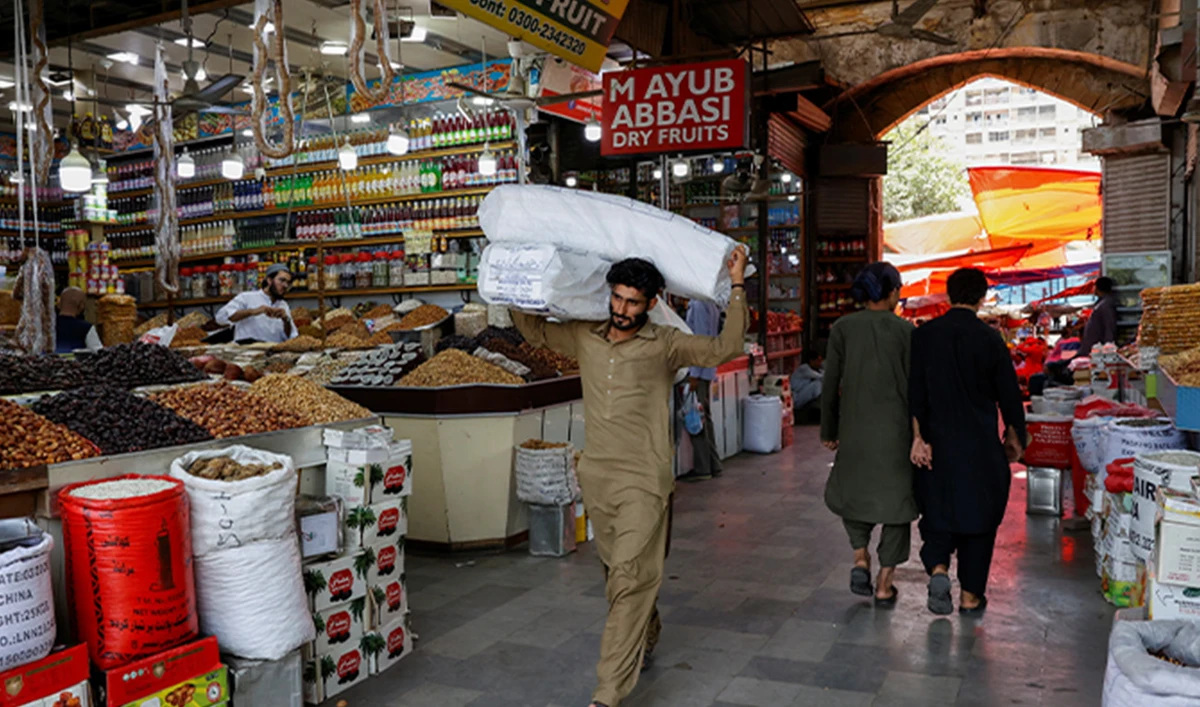
A man walks with sacks of supplies on his shoulder to deliver to a nearby shop at a market in Karachi, Pakistan June 11, 2024. (Reuters/File)
Short Url
Updated 24 April 2025
Follow

World Bank projects 2.7 percent growth for Pakistan in FY2025

  • Pakistan must convert stabilization into durable growth, says World Bank director
  • Inflation drop to 1.5 percent in February supports signs of Pakistan’s economic recovery

ISLAMABAD: Pakistan’s economy is projected to grow by 2.7 percent in the fiscal year ending June 2025, the World Bank said on Wednesday, indicating signs of stabilization amid easing inflation and improved financial conditions.
The World Bank, in its latest report titled “Reimagining a Digital Pakistan,” said the real GDP growth is expected to benefit from a rebound in private consumption and investment, driven by easing inflation, lower interest rates and improving business confidence.
This improvement in Pakistan’s economy is supported by declining inflation, which fell to 1.5 percent in February, prompting the central bank to reduce its policy rate to 12 percent after a series of cuts totaling 1,000 basis points since June 2024.
Despite these positive indicators, the country faces significant external financing challenges, including over $22 billion in external debt repayments, highlighting the need for continued structural reforms and fiscal consolidation.
“Pakistan’s economy continues to stabilize and is expected to grow by 2.7 percent in the current fiscal year ending June 2025, up from 2.5 percent in the previous year,” the World Bank said.
It added that agricultural growth remained modest due to unfavorable weather conditions and pest outbreaks while industrial activity weakened due to rising input costs, increased taxation and cuts in government expenditure.
The report said growth in Pakistan’s services sector remained “muted” due to spillover effects from weak agricultural and industrial activity, which will make it challenging for the government to create jobs and reduce poverty.
“Pakistan’s key challenge is to transform recent gains from stabilization into economic growth that is sustainable and adequate for poverty reduction,” World Bank Country Director for Pakistan, Najy Benhassine, said.
“High-impact reforms to prioritize an efficient and progressive tax system, support a market-determined exchange rate, reduce import tariffs to boost exports, improve the business environment and streamline the public sector would signal strong reform commitment, build confidence, and attract investment.”
The report said real GDP growth was expected to rise to 3.1 percent in FY26 and 3.4 percent in FY27 due to the predicted ongoing macroeconomic stabilization and the implementation of key economic reforms.
“The April 2025 edition, Taxing Times, projects regional growth to slow to 5.8 percent in 2025 — 0.4 percentage points below October projections — before ticking up to 6.1 percent in 2026,” the World Bank said. “This outlook is subject to heightened risks, including from a highly uncertain global landscape, combined with domestic vulnerabilities including constrained fiscal space.”



Pakistan, China to sign multiple MoUs at major agriculture investment conference today

Updated 18 January 2026
Follow

Pakistan, China to sign multiple MoUs at major agriculture investment conference today

  • Hundreds of Chinese and Pakistani firms to attend Islamabad event
  • Conference seen as part of expanding CPEC ties into agriculture, trade

KARACHI: Islamabad and Beijing are set to sign multiple memorandums of understanding (MoUs) to boost agricultural investment and cooperation at a major conference taking place in the capital today, Monday, with hundreds of Chinese and Pakistani companies expected to participate.

The conference is being billed by Pakistan’s Ministry of National Food Security and Research as a platform for deepening bilateral agricultural ties and supporting broader economic engagement between the two countries.

“Multiple memorandums of understanding will be signed at the Pakistan–China Agricultural Conference,” the Ministry of National Food Security said in a statement. “115 Chinese and 165 Pakistani companies will participate.”

The conference reflects a growing emphasis on expanding Pakistan-China economic cooperation beyond the transport and energy foundations of the flagship China-Pakistan Economic Corridor (CPEC) into agriculture, industry and technology.

Under its first phase launched in 2015, CPEC, a core component of China’s Belt and Road Initiative, focused primarily on transportation infrastructure, energy generation and connectivity projects linking western China to the Arabian Sea via Pakistan. That phase included motorways, power plants and the development of the Gwadar Port in the country's southwest, aimed at helping Pakistan address chronic power shortages and enhance transport connectivity.

In recent years, both governments have formally moved toward a “CPEC 2.0” phase aimed at diversifying the corridor’s impact into areas such as special economic zones, innovation, digital cooperation and agriculture. Second-phase discussions have highlighted Pakistan’s goal of modernizing its agricultural sector, attracting Chinese technology and investment, and boosting export potential, with high-level talks taking place between planning officials and investors in Beijing.

Agri-sector cooperation has also seen practical collaboration, with joint initiatives examining technology transfer, export protocols and value-chain development, including partnerships in livestock, mechanization and horticulture.

Organizers say the Islamabad conference will bring together government policymakers, private sector investors, industry associations and multinational agribusiness firms from both nations. Discussions will center on investment opportunities, technology adoption, export expansion and building linkages with global buyers within the framework of Pakistan-China economic cooperation.