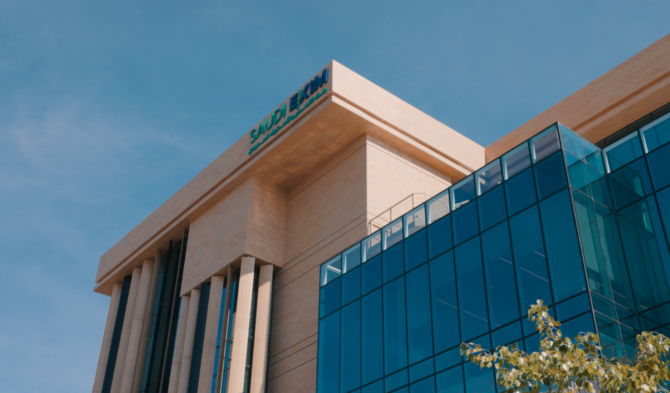

RIYADH: The Saudi Export-Import Bank more than doubled its credit facilities in 2024, reaching SR33.53 billion ($8.93 billion), as the Kingdom ramps up efforts to boost non-oil exports to international and high-potential markets.
The institution’s credit facilities rose 103.2 percent year on year, with disbursements for export financing reaching SR11.96 billion — up 70 percent from 2023. The value of exports covered by credit insurance also climbed 127 percent to SR21.57 billion over the same period, according to a statement.
This aligns with the bank’s goal to double the value of Saudi industrial exports from SR254 billion in 2022 to SR557 billion in 2030, and SR892 billion by 2035. It also reflects the financial entity’s mission to enable Saudi exports to reach global markets by bridging financing gaps and mitigating export risks.
Speaking at an event in Riyadh, EXIM Bank CEO Saad bin Abdulaziz Al-Khalb emphasized the growing need for specialized export financing institutions, citing the complexities of global supply chains and the limitations of traditional commercial banks in managing cross-border trade risk.
“He explained that credit operations differ from one country to another, therefore, the need arises for banks specialized in export and international credit operations to address this, and that commercial banks usually adhere to certain limits in accepting risks; this creates financing and insurance gaps that need to be filled, which is why countries have been forced to establish specialized export financing banks to fill these gaps,” the Saudi Press Agency reported.
At the 7th edition of the Knowledge Diwaniya, organized by the Ministry of Finance’s Mutamam Center, the CEO also noted that non-oil exports had grown by over 100 percent from 2020 to 2024, thanks to the support of the Kingdom’s leadership, and emphasized the bank’s role in enabling this growth.
The bank’s statement further revealed that, in 2024, its contribution to credit facilities for Saudi non-oil exports amounted to 7.66 percent, financing and insuring the export of Saudi non-oil products and services.
Additionally, the financial institution signed 30 financing and insurance agreements and 20 memoranda of understanding in 2024 to boost collaboration with global institutions. These included a letter of credit insurance agreement with Saudi Basic Industries Corp., the largest documentary credit insurance policy in the Middle East.
The bank also entered into a $300 million credit facility agreement with commodity firm Glencore and signed an MoU with the Export-Import Bank of the US.
Saudi EXIM also hosted the Berne Union Country Risk Specialists Meeting 2024 and launched the Kingdom’s first Graduate Development Program for Export Insurance.
Al-Khalb further clarified that the bank offers a comprehensive range of financing and insurance products covering local exporters, international buyers, global trading houses, and financial institutions worldwide.
He also noted that production input financing was introduced this year to support industrial facilities in the Kingdom by financing raw materials, production inputs, primary materials, semi-finished materials, and equipment.
These products have helped bridge the financing gaps left by commercial financial institutions and protect export parties from risks such as non-payment and market fluctuations.