

GAVI, Unicef supply refrigerated trucks to strengthen Pakistani children’s access to vaccines 

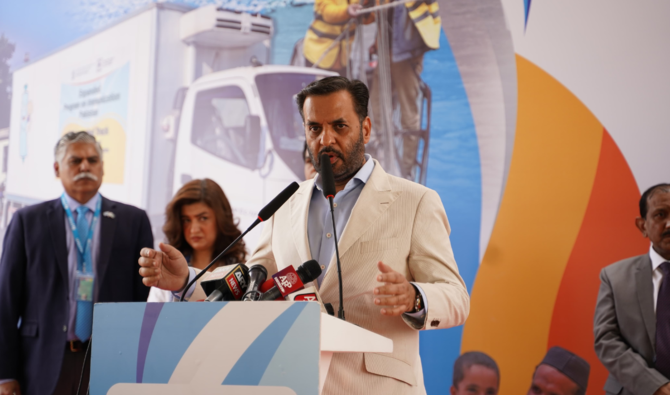
Federal Health Minister Syed Mustafa Kamal speaks at the handover ceremony of 31 refrigerated trucks by UNICEF and Gavi in Karachi, Pakistan on April 23, 2025. (GOP)
Short Url
Updated 23 April 2025
Follow

GAVI, Unicef supply refrigerated trucks to strengthen Pakistani children’s access to vaccines 

  • Five trucks to be allocated to each Pakistani province, says Health Minister Syed Mustafa Kamal
  • Harsh weather, difficult terrains and limited health care facilities complicate delivery of vaccines

ISLAMABAD: The United Nations International Children’s Emergency Fund (UNICEF) and global vaccine alliance Gavi have donated 31 refrigerated trucks to Pakistan, the country’s health ministry confirmed on Wednesday, in their bid to improve vaccine access for children in remote areas.

Children in Pakistan’s remote areas face considerable challenges in accessing vaccines. Many parts of the country, such as mountainous terrains in the north, desert areas in the south and conflict-affected zones lack proper road infrastructure and reliable transportation for vaccines. 

Refrigerated trucks, also known as cold chain vehicles, store vaccines in specific cold temperatures to ensure they do not lose their effectiveness. These trucks were provided through a collaborative effort between the Pakistani government, UNICEF and Gavi, the health ministry said. 

“UNICEF officially handed over 31 refrigerated trucks to the Federal Directorate of Immunization (FDI) in Islamabad today,” the Ministry of National Health Services Regulations and Coordination said. 

Health Minister Syed Mustafa Kamal and UNICEF’s representative in Pakistan, Abdullah Fadil, took part in a ceremony during which the trucks were handed over to Pakistan. 

The ministry quoted Kamal as saying that five refrigerated trucks would be allocated to each province of the country.

“These new refrigerated vehicles will significantly strengthen access to life-saving vaccines for children across Pakistan, including the remote regions of Gilgit-Baltistan and other hard-to-reach areas,” he said. 

Kamal also spoke about Pakistan’s ongoing national anti-polio drive, which began on Apr. 21 and will run for seven days. Over 450,000 frontline workers are taking part in the drive. 

The health minister expressed concern over parents’ growing refusals for polio drops and directed authorities to file a police report against vaccine refusers.

“Every child has the right to be protected from preventable diseases,” UNICEF’s Fadil was quoted as saying. “By safeguarding vaccine potency through a strengthened cold chain, we are making strides toward a healthier Pakistan where every child is fully immunized.”

The health ministry said UNICEF, with support from Gavi, was also providing technical assistance to improve vaccine micro plans, cold chain system strengthening and real-time monitoring.

This latest initiative builds upon ongoing support for vaccine access in Pakistan, which included the delivery of 23 refrigerated vehicles in 2021 and seven pick-up trucks earlier this year. 


Curfew extended in Gilgit-Baltistan, probe ordered after deadly Khamenei protests

Updated 03 March 2026
Follow

Curfew extended in Gilgit-Baltistan, probe ordered after deadly Khamenei protests

  • At least 15 people were killed in clashes with law enforcement agencies over the weekend in Gilgit-Baltistan
  • Government also announces a de-weaponization campaign, crackdown on hate speech and cybercrime in region

ISLAMABAD: The government in Pakistan’s Gilgit-Baltistan (GB) region on Tuesday extended a curfew in Gilgit district and ordered a judicial probe into violent protests over the killing of Iranian Supreme Leader Ali Khamenei in US-Israeli strikes last week, an official said.

At least 15 people were killed in clashes with law enforcement agencies over the weekend in GB, where protesters torched and vandalized several buildings, including United Nations regional offices, an army-run school, software technology park and a local charity building.

The violence prompted regional authorities to impose curfew in Gilgit and Skardu districts on March 2-4 as officials urged people to stay indoors and cooperate with law enforcers, amid widespread anger in Pakistan, particularly among members of the Shiite minority, over Khamenei’s killing.

On Tuesday, the GB government convened to review the situation and announced the extension of curfew in Gilgit among a number of security measures as well as ordered the establishment of a judicial commission to investigate the weekend violence in the region.

“The government has made it clear that the law will strictly take its course against elements involved in vandalism at government institutions, private properties and incidents of vandalism in Gilgit and Skardu and no kind of mischief will be tolerated,” Shabbir Mir, a GB government spokesperson, said in a statement.

“In view of the security situation, curfew will remain in force in Gilgit, while the decision to extend the curfew in Skardu will be taken keeping the ground realities and the changing situation in view.”

The statement did not specify how long the curfew will remain in place in Gilgit.

Besides the formation of the judicial commission to investigate the violent clashes, the government also decided to launch a large-scale de-weaponization campaign in the entire Gilgit district, for which relevant institutions have been directed to immediately complete all necessary arrangements, according to Mir.

In addition, a crackdown has been ordered on hate speech, spread of fake news and cybercrime.

“The aim of these decisions is to ensure the rule of law, protect the lives and property of citizens and crack down on miscreants,” he said. “Approval has also been given to immediately survey the affected infrastructure and start their restoration work on priority basis.”

Demonstrators in Pakistan’s southern port city of Karachi also stormed the US Consulate on Sunday, smashing windows and attempting to burn the building. Police responded with batons, tear gas, and gunfire, leaving 10 people dead and more than 50 injured.

Pakistani authorities have since beefed up security at US diplomatic missions across the country, including around the US consulate building in Peshawar, to avoid any further violence.