

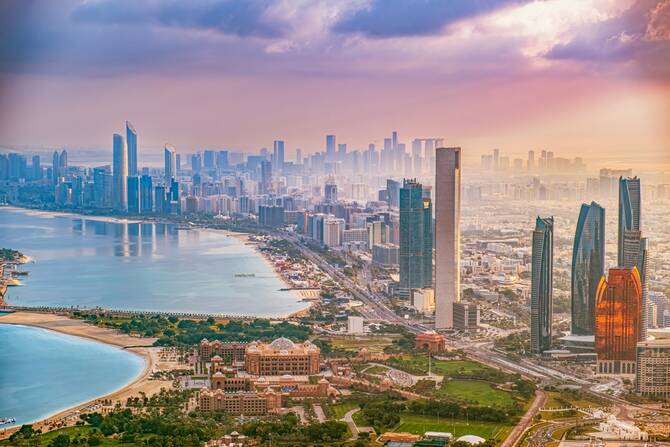
Abu Dhabi property market sees Q1 growth as investor demand holds strong 

Abu Dhabi’s performance mirrors the broader UAE real estate market. Shutterstock
Short Url
Updated 23 April 2025
Follow

Abu Dhabi property market sees Q1 growth as investor demand holds strong 

RIYADH: Abu Dhabi recorded strong real estate activity in the first quarter of 2025, with continued price growth and investor demand following 28,249 transactions worth 96.2 billion dirhams ($26.2 billion) in 2024. 

A new market report by Bayut noted that the momentum from 2024 — marked by a 24.2 percent year-on-year increase in transactions — was driven by capital appreciation, competitive yields, and the emirate’s rising profile as a high-return investment destination. 

Abu Dhabi’s performance mirrors the broader UAE real estate market, which has shown resilience amid global headwinds, supported by population growth, regulatory reforms, and sustained foreign investor interest. 

Haider Ali Khan, CEO of Bayut, said: “Abu Dhabi’s real estate sector in 2025 continues to build on last year’s strong momentum, remaining an attractive destination for global investors.” 

He added: “The influx of capital from sovereign wealth funds and the growing entrepreneurial landscape are driving renewed interest in the emirate.” 

Khan, who is also the head of Dubizzle Group MENA and a board member of the Dubai Chamber of Digital Economy, said that with over 30 new projects launched, 7.8 billion dirhams in foreign investment recorded in 2024, and an increased focus on transactions, “Abu Dhabi is establishing itself as a smart, future-ready hub for property investment.” 

Affordable areas such as Al Reef, Al Ghadeer, Khalifa City, and Al Shamkha remained popular with cost-conscious buyers, while mid-market hubs like Al Reem Island and Masdar City offered value with amenities, the report noted. 

High-net-worth buyers focused on Saadiyat Island, Yas Island, and Al Raha Beach. Luxury prices climbed between 2 and 7 percent in the first quarter, with Yas Island leading gains at 6.57 percent. Al Samha posted the highest increase in mid-tier apartment prices at 7.2 percent while affordable segment prices rose up to 2 percent. 

Rental yields remained attractive, with Al Ghadeer and Al Reef leading the affordable segment at 9.95 percent and 8.38 percent respectively, while Al Reem Island and Masdar City posted yields between 5.57 and 7.6 percent, the report noted. 

Off-plan developments also saw strong demand, with Bloom Living and Al Reeman 1 attracting budget-conscious buyers, while Saadiyat Cultural District and Yas Beach Residences remained popular among luxury investors. 


Gulf-EU value chain integration signals shift toward long-term economic partnership: GCC secretary general

Updated 5 sec ago
Follow

Gulf-EU value chain integration signals shift toward long-term economic partnership: GCC secretary general

RIYADH: Value chains between the Gulf and Europe are poised to become deeper and more resilient as economic ties shift beyond traditional trade toward long-term industrial and investment integration, according to the secretary general of the Gulf Cooperation Council.

Speaking on the sidelines of the World Governments Summit 2026 in Dubai, Jasem Al-Budaiwi said Gulf-European economic relations are shifting from simple commodity trade toward the joint development of sustainable value chains, reflecting a more strategic and lasting partnership.

His remarks were made during a dialogue session titled “The next investment and trade race,” held with Luigi Di Maio, the EU’s special representative for external affairs.

Al-Budaiwi said relations between the GCC and the EU are among the bloc’s most established partnerships, built on decades of institutional collaboration that began with the signing of the 1988 cooperation agreement.

He noted that the deal laid a solid foundation for political and economic dialogue and opened broad avenues for collaboration in trade, investment, and energy, as well as development and education.

The secretary general added that the partnership has undergone a qualitative shift in recent years, particularly following the adoption of the joint action program for the 2022–2027 period and the convening of the Gulf–European summit in Brussels.

Subsequent ministerial meetings, he said, have focused on implementing agreed outcomes, enhancing trade and investment cooperation, improving market access, and supporting supply chains and sustainable development.

According to Al-Budaiwi, merchandise trade between the two sides has reached around $197 billion, positioning the EU as one of the GCC’s most important trading partners.

He also pointed to the continued growth of European foreign direct investment into Gulf countries, which he said reflects the depth of economic interdependence and rising confidence in the Gulf business environment.

Looking ahead, Al-Budaiwi emphasized that the economic transformation across GCC states, driven by ambitious national visions, is creating broad opportunities for expanded cooperation with Europe. 

He highlighted clean energy, green hydrogen, and digital transformation, as well as artificial intelligence, smart infrastructure, and cybersecurity, as priority areas for future partnership.

He added that the success of Gulf-European cooperation should not be measured solely by trade volumes or investment flows, but by its ability to evolve into an integrated model based on trust, risk-sharing, and the joint creation of economic value, contributing to stability and growth in the global economy.

GCC–EU plans to build shared value chains look well-timed as trade policy volatility rises.

In recent weeks, Washington’s renewed push over Greenland has been tied to tariff threats against European countries, prompting the EU to keep a €93 billion ($109.7 billion) retaliation package on standby. 

At the same time, tighter US sanctions on Iran are increasing compliance risks for energy and shipping-related finance. Meanwhile, the World Trade Organization and UNCTAD warn that higher tariffs and ongoing uncertainty could weaken trade and investment across both regions in 2026.