ISTANBUL: An earthquake with a preliminary magnitude of 6.2 shook Istanbul and other areas Wednesday, prompting widespread panic and scores of injuries in the Turkish city of 16 million people, though there were no immediate reports of serious damage.
More than 150 people were hospitalized with injuries sustained while trying to jump from buildings, said the governor’s office in Istanbul, where residents are on tenterhooks because the city is considered at high risk for a major quake.
The earthquake had a shallow depth of 10 kilometers (about 6 miles), according to the United States Geological Survey, with its epicenter about 40 kilometers (25 miles) southwest of Istanbul, in the Sea of Marmara.
It was felt in the neighboring provinces of Tekirdag, Yalova, Bursa and Balikesir and in the city of Izmir, some 550 kilometers (340 miles) south of Istanbul. Interior Minister Ali Yerlikaya said the earthquake lasted 13 seconds and was followed by more than 50 aftershocks — the strongest measuring 5.9.
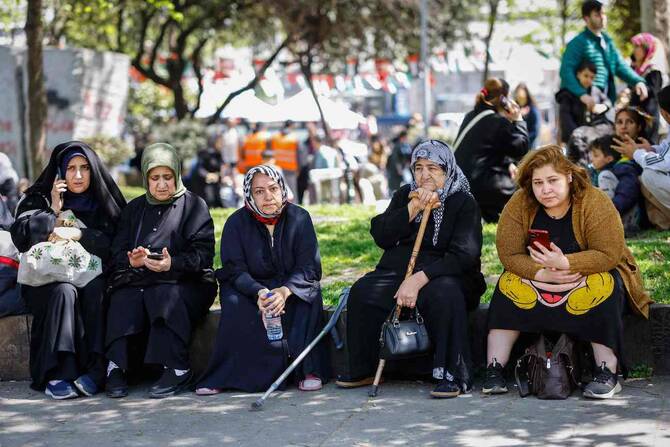
The quake started at 12:49 p.m. during a public holiday when many children were out of school and celebrating in the streets of Istanbul. Panicked residents rushed from their homes and buildings into the streets. The disaster and emergency management agency urged people to stay away from buildings.
More than 150 injured
“Due to panic, 151 of our citizens were injured from jumping from heights,” the Istanbul governor’s office said in a statement. “Their treatments are ongoing in hospitals, and they are not in life-threatening condition.”
Many residents flocked to parks, school yards and other open areas to avoid being near buildings in case of collapse or subsequent earthquakes. Some people pitched tents in parks.
“Thank God, there does not seem to be any problems for now,” President Recep Tayyip Erdogan said at an event marking the National Sovereignty and Children’s Day holiday. “May God protect our country and our people from all kinds of calamities, disasters, accidents and troubles.”
Leyla Ucar, a personal trainer, said she was exercising with her student on the 20th floor of a building when they felt intense shaking.
“We shook incredibly. It threw us around, we couldn’t understand what was happening, we didn’t think of an earthquake at first because of the shock of the event,” she said. “It was very scary.”
Senol Sari, 51, told The Associated Press he was with his children in the living room of their third floor apartment when he heard a loud noise and the building started shaking. They fled to a nearby park. “We immediately protected ourselves from the earthquake and waited for it to pass,” Sari said. “Of course, we were scared.”
They later were able to return home calmly, Sari said, but they remain worried that a bigger quake will some day strike the city. It’s “an expected earthquake, our concerns continue,” he said.
‘My children were a little scared’
Cihan Boztepe, 40, was one of many who hurriedly fled to the streets with his family in order to avoid a potential collapse. Boztepe, standing next to his sobbing child, told AP that in 2023 he was living in Batman province, an area close to the southern part of Turkiye where major quakes struck at the time, and that Wednesday’s tremor felt weaker and that he wasn’t as scared.
“At first we were shaken, then it stopped, then we were shaken again. My children were a little scared, but I wasn’t. We quickly gathered our things and went down to a safe place. If it were up to me, we would have already returned home.”
Turkiye’s Interior Minister Ali Yerlikaya said authorities had not received reports of collapsed buildings. He told HaberTurk television that there had been reports of damage to buildings.
The NTV broadcaster reported that a derelict and abandoned former residential building had collapsed in the historic Fatih district, which houses the Blue Mosque and the Hagia Sophia Grand Mosque.
Education Minister Yusuf Tekin announced that schools would be closed on Thursday and Friday in Istanbul.
“In line with the need for a safe space, our school gardens are open to the use of all our citizens,” Tekin said.
Urban reconstruction projects
Turkiye is crossed by two major fault lines, and earthquakes are frequent.
A magnitude 7.8 earthquake on Feb. 6, 2023, and a second powerful tremor hours later, destroyed or damaged hundreds of thousands of buildings in 11 southern and southeastern provinces, leaving more than 53,000 people dead. Another 6,000 people were killed in the northern parts of neighboring Syria.
Istanbul was not impacted by that earthquake, but the devastation heightened fears of a similar quake, with experts citing the city’s proximity to fault lines.
In a bid to prevent damage from any future quake, the national government and local administrations started urban reconstruction projects to fortify buildings at risk and launched campaigns to demolish buildings at risk of collapse.
On Wednesday, long queues formed at gas stations as residents, planning to leave Istanbul, rushed to fill up their vehicles. Among them was Emre Senkay who said he might leave in the event of a more severe earthquake later in the day.
“My plan is to leave Istanbul if there is a more serious earthquake,” he said.


![]()

Earthquake measuring 6.2 shakes Istanbul, injures more than 150 people
Short Url
https://arab.news/ymzwn
Earthquake measuring 6.2 shakes Istanbul, injures more than 150 people
- Quake started at 12:49 p.m. during a public holiday when many children were out of school and celebrating in the streets of Istanbul
- “Due to panic, 151 of our citizens were injured from jumping from heights,” the Istanbul governor’s office said in a statement


Latest updates


© 2026 SAUDI RESEARCH & PUBLISHING COMPANY, All Rights Reserved And subject to Terms of Use Agreement.