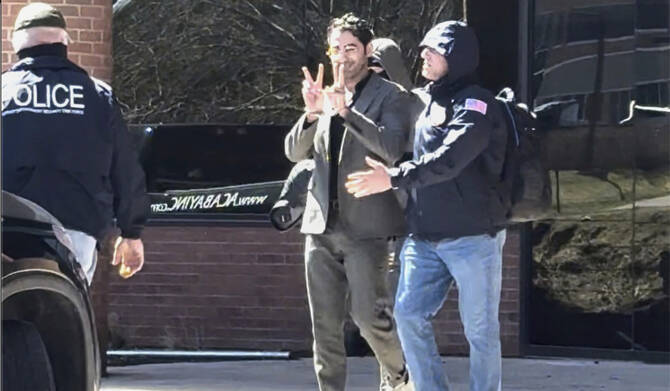
VERMONT, USA: A Palestinian man who led protests against the war in Gaza as a student at Columbia University and was recently arrested during an interview about finalizing his US citizenship says he’s “in good hands” at the Vermont prison where he is being held.
Mohsen Mahdawi, a legal permanent resident, was arrested April 14 in Colchester, Vermont. He met Monday with US Sen. Peter Welch of Vermont, a Democrat, who posted it on X.
“I’m staying positive by reassuring myself in the ability of justice and the deep belief of democracy,” Mahdawi said in Welch’s video. “This is the reason I wanted to become a citizen of this country, because I believe in the principles of this country.”
Welch’s office said Mahdawi was being detained at the Northwest State Correctional Facility in St. Albans, Vermont. His case is scheduled for a status conference Wednesday. His lawyers have called for his release.
The US Justice Department has not said why he’s being detained. The New York Times reported April 15 that Secretary of State Marco Rubio wrote a memo that says Mahdawi’s activities could “potentially undermine” the Middle East peace process.
“We do not comment on on any ongoing litigation,” the State Department press office said in response to an email seeking comment.
Rubio has cited a rarely used statute to justify the deportation of Columbia University graduate student Mahmoud Khalil. It gives Rubio power to deport those who pose “potentially serious adverse foreign policy consequences for the United States.”
An immigration judge ruled April 11 that Khalil can be forced out of the country as a national security risk, after lawyers argued the legality of deporting the activist who participated in pro-Palestinian demonstrations. His lawyers plan to appeal.
Mahdawi said that in studying for his citizenship test, he learned “that the freedom of speech and religion and assembly is guaranteed to everyone in the United States, which is part of the foundation of this country.”
Mahdawi said his work “has been centered on peacemaking.”
“My empathy, as I mentioned before, extends beyond the Palestinian people and my empathy extends to the Jews and to the Israelis,” he said. “And my hope and my dream is to see this conflict, if one might say, to see an end to the war, an end to the killing, to see a peaceful resolution between Palestinians and Israelis. How could this be a threat to anybody, except the war machine that is feeding this?”
Welch responded, “It would be good for everybody for us to have peace.”
Mahdawi said, “I want to tell everyone that I feel so loved and so supported. And I am here in good hands. I am centered, I am clear, I am grounded. And I don’t want you to worry about me.”
According to the court filing, Mahdawi was born in a refugee camp in the West Bank and moved to the United States in 2014. He recently completed coursework at Columbia and was expected to graduate in May before beginning a master’s degree program there in the fall.
As a student, Mahdawi was an outspoken critic of Israel’s military campaign in Gaza and organized campus protests until March 2024.


![]()

Detained Palestinian activist in Vermont prison says he’s ‘in good hands,’ focused on peacemaking
Short Url
https://arab.news/58jrg
Detained Palestinian activist in Vermont prison says he’s ‘in good hands,’ focused on peacemaking
- “I’m staying positive by reassuring myself in the ability of justice and the deep belief of democracy,” Mahdawi said
- The US Justice Department has not said why he’s being detained


Latest updates


© 2026 SAUDI RESEARCH & PUBLISHING COMPANY, All Rights Reserved And subject to Terms of Use Agreement.