

Many feared dead in gun attack on tourists in Indian-administered Kashmir

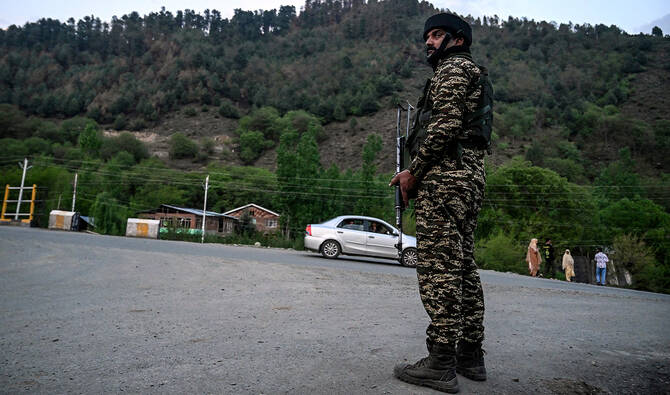
An Indian paramilitary personnel stands guard following an attack by a gunman near Pahalgam, south of Srinagar, on April 22, 2025. (AFP)
Short Url
Updated 22 April 2025
Follow

Many feared dead in gun attack on tourists in Indian-administered Kashmir

  • Initial reports say shots fired at mostly Indian tourists visiting Baisaran meadow
  • Attack much larger than anything directed at civilians in recent years, says official

SRINAGAR, India: Many people are feared to have died after gunmen indiscriminately fired at tourists in Indian-controlled Kashmir on Tuesday, officials said.

Police have described the incident as a “terror attack” and blamed militants fighting against Indian rule.

“This attack is much larger than anything we’ve seen directed at civilians in recent years,” Omar Abdullah, the region’s top elected official, wrote on social media.

“The death toll is still being ascertained so I don’t want to get into those details,” he said.

Initial reports said shots were fired at mostly Indian tourists visiting Baisaran meadow, some 5 kilometers (3 miles) from the disputed region’s resort town of Pahalgam.

Police and officials said tourists with gunshot wounds were evacuated to local hospitals.

The scene of the attack was cordoned off as police launched an operation to track down the attackers.

India’s home minister, Amit Shah, is heading to Srinagar, the main city in Indian-controlled Kashmir, where he said he would review the situation. Prime Minister Narendra Modi, who is on an official visit in Saudi Arabia, has been briefed about the incident, Shah said.

“We will come down heavily on the perpetrators with the harshest consequences,” Shah wrote in a post on the X social media platform.

Mirwaiz Umar Farooq, a key Kashmiri resistance leader, condemned what he described as a “cowardly attack on tourists.”

“Such violence is unacceptable and against the ethos of Kashmir which welcomes visitors with love and warmth. Condemn it strongly,” he wrote on X.

The attack coincided with the visit to India of US Vice President JD Vance, who is on a largely personal four-day visit.

The meadow in Pahalgam is a popular sightseeing destination, surrounded by snow-capped mountains and dotted with pine forests. It is visited by hundreds of tourists every day.

Nuclear-armed rivals India and Pakistan each administer part of Kashmir, but both claim the territory in its entirety.

Tuesday’s attack seems to be a major shift in the regional conflict where tourists for many years have largely been spared from violence despite a spate of targeted killings of Hindus, including immigrant workers from Indian states, after New Delhi ended the region’s semi-autonomy in 2019 and drastically curbed dissent, civil liberties and media freedoms.

Tensions have been simmering ever since as India has intensified its counterinsurgency operations.

The region, known for rolling Himalayan foothills, exquisitely decorated houseboats and pristine meadows, has also become a major domestic tourist destination, with hotels booked out for months. Kashmir has also drawn millions of visitors, who enjoy a strange peace kept by ubiquitous security checkpoints, armored vehicles and patrolling soldiers.

Although violence has ebbed in recent times in Kashmir Valley, the heart of anti-India rebellion, fighting between government forces and rebels has largely shifted to remote areas of Jammu region including Rajouri, Poonch and Kathua, where Indian troops have faced deadly attacks.

Militants in the Indian-controlled portion of Kashmir have been fighting New Delhi’s rule since 1989. Many Muslim Kashmiris support the rebels’ goal of uniting the territory, either under Pakistani rule or as an independent country.

India insists the Kashmir militancy is Pakistan-sponsored “terrorism.” Pakistan denies the charge, and many Kashmiris consider it a legitimate freedom struggle. Tens of thousands of civilians, rebels and government forces have been killed in the conflict.


Carney says Canada has no plans to pursue free trade agreement with China as Trump threatens tariffs

Updated 26 January 2026
Follow

Carney says Canada has no plans to pursue free trade agreement with China as Trump threatens tariffs

TORONTO: Canadian Prime Minister Mark Carney said Sunday his country has no intention of pursuing a free trade deal with China. He was responding to US President Donald Trump’s threat to impose a 100 percent tariff on goods imported from Canada if America’s northern neighbor went ahead with a trade deal with Beijing.
Carney said his recent agreement with China merely cuts tariffs on a few sectors that were recently hit with tariffs.
Trump claims otherwise, posting that “China is successfully and completely taking over the once Great Country of Canada. So sad to see it happen. I only hope they leave Ice Hockey alone! President DJT”
The prime minister said under the free trade agreement with the US and Mexico there are commitments not to pursue free trade agreements with nonmarket economies without prior notification.
“We have no intention of doing that with China or any other nonmarket economy,” Carney said. “What we have done with China is to rectify some issues that developed in the last couple of years.”
In 2024, Canada mirrored the United States by putting a 100 percent tariff on electric vehicles from Beijing and a 25 percent tariff on steel and aluminum. China had responded by imposing 100 percent import taxes on Canadian canola oil and meal and 25 percent on pork and seafood.
Breaking with the United States this month during a visit to China, Carney cut its 100 percent tariff on Chinese electric cars in return for lower tariffs on those Canadian products.
Carney has said there would be an initial annual cap of 49,000 vehicles on Chinese EV exports coming into Canada at a tariff rate of 6.1 percent, growing to about 70,000 over five years. He noted there was no cap before 2024. He also has said the initial cap on Chinese EV imports was about 3 percent of the 1.8 million vehicles sold in Canada annually and that, in exchange, China is expected to begin investing in the Canadian auto industry within three years.
Trump posted a video Sunday in which the chief executive of the Canadian Vehicle Manufacturers’ Association warns there will be no Canadian auto industry without US access, while noting the Canadian market alone is too small to justify large scale manufacturing from China.
“A MUST WATCH. Canada is systematically destroying itself. The China deal is a disaster for them. Will go down as one of the worst deals, of any kind, in history. All their businesses are moving to the USA. I want to see Canada SURVIVE AND THRIVE! President DJT,” Trump posted on social media.
Trump’s post on Saturday said that if Carney “thinks he is going to make Canada a ‘Drop Off Port’ for China to send goods and products into the United States, he is sorely mistaken.”
“We can’t let Canada become an opening that the Chinese pour their cheap goods into the U.S,” US Treasury Secretary Scott Bessent said on ABC’s “This Week.”
“We have a , but based off — based on that, which is going to be renegotiated this summer, and I’m not sure what Prime Minister Carney is doing here, other than trying to virtue-signal to his globalist friends at Davos.”
Trump’s threat came amid an escalating war of words with Carney as the Republican president’s push to acquire Greenland strained the NATO alliance.
Carney has emerged as a leader of a movement for countries to find ways to link up and counter the US under Trump. Speaking in Davos before Trump, Carney said, “Middle powers must act together because if you are not at the table, you are on the menu” and he warned about coercion by great powers — without mentioning Trump’s name. The prime minister received widespread praise and attention for his remarks, upstaging Trump at the World Economic Forum.
Trump’s push to acquire Greenland has come after he has repeatedly needled Canada over its sovereignty and suggested it also be absorbed into the United States as a 51st state. He posted an altered image on social media this week showing a map of the United States that included Canada, Venezuela, Greenland and Cuba as part of its territory.