KYIV: The Kremlin on Tuesday warned against rushing Ukraine peace talks, pushing back on US President Donald Trump’s hopes for a speedy deal the day before Ukraine’s allies are set to meet in London.
Trump, who promised on the campaign trail to strike a deal between Moscow and Kyiv in 24 hours, has in three months failed to wrangle concessions from Russian President Vladimir Putin to halt his invasion.
The Republican had said over the weekend he hoped a peace deal could be struck “this week” despite no signs the two sides are anywhere close to agreeing even a ceasefire, let alone a wider long-term settlement.
Moscow’s forces occupy around a fifth of Ukrainian territory and tens of thousands have been killed since they invaded in February 2022.
“This topic is so complex, connected with a settlement, that, of course, probably it is not worth setting any rigid time frames and trying to get a settlement, a viable settlement, in a short-time frame,” Kremlin spokesman Dmitry Peskov told state TV on Tuesday.
After rejecting a US-Ukrainian offer for a full and unconditional ceasefire last month, Putin announced a surprise Easter truce over the weekend.
Fighting dipped during the 30-hour period but Russia launched fresh attacks on residential areas on Monday and Tuesday, Ukrainian officials said.
Kyiv and its allies dismissed the truce as a PR exercise from Putin.
“The Easter truce that he announced somewhat unexpectedly was a marketing operation, a charm operation aimed at preventing President Trump from becoming impatient and angry,” French Foreign Minister Jean-Noel Barrot told the FranceInfo broadcaster.
Ukraine’s allies will meet in London on Wednesday, a senior Kyiv official told AFP, where they are expected to continue discussions on the contours of a possible deal they could all get behind.
European leaders are scrambling to work out how they can support Ukraine should Trump pull Washington’s vital military and financial backing.
Ukrainian President Volodymyr Zelensky said his team’s “first priority” at the London talks would be the idea of “an unconditional ceasefire.”
Zelensky proposed to Russia on Sunday halting missile and drones strikes against civilian facilities for at least 30 days.
While saying he would “analyze” the idea, Putin threw doubt on it 24 hours later by accusing Kyiv of using civilian facilities for military purposes.
He held open the prospect of bilateral talks on the topic, though the Kremlin said there were no fixed plans to engage with Kyiv.
“There are no concrete plans (to talk), there is readiness from Putin to discuss this question,” Putin’s spokesman Dmitry Peskov told reporters on Tuesday.
“If we are talking about civilian infrastructure, then we need to understand, when is it civilian infrastructure and when is it a military target,” he added.
The talks in London — a follow-up to a meeting in Paris last week — come after Russia resumed its aerial attacks.
Russia hit the southern city of Zaporizhzhia with “two guided aerial bombs” on Tuesday, killing one and wounding 23, the regional head said.
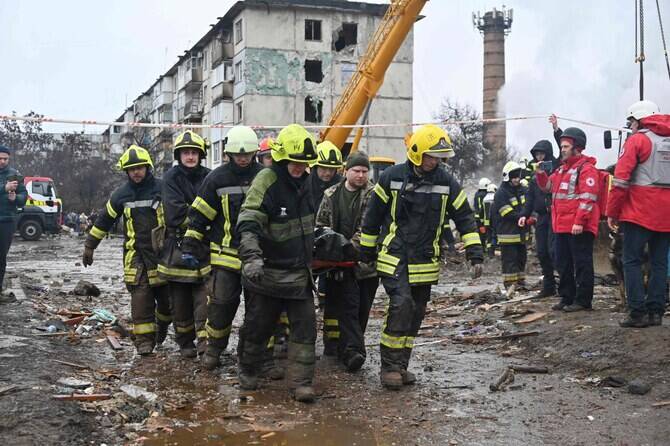
Photos from Ukraine’s emergency services showed the outer walls of an apartment block blown open and a bloodied man being tended to by medics on a stretcher, with bandages around his head and arms.
“One guided aerial bomb hit an infrastructure facility, another one hit a densely populated neighborhood, a residential building directly,” Zaporizhzhia Governor Ivan Fedorov said on Telegram.
Russian strikes wounded another six in the southern city of Kherson and seven in Kharkiv, in the north east.
Its army also claimed to have captured a small village in the eastern Donetsk region, where its troops are advancing.
In Paris last week, US Secretary of State Marco Rubio presented Washington’s plan for ending the war, before both he and Trump warned Washington’s patience was running thin and could lead it to withdraw.
Many in Ukraine fear any settlement he brokers could reward Russian aggression.


![]()

Kremlin warns against rushing Ukraine talks
Short Url
https://arab.news/pw9fn
Kremlin warns against rushing Ukraine talks
- “This topic is so complex, connected with a settlement, that, of course, probably it is not worth setting any rigid time frames and trying to get a settlement,” Peskov said
- Ukrainian President Volodymyr Zelensky said his team’s “first priority” at the London talks would be the idea of “an unconditional ceasefire“


Latest updates


© 2026 SAUDI RESEARCH & PUBLISHING COMPANY, All Rights Reserved And subject to Terms of Use Agreement.