Jerusalem patriarch hails pope’s commitment to Gaza

1 / 2
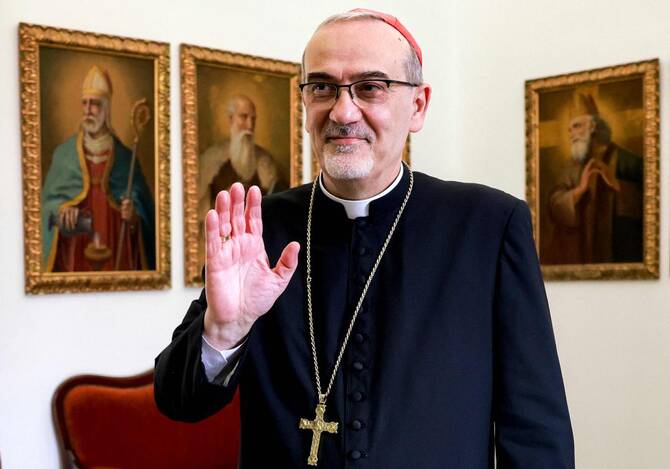
Cardinal Pierbattista Pizzaballa, Latin Patriarch of Jerusalem, gives a press conference at the patriarchate headquarters in the old city of Jerusalem on April 22, 2025. (AFP)
2 / 2
Cardinal Pierbattista Pizzaballa, Latin Patriarch of Jerusalem, gestures during a press conference at the patriarchate headquarters in the old city of Jerusalem on April 22, 2025. (AFP)
Short Url
Updated 23 April 2025
Follow

Jerusalem patriarch hails pope’s commitment to Gaza

  • Patriarch thanked numerous Palestinian and Israeli public figures who offered condolences, did not comment on lack of any official message from Netanyahu

JERUSALEM: The Latin patriarch of Jerusalem, Archbishop Pierbattista Pizzaballa, on Tuesday hailed Pope Francis’s support for Gazans and engagement with the small Catholic community in the war-battered Palestinian territory.
The Catholic church’s highest authority in the region, who is considered a potential successor to the late pontiff, Pizzaballa told journalists in Jerusalem that “Gaza represents, a little bit, all what was the heart of his pontificate.”
Pope Francis, who died on Monday aged 88, advocated peace and “closeness to the poor... and to the neglected one,” said the patriarch.
These positions became particularly evident in Francis’s response to the Israel-Hamas war which broke out in October 2023, Pizzaballa said.
“He was very close to the community of Gaza, the parish of Gaza, he kept calling them many times — for a certain period, also every day, every evening at 7 pm,” said the patriarch.
He added that by doing so, the pope “became for the community something stable, and also comforting for them, and he knew this.”
Out of the Gaza Strip’s 2.4 million people, about 1,000 are Christians. Most of them are Orthodox, but according to the Latin Patriarchate, there are about 135 Catholics in the territory.
Since the early days of the war, members of the Catholic community have been sheltering at Holy Family Church compound in Gaza City, and some Orthodox Christians have also found refuge there.
Pope Francis repeatedly called for an end to the war. The day before his death, in a final Easter message delivered on Sunday, he condemned the “deplorable humanitarian situation” in the besieged territory.
“Work for justice... but without becoming part of the conflict,” said Pizzaballa of the late pontiff’s actions.
“For us, for the Church, it leaves an important legacy.”
The patriarch thanked the numerous Palestinian and Israeli public figures who have offered their condolences, preferring not to comment on the lack of any official message from Israel’s Prime Minister Benjamin Netanyahu.
Even as “the local authorities... were not always happy” with the pope’s positions or statements, they were “always very respectful,” he said.
Pizzaballa said he will travel to Rome on Wednesday, after leading a requiem mass for the pope at the Church of the Holy Sepulchre in Jerusalem in the morning.
As one of the 135 cardinal electors, the Latin patriarch will participate in the conclave to elect a new pope.
Pizzaballa, a 60-year-old Italian Franciscan who also speaks English and Hebrew, arrived in Jerusalem in 1990 and was made a cardinal in September 2023, just before the Gaza war began.
His visits to Gaza and appeals for peace since then have attracted international attention.


A history of strikes on Iran from 1980 to 202

Updated 8 sec ago
Follow

A history of strikes on Iran from 1980 to 202

  • From Operation Ajax in 1953 to Epic Fury yesterday, US-Iran tensions have repeatedly spilled into open conflict
  • The latest joint Israeli-US strikes mark a turning point in a rivalry that dates back to the 1979 Islamic Revolution

LONDON: The war that generations of diplomats, generals and spies had tried to avoid began on Saturday morning, when waves of US and Israeli aircraft and missiles struck targets across Iran, including in Kermanshah, Qom, Isfahan, Tabriz and Karaj, in what President Donald Trump called a “massive and ongoing” campaign.

For nearly half a century, the US and Iran have circled each other through covert action, proxy wars, sanctions and sporadic clashes, but never tipping into open conflict. That balance has now collapsed.

Ajax, Eagle Claw, Nimble Archer, Prime Chance, Praying Mantis, Midnight Hammer and now – in collaboration with Israel’s own Operation Lion’s Roar – Operation Epic Fury.

There has been no shortage of US military operations against Iran or Iranian forces in the Gulf ever since the two countries became sworn enemies following the overthrow of the pro-Western Shah by the Islamic Revolution in 1979.

The seeds of that revolution, and the subsequent emergence of Iran as a destructive force in the Middle East, were sown in 1953. Operation Ajax, a coup engineered by America’s CIA and the UK’s MI6, overthrew Iran’s democratically elected prime minister, Mohammed Mosaddegh, who had attempted to nationalize the British-owned Anglo-Persian Oil Company.

As part of that plot, America’s first attack on Iranian soil took place in August 1953 when, in a bid to stir up anti-Communist sentiment, CIA operatives bombed the home of a prominent Muslim in Tehran.

The coup, which led to the installation of the Shah, paved the way for the 1979 revolution, the return of Ayatollah Khomeini from exile and the foundation of the Islamic Republic of Iran.

America’s first military incursion followed shortly afterward. When news broke in 1980 that the deposed Shah had been flown to America for medical treatment, Iranian revolutionary students seized the US embassy in Tehran and held 52 Americans hostage for 444 days.

US President Jimmy Carter authorized an audacious rescue bid, Operation Eagle Claw, but it ended in disaster, thanks to poor planning and a collision between two US aircraft on the ground in central Iran, which cost the lives of eight US personnel.

It was President Ronald Reagan, Carter’s successor, who designated Iran as a state sponsor of terror following the bombing of a US base in Beirut in 1983 by Iran-backed Hezbollah, in which 241 US military personnel were killed.

Between 1987 and 1989, America and Iran came to blows several times in the Gulf during Operation Earnest Will, in which the US navy sought to protect tankers from Iranian attacks during the Iran-Iraq war.

The US Navy aircraft carrier USS Gerald R. Ford departs Souda Bay on the island of Crete on February 26, 2026, as part of the US military buildup in the Middle East. (AFP)

In a secret parallel operation, codenamed Prime Chance, US special forces attacked Iranian ships laying mines under cover of darkness, and in 1987 Operation Nimble Archer saw the US navy attack and destroy an Iranian oil platform.

The following year, two Iranian warships and three attack speedboats were sunk with the loss of 56 lives during Operation Praying Mantis (1988), launched in retaliation for the mining of a US frigate.

Also in 1988, the USS Vincennes, an American warship on patrol in the Gulf, shot down a civilian Iranian Airbus A300 on a scheduled flight to Dubai. All 290 people on board, including 65 children, were killed.

For the past 47 years, America’s main weapon against Iran has been sanctions. They were imposed for the first time in November 1979, during Carter’s presidency, in response to the takeover of the US embassy and the hostage crisis. Diplomatic ties between the US and Iran were severed the following year.

Sanctions targeted at Iran’s nuclear program and Tehran’s support for terrorist proxies, including Hamas and Hezbollah, were first imposed during Bill Clinton’s presidency in 1995.

The pressure was further increased by President Barack Obama between 2010 and 2013. But it was under his administration that, in 2015, the US agreed to ease sanctions in exchange for Iran signing up to the Joint Comprehensive Plan of Action, a deal under which it agreed to limit its nuclear program.

In May 2018, during his first presidency, President Donald Trump unilaterally withdrew the US from the JCPOA and imposed fresh sanctions on Iran.

In 2019, the Trump administration designated Iran’s Quds Force a terror organization. The following year, in the dying days of the first Trump presidency, the US killed Qassem Soleimani, the head of the organization, in a drone strike at Baghdad airport.

Trump returned to office in January 2025 and nuclear talks, mediated by Oman, began in April that year. The first round ended inconclusively. But on June 13, two days before the talks were due to resume, Israel launched a surprise attack on Iranian nuclear targets.

It was the beginning of the so-called Twelve Day War. On June 21 America joined the conflict, sending long-range bombers to hit targets including nuclear facilities at Fordow, Natanz and Isfahan in Operation Midnight Hammer.

Indirect talks between the two countries resumed in Muscat, Oman, on Feb. 6 this year, and continued in Geneva on Thursday.

They appeared to have gone well.

Afterward, Iranian Foreign Minister Abbas Araghchi said they had made “very good progress and entered into the elements of an agreement very seriously, both in the nuclear field and in the sanctions field.”

A US official described the talks as “positive,” and a further round was proposed for this week.

But for the past few weeks, even as the talks were under way, America had been assembling the largest force of warships and aircraft seen in the region since the invasion of Iraq in 2003.

On Friday, President Trump said he was not happy with the way the talks were going but implied they would continue. “We’ll see what happens,” he said. “We’re talking later.”

But the talking had stopped.

On Saturday morning, the world woke to the news that at 09:30 a.m. Tehran time, the US and Israel had launched Operation Epic Fury, a joint attack on Iran.