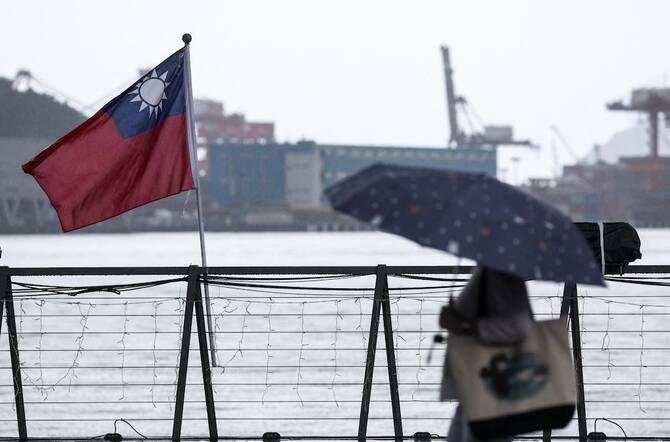
Taiwan cabinet to ask parliament to unfreeze $4bn amid budget standoff

Taiwan’s opposition has shown little appetite to seek compromise on the budget issue, which the government says could seriously affect their operations. (AFP)
Short Url
Updated 22 April 2025
Follow

Taiwan cabinet to ask parliament to unfreeze $4bn amid budget standoff

  • Cabinet spokesperson Michelle Lee says the government will ask parliament to unfreeze T$138.1 billion ($4.25 billion) in funds
  • Cabinet will also seek a legal interpretation from the constitutional court on both the constitutionality of the budget as passed by lawmakers

TAIPEI: Taiwan’s cabinet said on Tuesday it will ask the opposition controlled legislature to release more than $4 billion in funds frozen as part of a stand-off over this year’s budget, which the government says could seriously affect their operations.
While the Democratic Progressive Party’s (DPP) Lai Ching-te won the presidency in last year’s elections, the party lost its majority in parliament.
Taiwan’s main opposition party, the Kuomintang (KMT), along with the small Taiwan People’s Party (TPP), control the most seats, and earlier this year voted through sweeping cuts to 2025’s budget, saying they were targeting waste, and froze other funds saying they wanted greater oversight on spending plans.
In a statement, cabinet spokesperson Michelle Lee said the government will ask parliament to unfreeze T$138.1 billion ($4.25 billion) in funds.
The cabinet “hopes the Legislative Yuan can unfreeze it all in a short period of time to reduce the difficulties and inconveniences people have in their dealings with the administration,” Lee said, using parliament’s formal name.
The cabinet will also seek a legal interpretation from the constitutional court on both the constitutionality of the budget as passed by lawmakers, and a separate legal amendment granting more money to local governments at the expense of the central government, Lee added.
The defense ministry has warned of a “serious impact” to security from the amended budget, saying it will require a cut in defense spending of some T$80 billion at a time when the island is facing an elevated Chinese military threat.
Taiwan’s opposition has shown little appetite to seek compromise with the government on the budget issue, given they are angered at a campaign led by civic groups and backed by senior DPP officials to recall a swathe of opposition lawmakers.
The KMT and TPP chairmen met earlier on Tuesday vowing to redouble efforts to work together against the “green communists,” referring to the DPP’s party colors, and will hold a joint protest in front of the presidential office on Saturday.
“We don’t just want to take down Lai Ching-te, but the entire corrupt, arrogant and abusive system,” KMT Chairman Eric Chu wrote on his Facebook page after meeting TPP Chairman Huang Kuo-chang.
Lai and the DPP’s public approval ratings have remained relatively high.
A poll last week by Taiwan television station Mirror TV put the DPP’s approval rating at 45 percent, relatively steady over the past year, with both the KMT and TPP on around 28 percent, both down compared with the year ago period.


India’s wealthy embrace a new luxury symbol: water

Updated 51 min 6 sec ago
Follow

India’s wealthy embrace a new luxury symbol: water

  • Tap water in India is not fit for human consumption
  • Wealthy opt for premium water as wellness craze boosts industry

NEW DELHI: At an Indian gourmet food store, Avanti Mehta is organizing a blind tasting of drinks sourced from France, Italy and India. No, ​this isn’t wine, it’s water.
Participants use tiny shot glasses to check the minerality, carbonation and salinity in samples of Evian from the French Alps, Perrier from southern France, San Pellegrino from Italy and India’s Aava from the foothills of the Aravalli mountains.
“They will all taste different ... you should be choosing a water that can give you some sort of nutritional value,” said Mehta, who is 32 and calls herself India’s youngest water sommelier, a term usually associated with premium wine. Her family owns the Aava mineral water brand. Premium water is a $400 million business in the world’s most populous nation and is growing bigger as its wealthy see it as a new status symbol that fits in with a spreading wellness craze.
Premium Indian mineral water costs around $1 for a one-liter bottle, while imported brands are upwards of $3, or 15 times the price of the country’s lowest-priced basic bottled water.
Clean water is a privilege in the country of 1.4 billion people where ‌researchers say 70 percent of ‌the groundwater is contaminated. Tap water remains unfit to drink, and 16 people died in Indore city ‌after ⁠consuming contaminated ​tap water ‌in December.
Many in India see bottled water as a necessity and standard 20 US-cent bottles are available widely at convenience stores, restaurants and hotels. The market is worth nearly $5 billion annually and is set to grow 24 percent a year — among the fastest in the world.

Workers arrange PET (Polyethylene Terephthalate) bottles filled with natural water on a conveyor at Tata's Himalayan natural mineral water bottling plant in Dhaula Kuan, Himachal Pradesh, India. (REUTERS)

Bottled water demand in United States or China is driven by convenience, making it a $30 billion-plus market in each country which will grow just 4-5 percent each year, Euromonitor says.
In India, the premium water segment is leading the surge in demand, accounting for 8 percent of the bottled water market last year compared to just 1 percent in 2021, Euromonitor said.
“Distrust of municipal water in some areas has escalated the demand for bottled water. Now, people understand how mineral water has more health benefits. It’s expensive, but the category will boom,” said Amulya Pandit, a senior consultant at Euromonitor specializing in the drinks ⁠market.
Among its consumers are New Delhi-based real estate developer B.S. Batra, who says his family uses only premium water at home to get more minerals and safeguard health.
“You feel different, more energetic during the day,” ‌said Batra, 49, an avid badminton player.
“I consume mineral water even with whisky at home, and ‍kids use it for their smoothies.”

Natural water is filled into PET (Polyethylene Terephthalate) bottles at a bottling machine at Tata's Himalayan natural mineral water bottling plant in Dhaula Kuan, Himachal Pradesh, India. (REUTERS)


Water lures Bollywood star, wealthy
The popular 20-cent plastic ‍bottled water is mainly made by Pepsi, Coca-Cola and Indian market leader Bisleri. In addition, Indians who can afford it, install purifiers in their homes which ‍clean the water but also remove most minerals.
Imported and local premium waters are luring wealthy consumers and businesses alike.
Bollywood star Bhumi Pednekar and her sister have launched Backbay — selling 750 ml cartons of mineral water for $2.2; Indian conglomerate Tata is expanding its premium water portfolio, and retailers and businesses are reporting higher sales.
Tata Consumer Products, also Starbucks’ partner in India, sells 20-cent bottled water, but premium water is its priority as it sees affluent, health-focused consumers willing to spend on the drink without worrying about the price, CEO Sunil D’Souza said in ​an interview.
“I don’t have to push water uphill...I see a long, long, long runway for the business,” he said.
Tata’s premium “Himalayan” mineral water factory — which a Reuters photographer visited — is located in the foothills of the Himalayan range in Himachal Pradesh state. Workers there largely ⁠keep a hands-free watch on machines filling plastic and glass bottles with water sourced from a natural underground aquifer.

A drone view shows Tata's Himalayan natural mineral water bottling plant in Dhaula Kuan, Himachal Pradesh, India. (REUTERS)


Looking for springs
Most Indians prefer still water, and the sparkling variant remains niche. Tata said it plans to launch a sparkling Himalayan water, and is also scouting for natural springs for expanding its other offerings. At three Foodstories Indian gourmet stores, sales of premium waters tripled in 2025. Customer demand prompted the chain to import “light and creamy” Saratoga Spring Water from New York, which costs 799 rupees ($9) for a 355-milliliter (12-fluid-ounce) bottle, and stocks sold out within days, said co-founder Avni Biyani.
Indian mineral water brand Aava’s sales touched a record 805 million rupees ($9 million) last year, growing 40 percent a year since 2021. Tata said its basic and premium water portfolio will grow 30 percent a year, after growing tenfold to $65 million in six years.
Imported waters, which attract an over 30 percent tax, are pricier than Indian brands. Nestle’s Perrier and San Pellegrino, and Danone’s Evian retail for over 300 rupees, or $3.20, for a 750 ml bottle.
Nestle declined to comment, while Danone said the Indian bottled water market was growing at a “robust” pace but imported waters “tend to be niche and boutique.”
“When you open your tap, you’re not getting an Aava, Evian ... And that is what you’re essentially paying for,” said water sommelier Mehta.
At the water tasting session, some participants said they enjoyed the experience ‌but many found the price hard to swallow.
“To be honest, it is kind of expensive,” said executive Hoshini Vallabhaneni, one of 14 people at the event. “For everyday use — it will burn a hole in the pocket.”