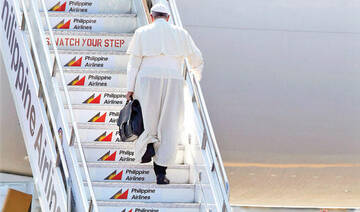
MANILA: Hundreds of Filipinos gathered at a solemn Mass held for Pope Francis on Tuesday, following his passing that has stirred deep sorrow among Catholics around the world, many of whom saw him as a humble and compassionate leader.
In one of the world’s largest Catholic strongholds, the grief was palpable as worshippers filled churches to honor the pontiff, known affectionately in the Philippines as “Lolo Kiko,” or Grandpa Kiko.
One of the chapels inside the Manila Cathedral displayed a framed photo of the Argentine pope surrounded by flowers and candles, as prayers for his eternal repose and solemn hymns sung by the choir echoed through the church.
“Lolo Kiko was a true father to us,” said Cardinal Jose Advincula, the archbishop of Manila, during the morning Mass he led at the cathedral. Francis, the first Latin American leader of the Roman Catholic Church, died on Monday after suffering a stroke and cardiac arrest, the Vatican said, ending an often turbulent reign in which he sought to overhaul an ancient and divided institution. The Philippines, home to more than 80 million Catholics, has long had a special connection with Francis, who visited the country in 2015, drawing a record crowd of up to seven million people at a historic Mass in the capital.
In his homily, the pope urged Filipinos to shun “social structures which perpetuate poverty, ignorance and corruption.”
Francis’ journey included a visit to Tacloban, where he met with survivors of Typhoon Haiyan, the deadliest storm in Philippine history.
Powerful force
Cardinal Advincula described the 2015 visit of Francis as “a moment of grace forever etched in our memory.” Philippine President Ferdinand Marcos Jr, a Catholic, described Francis as the “best pope in my lifetime” as he expressed deep sorrow over his passing.
As the Church prepares for a new conclave, attention has turned to what could be a historic shift – one the possible candidates to succeed Pope Francis is Filipino Cardinal Luis Antonio Tagle. Tagle, 67 is often called the “Asian Francis” because of his similar commitment to social justice and if elected he would be the first pontiff from Asia, where only the Philippines and East Timor have majority Catholic populations.
On paper, Tagle, who generally prefers to be called by his nickname “Chito,” seems to have all the boxes ticked to qualify him to be a pope.
He has had decades of pastoral experience since his ordination to the priesthood in 1982. He then gained administrative experience, first as bishop of Imus and then as archbishop of Manila.

‘A true father to us’ – Filipinos mourn Pope Francis
Short Url
https://arab.news/j4r25
‘A true father to us’ – Filipinos mourn Pope Francis
- Grief palpable in one of the world’s largest Catholic strongholds
- Francis known affectionately in the Philippines as ‘Lolo Kiko’
Poland withdraws from treaty banning antipersonnel mines and will use them to defend against Russia
- 1997 Anti-Personnel Mine Ban Treaty prohibits signatories from keeping or using antipersonnel mines
- Poland will begin domestic production of both antipersonnel and anti-tank land mines
WARSAW: Poland will use antipersonnel as well as anti-tank land mines to defend its eastern border against the growing threat from Russia, Poland’s deputy defense minister said on Friday as the country officially left an international convention banning the use of the controversial weapons.
The 1997 Anti-Personnel Mine Ban Treaty, also known as the Ottawa Convention, prohibits signatories from keeping or using antipersonnel mines, which can last for years and are known for having caused large-scale suffering among civilians in former conflict zones in countries including Cambodia, Angola and Bosnia and Herzegovina.
Poland, which ratified the document in 2012 and completed the destruction of its domestic anti-personnel mine stockpile in 2016, withdrew from the treaty on Friday and says it plans to renew manufacturing weapons.
“These mines are one of the most important elements of the defense structure we are constructing on the eastern flank of NATO, in Poland, on the border with Russia in the north and with Belarus in the east,” Paweł Zalewski, Poland’s deputy defense minister, said.
He said Poland needed to defend itself against Russia, a country which “has very aggressive intentions vis a vis its neighbors” and which itself never committed to the international land mine ban treaty.
Since Russia’s full-scale invasion of Ukraine, nearby countries have been reassessing their participation in the international treaty. Last year, Warsaw joined Finland, the three Baltic states of Estonia, Latvia and Lithuania, and Ukraine to announce it would leave the treaty.
Russia is one of nearly three dozen countries that have never acceded to the Ottawa treaty, alongside the United States.
Poland vows to make its own mines
Zalewski said that Poland will begin domestic production of both antipersonnel and anti-tank land mines, adding that the government would cooperate with Polish producers. He said Poland was aiming for self-sufficiency.
Land mines are an explosive weapon that’s placed on or just under the ground and blows up when a person or a vehicle crosses over them. Anti-tank mines, which are designed not to be triggered by a person’s weight, are not forbidden by the Ottawa Convention.
Speaking on Thursday after attending a demonstration of Bluszcz, an unmanned vehicle designed to distribute anti-tank mines produced by Polish company Belma SA and a military research institute, Polish Prime Minister Donald Tusk said Poland would “soon” have the ability to mine its eastern borders within 48 hours in case of a threat.
Given the length of the country’s eastern borders, he said, “a lot” of land mines will be needed.
Poland says it will only use mines in case of ‘realistic threat of Russian aggression’
Poland plans to prepare mine stockpiles as part of the so-called Eastern Shield, a system of enhanced fortifications Poland has been building on its borders with Belarus and Russia since 2024, Zalewski said.
But he said that Poland would only deploy the mines along its borders “when there is a realistic threat of Russian aggression.”
“We very much respect our territory and we don’t want to exclude it from day to day use for the Polish citizens,” Zalewski said.
Human rights groups have condemned moves to withdraw from the Ottawa Convention, arguing that anti-personnel mines are too dangerous to civilians.
But Zalewski responded that the country is striking a balance by keeping the mines in reserve unless the country faces attack.
“We are not an aggressive country,” he said, “but we have to use all means to deter Russia.”
The 1997 Anti-Personnel Mine Ban Treaty, also known as the Ottawa Convention, prohibits signatories from keeping or using antipersonnel mines, which can last for years and are known for having caused large-scale suffering among civilians in former conflict zones in countries including Cambodia, Angola and Bosnia and Herzegovina.
Poland, which ratified the document in 2012 and completed the destruction of its domestic anti-personnel mine stockpile in 2016, withdrew from the treaty on Friday and says it plans to renew manufacturing weapons.
“These mines are one of the most important elements of the defense structure we are constructing on the eastern flank of NATO, in Poland, on the border with Russia in the north and with Belarus in the east,” Paweł Zalewski, Poland’s deputy defense minister, said.
He said Poland needed to defend itself against Russia, a country which “has very aggressive intentions vis a vis its neighbors” and which itself never committed to the international land mine ban treaty.
Since Russia’s full-scale invasion of Ukraine, nearby countries have been reassessing their participation in the international treaty. Last year, Warsaw joined Finland, the three Baltic states of Estonia, Latvia and Lithuania, and Ukraine to announce it would leave the treaty.
Russia is one of nearly three dozen countries that have never acceded to the Ottawa treaty, alongside the United States.
Poland vows to make its own mines
Zalewski said that Poland will begin domestic production of both antipersonnel and anti-tank land mines, adding that the government would cooperate with Polish producers. He said Poland was aiming for self-sufficiency.
Land mines are an explosive weapon that’s placed on or just under the ground and blows up when a person or a vehicle crosses over them. Anti-tank mines, which are designed not to be triggered by a person’s weight, are not forbidden by the Ottawa Convention.
Speaking on Thursday after attending a demonstration of Bluszcz, an unmanned vehicle designed to distribute anti-tank mines produced by Polish company Belma SA and a military research institute, Polish Prime Minister Donald Tusk said Poland would “soon” have the ability to mine its eastern borders within 48 hours in case of a threat.
Given the length of the country’s eastern borders, he said, “a lot” of land mines will be needed.
Poland says it will only use mines in case of ‘realistic threat of Russian aggression’
Poland plans to prepare mine stockpiles as part of the so-called Eastern Shield, a system of enhanced fortifications Poland has been building on its borders with Belarus and Russia since 2024, Zalewski said.
But he said that Poland would only deploy the mines along its borders “when there is a realistic threat of Russian aggression.”
“We very much respect our territory and we don’t want to exclude it from day to day use for the Polish citizens,” Zalewski said.
Human rights groups have condemned moves to withdraw from the Ottawa Convention, arguing that anti-personnel mines are too dangerous to civilians.
But Zalewski responded that the country is striking a balance by keeping the mines in reserve unless the country faces attack.
“We are not an aggressive country,” he said, “but we have to use all means to deter Russia.”
© 2026 SAUDI RESEARCH & PUBLISHING COMPANY, All Rights Reserved And subject to Terms of Use Agreement.