Pakistan, UAE sign multiple pacts to strengthen trade and culture cooperation

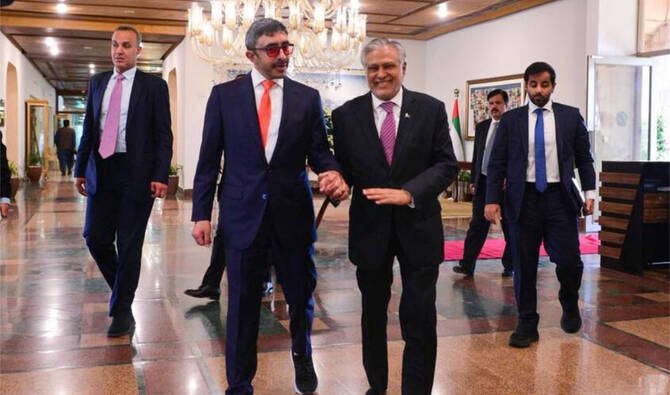
Pakistan’s Foreign Minister and Deputy Prime Minister Ishaq Dar, right, receives his UAE counterpart, Sheikh Abdullah bin Zayed Al-Nahyan, in Islamabad on Monday. (Supplied)
Short Url
Updated 21 April 2025
Follow

Pakistan, UAE sign multiple pacts to strengthen trade and culture cooperation

  • UAE Deputy PM Sheikh Abdullah bin Zayed Al-Nahyan is in Islamabad on 2-day visit

ISLAMABAD: Pakistan and the UAE on Monday signed multiple agreements to further cooperation in trade, culture and consular affairs.

This took place during a visit by the UAE’s Deputy Prime Minister and Minister of Foreign Affairs Sheikh Abdullah bin Zayed Al-Nahyan to Islamabad.

Sheikh Abdullah arrived in Islamabad on Sunday for a two-day visit aimed at strengthening cooperation in energy, trade and security, Pakistan’s Foreign Ministry said in an earlier statement.

Pakistan and the UAE have deepened their economic partnership in recent years.

The UAE is Pakistan’s third-largest trading partner after China and the US, and a major source of foreign investment, with over $10 billion invested in the last two decades.

“I must say that our relationship has been growing on a good pace,” Sheikh Abdullah said during a joint media briefing with his Pakistan counterpart Ishaq Dar at the Ministry of Foreign Affairs.

“I think both our leaders, the people of Pakistan and the UAE do want to see more development in the relationship,” he added.

Sheikh Abdullah said relations between the two countries, over the past few years, have been “moving faster than they have for a while.”

“And I really look forward that the good spirit that has been moving the relationship in the last few months would continue on so many different cycles, if it’s trade, investment, aviation,” he added.

Dar and Sheikh Abdullah signed several agreements to promote cooperation between the two countries in multiple sectors including culture, trade and consular affairs, the state-run Associated Press of Pakistan said.

They signed a pact between the UAE’s Ministry of Culture and its Pakistan counterpart. And they also inked an agreement to establish a joint committee for consular affairs.

The officials also witnessed the signing of a pact to set up a UAE-Pakistan Joint Business Council. The agreement was inked between the Federation of UAE Chambers of Commerce and Industry and the Federation of Pakistan Chamber of Commerce and Industry.

The UAE royal is also scheduled to meet Prime Minister Shehbaz Sharif during his visit.

The UAE is home to over a million expatriates from the Asia nation, the second-largest overseas Pakistani community globally, and a major source of remittances.

Policymakers in Islamabad view the UAE as an ideal export destination due to its geographic proximity, which lowers freight costs and facilitates smoother trade.

In recent years, the two countries have signed a series of agreements to boost economic ties.

In February, during the Abu Dhabi crown prince’s visit to Pakistan, the two sides signed accords in mining, railways, banking and infrastructure.

Last year in January, Pakistan and the UAE signed deals worth more than $3 billion covering railways, economic zones and infrastructure development.

The UAE has become a crucial partner for Pakistan amid Islamabad’s efforts to achieve sustainable growth after suffering from a prolonged macroeconomic crisis.


Outrage after Trump claims NATO troops avoided Afghan frontline

Updated 6 sec ago
Follow

Outrage after Trump claims NATO troops avoided Afghan frontline

  • Donald Trump appeared unaware that 457 British soldiers died fighting in Afghanistan following the September 11 attacks on the US
LONDON: A UK minister said Friday that US President Donald Trump was “plainly wrong” to claim that NATO soldiers did not fight on the front line in Afghanistan, as the claim sparked outrage in Britain.
In an interview with Fox News aired on Thursday, Trump appeared unaware that 457 British soldiers died fighting in the South Asian country following the September 11 attacks on the United States.
“They’ll say they sent some troops to Afghanistan,” Trump told the US outlet.
“And they did, they stayed a little back, a little off the front lines,” he added.
Trump also repeated his suggestion that NATO would not come to the aid of the United States if asked to do so.
In fact, following the 9/11 attacks, the UK and a number of other allies joined the US from 2001 in Afghanistan after it invoked NATO’s collective security clause.
As well as Britain’s, troops from other NATO ally countries including Canada, France, Germany, Italy and Denmark and others also died.
Care Minister Stephen Kinnock said he expected Prime Minister Keir Starmer would bring the issue up with Trump.
“I think he will, I’m sure, be raising this issue with the president... He’s incredibly proud of our armed forces, and he will make that clear to the president,” he told LBC Radio.
Trump’s comments were “plainly wrong” and “deeply disappointing,” Kinnock told broadcaster Sky News.
“It just doesn’t really add up what he said, because the fact of the matter is the only time that article 5 has been invoked was to go to the aid of the United States after 9/11,” he said.
“And many, many British soldiers and many soldiers from other European NATO allies gave their lives in support of American missions, American-led missions in places like Afghanistan and Iraq,” he added.
Lucy Aldridge, whose son William died aged 18 in Afghanistan, told The Mirror newspaper that Trump’s remarks were “extremely upsetting.”
Emily Thornberry, chair of parliament’s Foreign Affairs Committee, called them “so much more than a mistake.”
“It’s an absolute insult. It’s an insult to 457 families who lost someone in Afghanistan. How dare he say we weren’t on the front line,” the Labour Party politician said on the BBC’s Question Time program on Thursday evening.
According to official UK figures, 405 of the 457 British casualties who died in Afghanistan were killed in hostile military action.
The US reportedly lost more than 2,400 soldiers.