

Pakistan to start vaccination process for Hajj pilgrims from today

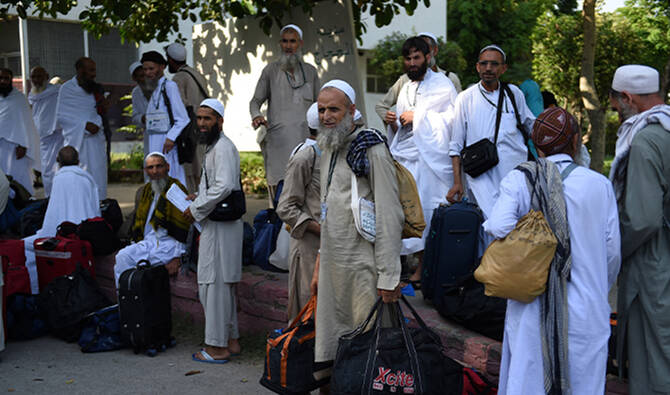
Pakistani Hajj pilgrims wait for transport at The Hajj Complex in Islamabad on August 23, 2016, before leaving for the annual Hajj pilgrimage. (AFP/File)
Short Url
Updated 21 April 2025
Follow

Pakistan to start vaccination process for Hajj pilgrims from today

  • Hajj pilgrims from around the world must comply with strict vaccination requirements set by Saudi Arabia’s ministry of health
  • Vaccines will be provided in Islamabad, Lahore, Peshawar and Multan cities from Monday, in Karachi and other cities from Tuesday

ISLAMABAD: Pakistan’s religion ministry will start providing mandatory vaccines to Hajj pilgrims from today, Monday, state-run media reported as Islamabad undertakes preparations for the annual Islamic pilgrimage. 

Hajj pilgrims from around the world must comply with strict vaccination requirements set by Saudi Arabia’s Ministry of Health to ensure public safety during one of the world’s largest annual gatherings.

Mandatory vaccines include the meningitis shot, with additional recommendations for the seasonal influenza vaccine, while travelers from regions prone to yellow fever and polio must also provide corresponding immunization certificates. 

“Ministry of Religious Affairs will start provision of vaccine to intending Hajj pilgrims from Monday,” state broadcaster Radio Pakistan said in a report. “The vaccine will be provided in Islamabad, Lahore, Peshawar and Multan from Monday,” it added. 

Meanwhile, the state broadcaster said Hajj pilgrims in Karachi, Rahim Yar Khan, Sukkur, Faisalabad and Sialkot cities will start receiving vaccines from Tuesday.

“In Quetta, mandatory vaccination for Hajj pilgrims will be carried out on Wednesday,” it said, adding that the religion ministry will also provide gifts to Hajj pilgrims. 

Pakistan’s religion ministry announced this month around 90,000 Pakistanis are expected to perform Hajj this year under the government scheme. Saudi Arabia has allowed Pakistan a quota of 179,210 pilgrims for the pilgrimage, which is split equally between government and private schemes. 

Prime Minister Shehbaz Sharif has formed a three-member inquiry committee to investigate why Pakistan failed to fully utilize its quota of 179,210 pilgrims for Hajj 2025.

Hajj flight operations are set to begin from Apr. 29, with the first flight departing from Pakistan’s eastern city of Lahore.


Pakistan Navy seizes $3 million of narcotics in Arabian Sea under regional security patrol

Updated 07 December 2025
Follow

Pakistan Navy seizes $3 million of narcotics in Arabian Sea under regional security patrol

  • Official statement says the haul was made during an anti-narcotics operation conducted by PNS Yamama
  • Seizure comes after a record haul of nearly $972 million was reported in the North Arabian Sea in October

KARACHI: Pakistan Navy said on Sunday a patrol vessel operating in the Arabian Sea had seized 1,500 kg of narcotics, the latest interdiction under a regional maritime security deployment aimed at curbing illicit activity along key shipping routes.

The operation took place under the Regional Maritime Security Patrol (RMSP), a Pakistan-led initiative that deploys naval assets across the Arabian Sea and adjoining waters to deter smuggling, piracy and other non-traditional security threats.

The framework combines independent patrols with coordination involving regional and international partners.

“Pakistan Navy Ship Yamama, while deployed on Regional Maritime Security Patrol in the Arabian Sea, successfully conducted an anti-narcotics operation, leading to the seizure of 1,500 kilograms of hashish valued at approximately 3 million US dollars,” the Navy said.

The interdiction, it added, underscored the force’s “unwavering commitment to combating illicit activities and ensuring security in the maritime domain.”

Pakistan Navy said it routinely undertakes RMSP missions to safeguard national maritime interests through “robust vigilance and effective presence at sea,” and continues to play a proactive role in collaborative maritime-security efforts with other regional navies.

The seizure comes amid heightened counter-narcotics activity at sea.

In October, a Pakistani vessel seized a haul worth nearly $972 million in what authorities described as one of the largest drug seizures ever reported in the North Arabian Sea.

Last month, Pakistan Navy units operating under a Saudi Arabia-led multinational task force seized about 2,000 kg of methamphetamine, valued at roughly $130 million, highlighting the role of regional cooperation in disrupting trafficking networks.