

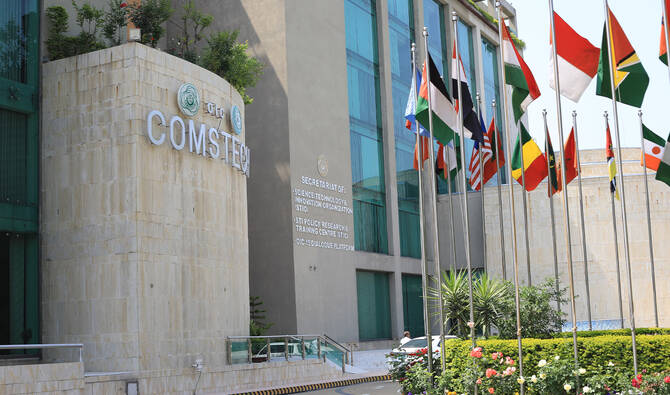
COMSTECH to host sixth OIC steering committee meeting in Islamabad from Apr. 22-24 

The picture shared by COMSTECH on April 20, 2025 shows the building of COMSTECH in Islamabad, Pakistan. (COMSTECH)
Short Url
Updated 21 April 2025
Follow

COMSTECH to host sixth OIC steering committee meeting in Islamabad from Apr. 22-24 

  • Meeting will focus on reviewing implementation progress of OIC’s science, technology and innovation agenda 2026, says COMSTECH
  • Representatives of 17 OIC institutions from Saudia Arabia, Turkiye, Jordan, Bangladesh, Malaysia and Pakistan to attend the meeting 

ISLAMABAD: The Ministerial Standing Committee of the Organization of Islamic Cooperation for Scientific and Technological Cooperation (COMSTECH) is set to host the sixth meeting of the OIC steering committee for the implementation of the OIC Science, Technology and Innovation (STI) Agenda 2026 from Apr. 22-24 in Islamabad, the organization said recently. 

Established by the OIC in 1981 and headquartered in Islamabad, COMSTECH continues to serve as a cornerstone of the OIC’s mission to promote scientific excellence and technological innovation, focusing on sustainable development, poverty reduction and improvement in quality of life across member states.

Confirmed participants of the upcoming steering committee meeting include heads and representatives of 17 OIC institutions from Saudi Arabia, Kazakhstan, Turkiye, Jordan, Uganda, Bangladesh, Malaysia and Pakistan, COMSTECH said. 

“The upcoming Steering Committee meeting will focus on reviewing the implementation progress of the OIC STI Agenda 2026, which was initiated following the First OIC Summit on STI in Astana, Kazakhstan, 2017,” COMSTECH said in a statement issued on Sunday. 

“The agenda aims to foster research collaboration, knowledge sharing, and technology transfer among OIC member states to support sustainable development.”

It said key agenda items also include reviewing member states’ progress on STI Agenda 2026 goals, identifying new joint initiatives and partnerships and discussing future actions leading toward the proposed OIC STI Agenda. 

The meeting will also feature presentations from OIC institutions on their progress, challenges and recommendations under the Abu Dhabi Declaration (2022). 

To prepare for the event, COMSTECH’s Coordinator General Prof. Dr. M. Iqbal Choudhary chaired a high-level preparatory meeting at the body’s headquarters in Islamabad on Sunday where he issued key directives to ensure the smooth execution of the Steering Committee’s sessions. COMSTECH said its senior officials, program managers and departmental representatives attended the meeting.

COMSTECH said it continues to play a central role in facilitating STI cooperation and will oversee coordination among partner institutions to implement recommended initiatives and sustain momentum toward the strategic objectives of the OIC-STI agenda.


UAE-Pakistan trade pact in ‘final stage of signing,’ envoy says in address to Lahore chamber 

Updated 11 February 2026
Follow

UAE-Pakistan trade pact in ‘final stage of signing,’ envoy says in address to Lahore chamber 

  • UAE ambassador tells business leaders Comprehensive Economic Partnership Agreement near signing
  • Chamber cites $7.8 billion remittances from UAE in 2024, urges broader cooperation beyond petroleum trade 

ISLAMABAD: The Lahore Chamber of Commerce & Industry (LCCI) on Wednesday quoted the UAE’s ambassador as saying the Emirates and Pakistan were in the “final stage” of signing a Comprehensive Economic Partnership Agreement (CEPA) to enhance trade and remove obstacles. 

Pakistan and the UAE maintain close economic ties, with the Gulf state serving as one of Islamabad’s largest trading partners and a major source of remittances. Trade between the two countries currently stands at around $8–10 billion, according to figures from the LCCI, while millions of Pakistanis live and work in the UAE. A Comprehensive Economic Partnership Agreement, a broad trade framework aimed at reducing tariffs, easing market access and strengthening investment flows, would formalize and potentially deepen those ties.

Speaking at the Lahore Chamber, UAE Ambassador Salem Mohammed Al Zaabi said the CEPA would help remove business obstacles and deepen economic ties between the two countries.

“Pakistan and the UAE are at the final stage of signing a Comprehensive Economic Partnership Agreement, which would significantly boost bilateral trade and remove business obstacles between the two countries,” Al Zaabi was quoted as saying in a statement issued by the Lahore Chamber.

He added that the existing trade volume of around $8–10 billion did not reflect the full potential of the relationship and his government had a “clear directive” to double the figure as soon as possible.

Al Zaabi said the UAE was expanding investments in Pakistan in sectors including infrastructure, ports, aviation, agriculture, minerals and railways.

He said discussions with Pakistan’s Railway Ministry were progressing and that new agreements related to supply chain connectivity from northern regions to Karachi, including the possibility of a dry port, would be announced soon. He added that the Joint Business Council between the two countries was being activated and efforts were underway to convene its meeting to enhance institutional cooperation.

The UAE ambassador also outlined steps being taken to streamline visa procedures and improve skilled labor mobility.

Referring to the visa process, Al Zaabi said both countries were working to streamline procedures through digital systems and appreciated the efforts of Pakistan’s Ministry of Interior, according to the LCCI statement. He said discussions were underway with the Punjab Skilled Labor Authority to enhance cooperation in skilled workforce mobility.

He added that he was “personally working at operational and technical levels to ensure that all signed agreements, including CEPA and other trade frameworks, are fully implemented.”

The envoy said the UAE was rapidly shifting toward an artificial intelligence-driven and digitized economy, with nearly 99 percent of government services available online.

Highlighting his country’s focus on information technology, digital banking and innovation, the ambassador invited the Lahore Chamber to share a comprehensive document outlining challenges and investment opportunities. He said the UAE Embassy would consider recommendations from the business community and extend facilitation to investors from both sides, adding that special consideration would be given to visa recommendations forwarded by the Chamber for genuine business cases.

He also acknowledged the contribution of the Pakistani community to the UAE’s development, particularly in aviation and finance, and noted that the UAE economy had diversified, reducing oil dependence to below 25 percent.

LCCI President Faheem Ur Rehman Saigol described the UAE as one of Pakistan’s most important trading partners in the Middle East and a major source of remittances.

He said remittances from the UAE reached $7.8 billion in 2024, while Pakistan’s exports to the UAE stood at $2.1 billion in the 2024–25 fiscal year. Imports from the UAE were around $8 billion, largely consisting of petroleum products, according to the Chamber’s statement.

The figures highlight a persistent trade imbalance, with Pakistan importing significantly more from the UAE than it exports, even as millions of Pakistani workers live and work in the Gulf state.

Saigol said there was “vast untapped potential” for cooperation in renewable energy, agriculture and food processing, information technology, logistics, construction, tourism, health care and mining. He proposed establishing dedicated display centers for Pakistani products in the UAE, leveraging the country’s role as a global re-export hub, and called for stronger engagement through trade delegations, business-to-business meetings and joint ventures.