ISLAMABAD: The chief of Pakistan’s influential religio-political party Jamaat-e-Islami (JI) on Sunday announced a nationwide strike for April 26 in solidarity with Palestine, urging citizens to boycott brands allegedly supporting Israel amid its ongoing military offensive in Gaza.
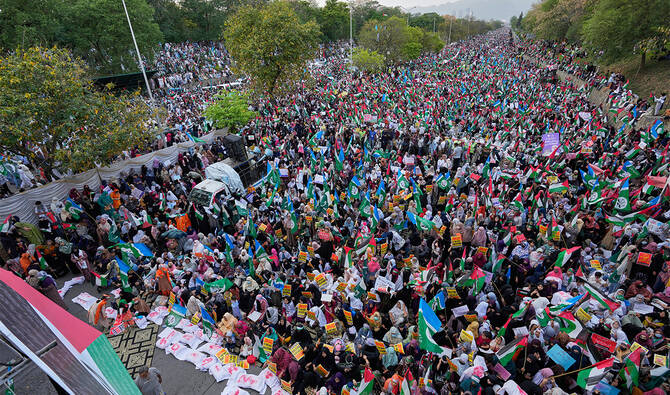
The call came during a large Gaza Solidarity March held on the Expressway connecting Islamabad and Rawalpindi, after authorities blocked access to Islamabad’s Red Zone, where JI had originally planned to rally near the US embassy.
The party has held similar protests in Karachi, Lahore and other cities in recent weeks, criticizing Washington’s support for Israel’s military campaign against the Palestinian territory.
“There will be a complete nationwide strike on April 26,” JI chief Hafiz Naeem-ur-Rehman said in his address to the crowd. “We will go from shop to shop, urging people to suspend business activities ... as we will wage a jihad through boycotts, strikes and social media campaigns.”
Rehman called on Pakistanis to boycott all products linked to Israel, vowing to keep the movement peaceful but persistent.
He also urged the government to formally recognize Hamas and allow it to open an office in Pakistan, calling the group “a legitimate power” that won democratic elections in 2006.
Participants at the march echoed Rehman’s demands, saying Pakistanis should take a more active role in supporting Palestinians by avoiding Israeli-linked brands and pushing the government to take diplomatic initiatives.
“We should boycott brands that support Israel in order to inflict financial damage and send a strong, clear message,” said a woman attending the march with her family, who identified herself as Mrs. Majid.
Dr. Liaqat Ali Meher, who traveled from District Gujrat in Punjab, said Muslim countries should go beyond verbal condemnations and coordinate political pressure on Israel and the US.
“The government should send parliamentary delegations to various countries to build political pressure on Israel and the United States to stop the killing of innocent people, including women and children,” he said.
Others at the march described their participation as a gesture of unity with Palestinians.
“The aim of our participation in this rally is to raise our voice for all the Palestinians martyred by Israel and to show that we stand with them and share in their pain,” Yasir Khan, an Islamabad-based government employee, said.
Pakistan does not maintain diplomatic relations with Israel and has repeatedly condemned its military actions in Gaza, particularly the killing of thousands of unarmed civilians.
Islamabad has also called for the resumption of humanitarian aid to the besieged enclave and renewed negotiations toward a two-state solution.
It has long supported the creation of an independent Palestinian state based on pre-1967 borders, with East Jerusalem as its capital.
Since October 7, 2023, more than 51,000 Palestinians have been killed and over 116,000 wounded in Israel’s military campaign in Gaza, according to the Gaza Health Ministry.


![]()

Islamabad locked down as Pakistani party stages mass rally in solidarity with Gaza
Short Url
https://arab.news/9sqt9
Islamabad locked down as Pakistani party stages mass rally in solidarity with Gaza
- Jamaat-e-Islami’s top leader urges government to recognize Hamas, open its office in Pakistan
- Hafiz Naeem-ur-Rehman calls on the people of Pakistan to boycott all products linked to Israel
Latest updates





© 2026 SAUDI RESEARCH & PUBLISHING COMPANY, All Rights Reserved And subject to Terms of Use Agreement.