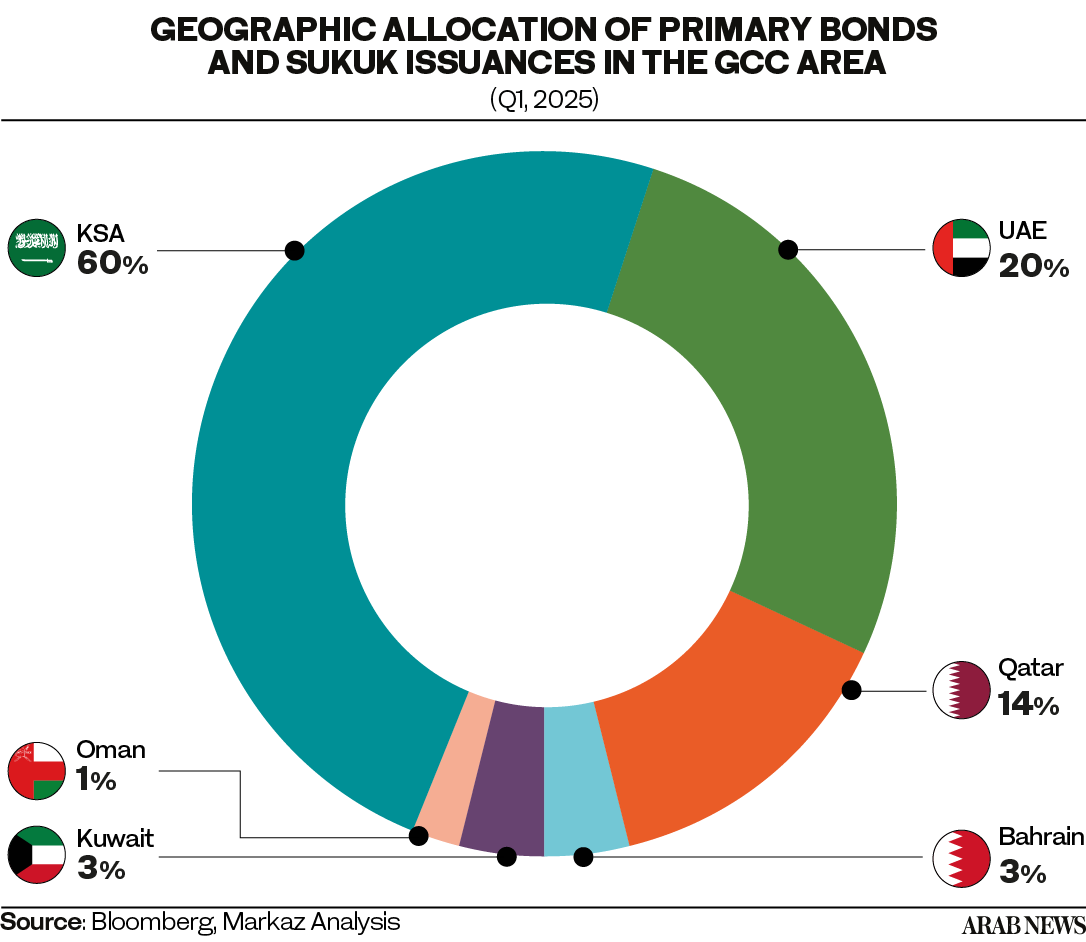
RIYADH: Saudi Arabia dominated the Gulf’s primary debt market in the first quarter of 2025, raising $31.01 billion through 41 bond and sukuk issuances, a new analysis showed.
According to the Kuwait Financial Center, also known as Markaz, the Kingdom accounted for 60.2 percent of total issuances across the Gulf Cooperation Council, reaffirming its status as the region’s largest fixed income market.
Despite its lead, Saudi Arabia's issuance volume declined 19.6 percent year on year from $38.55 billion in the first quarter of 2024. Overall, the GCC’s primary debt issuances totaled $51.51 billion in the first quarter, marking a 7.1 percent decrease from the same period last year.
“As for issuer preferences, Q1 2025 saw an increased appetite for conventional bond issuances in the GCC, representing 65.5 percent of total issuances for the quarter,” Markaz noted.
It added: “This follows the same trend as in Q1 2024, where conventional bonds also represented the bulk of issuances, with 52.6 percent of all issuances in Q1 2024 being conventional bonds.”
Regional outlook
The Kingdom’s debt market has grown significantly in recent years, driven by investor interest in fixed income amid rising interest rates.
In February, Saudi Arabia raised €2.25 billion ($2.36 billion) through a euro-denominated bond sale, which included its inaugural green tranche, as part of its Global Medium-Term Note Issuance Program.
The National Debt Management Center also completed a riyal-denominated sukuk issuance worth SR3.07 billion ($818 million) in February, following an issuance of SR3.72 billion in January.
Following Saudi Arabia, the UAE ranked second with $10.17 billion raised from 29 offerings, representing a 19.7 percent market share. The UAE’s issuances also surged 61.6 percent from the same period last year, according to Markaz.
Qatar came third, raising $7.14 billion through 38 offerings, accounting for 13.9 percent of total issuances.
Bahrain recorded issuances worth SR1.53 billion, a 44.5 percent drop year on year.
Kuwait raised $1.41 billion from nine issuances, marking a 40.9 percent increase from the previous year.
Omani entities issued just $260 million from one transaction, the lowest in the region, representing 0.5 percent of the total value.
Issuances by type
GCC corporate issuances totaled $32.11 billion in the first quarter, a 45.3 percent year-on-year increase. These made up 62.4 percent of total issuances.
Government-related corporate entities raised $6.8 billion, accounting for 21.2 percent of corporate issuance.
The report noted that total sovereign primary issuances in the GCC fell to $19.39 billion in the first quarter, marking a 41.8 percent decline from the same period last year.
In December 2024, an analysis by Kamco Invest highlighted the growth of the region’s debt market and projected that Saudi Arabia would account for the largest share of bond and sukuk maturities in the GCC, reaching $168 billion between 2025 and 2029.
Kamco Invest added that maturities in the Kingdom would be driven primarily by government-issued bonds and sukuk, expected to total $110.2 billion during the period.
In its latest report, Markaz noted that conventional issuances rose 15.8 percent year-on-year to $32.12 billion in the first quarter.
In contrast, sukuk issuances declined 32.5 percent over the same period, totaling $17.75 billion.
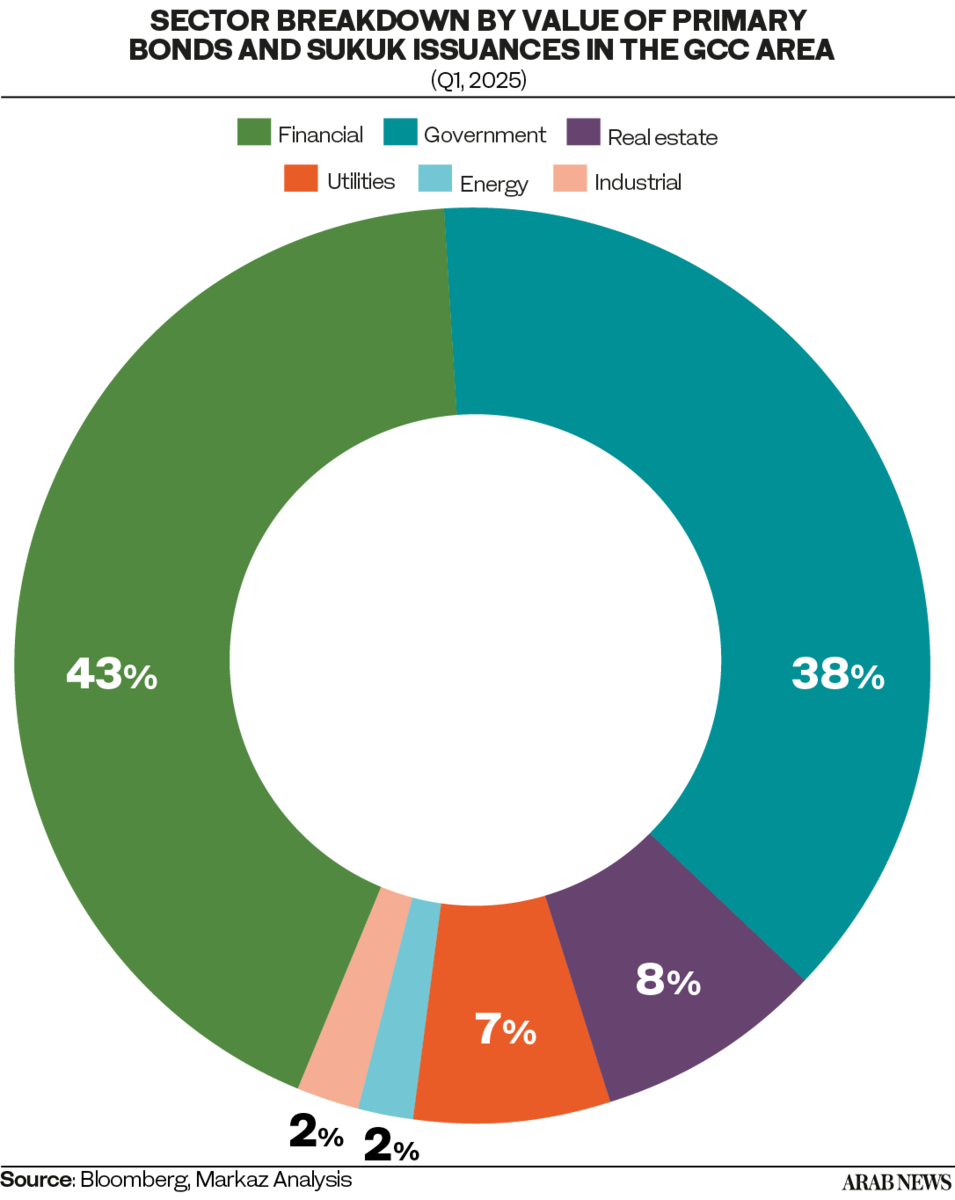
Sector breakdown
The financial sector led bond and sukuk activity in the first quarter, raising $22 billion through 100 issuances — or 42.8 percent of the total.
The government sector followed with $19.4 billion from 12 issuances, representing 37.6 percent of the market.
The real estate sector raised $4.3 billion from five transactions.
Maturity and currency profile
Markaz said that primary issuances with tenors of less than five years accounted for 53.1 percent of the GCC debt capital markets in the first quarter, with a total value of $27.4 billion across 99 issuances.
Issuances with tenors of five to ten years followed, raising $18.4 billion through 20 deals, representing 35.8 percent of the total.
Offerings with maturities of 10 to 30 years made up 1.6 percent of the market in the first three months of the year, with a single issuance valued at $809 million.
“One issuance also came in with a maturity greater than 30 years, with a value of $1 billion. Finally, perpetual issuances saw an increase in both the size and number of issuances when compared to the first quarter of 2024, with a total value of $3.9 billion through 4 issuances,” Markaz added.
In the first quarter of this year, GCC primary issuances ranged in size from $2 million to $5 billion.
The report noted that issuances valued at $1 billion or more raised the largest share, totaling $31.9 billion across 18 offerings. This segment represented 61.9 percent of the total amount issued in the GCC during the same period.
Issuances between $500 million and $1 billion followed, raising $14.4 billion through 22 deals.
The highest number of issuances came in the under $100 million category, with 65 transactions collectively raising $1.9 billion during the first quarter.
Markaz also highlighted that US dollar-denominated issuances dominated the bonds and sukuk primary market in the GCC, raising $44.9 billion through 92 offerings. These issuances accounted for 87.2 percent of the total value raised in the region.
The second-largest currency for issuances was the euro, which raised $3 billion through four transactions.
In February, credit rating agency Fitch projected that Saudi Arabia would play a key role in driving US dollar debt and sukuk issuance in 2025 and 2026, as the Kingdom’s financial institutions and corporations continue to tap international debt markets for diversified funding sources.
Fitch added that Saudi banks alone are expected to issue over $30 billion in dollar-denominated issuances this year.
The agency further noted that Saudi banks have significantly expanded their international debt capital market activities since 2020, aligning with their growth strategies and foreign-currency requirements.
Additionally, Fitch forecasted that Saudi Arabia’s debt capital market would reach $500 billion by the end of 2025, supported by the Kingdom’s economic diversification efforts under Vision 2030.