

Putin attends Orthodox Easter service after declaring ceasefire in Ukraine

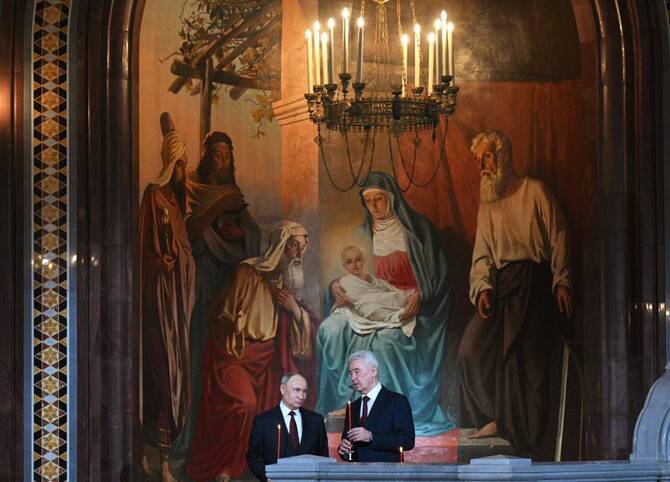
In this pool photograph distributed by Russian state agency Sputnik, Russia’s President Vladimir Putin (L) and Moscow Mayor Sergei Sobyanin attend an Orthodox Easter service at the Christ the Savior Cathedral in Moscow early on April 20, 2025. (AFP)
Short Url
Updated 20 April 2025
Follow

Putin attends Orthodox Easter service after declaring ceasefire in Ukraine

  • The traditionally sung service starts late on a Saturday and lasts into the early hours of Sunday
  • Zelensky says Russian army ‘trying to create impression’ of Easter ceasefire

MOSCOW: President Vladimir Putin and Moscow Mayor Sergei Sobyanin joined other worshippers for an Easter service led by the head of Russia’s Orthodox Church, Patriarch Kirill, a faithful backer of the Russian leader and an advocate for the war in Ukraine.
Hours after declaring a unilateral Easter ceasefire that Kyiv said was just words as fighting continued, Putin and Sobyanin stood in Moscow’s main church, the Cathedral of Christ the Savior, while Kirill led a procession, video of the service showed.
Holding a lit thin red candle and donning a dark suit, white shirt and a red tie as in years past, the Russian leader crossed himself several times when Kirill announced “Christ is risen.”
The traditionally sung service starts late on a Saturday and lasts into the early hours of Sunday.
For Putin, the Orthodox faith is central to his world view and he always attends services during major church holidays. For Orthodox Russians, Easter is the most important religious holiday.
At the service, Krill called for “lasting and just peace can be established in the vast expanses of historical Rus,” RIA state news agency reported, in what was a reference to a medieval territory that encompassed parts of what is now Ukraine, Belarus and Russia. “How wonderfully it was said, do not do evil to another and do not treat others as you would not want them to treat you,” TASS agency cited Kirill as saying.
“If people adhered to this holiday commandment, then life would be completely different: family and social life and — let me say this — inter-governmental.”
Kirill has strongly backed the war in Ukraine, now in its fourth year. Thousands have been killed, the vast majority of them Ukrainians, and millions driven from their homes since Putin ordered the invasion of Ukraine in February 2022.

Zelensky says Russian army ‘trying to create impression’ of Easter ceasefire

President Volodymyr Zelensky said on Sunday that the Russian army is making a pretense of an Easter ceasefire declared by President Vladimir Putin, continuing overnight attempts to inflict front-line losses on Ukraine.
“In general, as of Easter morning, we can say that the Russian army is trying to create a general impression of a ceasefire, but in some places it does not abandon individual attempts to advance and inflict losses on Ukraine,” Zelensky said in a post on social media.

Early on Sunday, Ukrainian forces reported 59 instances of shelling and five assault attempts along the front line, he said.
“Russia must fully comply with the conditions of silence,” Zelensky said.
He reiterated that Kyiv was willing to extend the ceasefire for 30 days but said that if Russia kept fighting on Sunday, so would Ukraine.
“Ukraine will continue to act in a mirror manner,” he said.


Fossils of ‘Java Man,’ first known Homo erectus, return to Indonesia

Updated 18 December 2025
Follow

Fossils of ‘Java Man,’ first known Homo erectus, return to Indonesia

  • Netherlands to repatriate more than 28,000 items in Dubois collection in 2026
  • Fossils excavated in Indonesia were ‘removed against will of people’  

JAKARTA: Prehistoric bones belonging to “Java Man” — the first known fossil evidence of Homo erectus — went on display at Indonesia’s National Museum on Thursday, more than 130 years after they were taken to the Netherlands during Dutch colonial rule.

The parts of the skeleton — a skull fragment, molar and thigh bone — were uncovered along the Bengawan Solo River on Java island in the late 19th century by Dutch anatomist and geologist Eugene Dubois. 

The three items, and a related shell that was scratched by early Homo erectus, are the first in the planned repatriation of more than 28,000 fossils and natural history objects originating in Java and Sumatra that Dubois had removed. 

“Repatriation is a national priority,” Indonesian Culture Minister Fadli Zon said during an official handover ceremony in Jakarta. 

“We bear the responsibility to protect cultural heritage, restore historical narratives and ensure public access to the cultural and scientific heritage that belongs to Indonesia.” 

Fossils of the Java Man, which was hand-carried in a GPS-tracked, climate-controlled suitcase with a diplomatic seal, were some of the first pieces of evidence showing links between apes and humans. 

The fossils are part of the larger Dubois collection that was managed by Naturalis Biodiversity Center, a 200-year-old scientific institution in Leiden. 

The rest of the collection will be transferred to Indonesia in 2026, the Dutch Embassy in Jakarta said in a statement, adding that Indonesia’s National Research and Innovation Agency will take a lead role in preserving and managing the items. 

“This handover marks the beginning of the next phase. We intend to repatriate thousands of items excavated in Indonesia over 130 years ago,” said Marcel Beukeboom, general director of Naturalis Biodiversity Center. 

“This fossil bears witness to an important link in human evolution, while also representing part of Indonesian history and cultural heritage,” he said.

Jakarta started to campaign for the Dutch government to return stolen Indonesian artifacts after declaring independence in 1945, but the Netherlands started to return stolen items only in small numbers in the 1970s. 

Recent efforts by the Indonesian Repatriation Committee have brought back home hundreds of artifacts since 2023, bringing the number to more than 2,000 items so far. 

The repatriation of the Dubois collection was first announced in September, following recommendation by the Netherlands’ Colonial Collections Committee. 

“The Colonial Collections Committee has concluded … that the Dutch state never owned the Dubois collection,” the Dutch government said in a news release issued at the time. 

“The committee believes that the circumstances under which the fossils were obtained means it is likely they were removed against the will of the people, resulting in an act of injustice against them.

“Fossils held spiritual and economic value for local people, who were coerced into revealing fossil sites.” 

The returned fossils are now a centerpiece of “Early History,” a new permanent exhibit at the National Museum in Jakarta that opened to the public on Thursday. 

It explores the history of human civilization throughout Indonesia, with displays including a replica of one of the world’s oldest cave paintings from South Sulawesi and inscriptions from the 4th-century Hindu Kutai Martadipura Kingdom in East Kalimantan.