

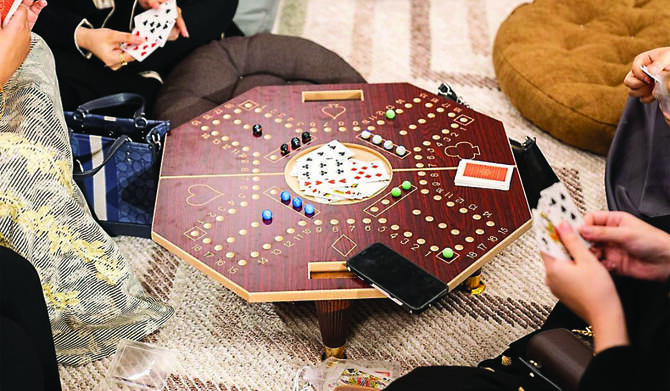


RIYADH: In a screen-saturated world where social interactions often shrink to notifications, analog fun is reshaping Saudi leisure. Board games, once dismissed as childish relics, are experiencing a revival across the Kingdom. Whether at home, in cafes, or at traditional majlis gatherings, Saudis are increasingly turning to tabletop games for fun, connection and cultural relevance.
What began as a simple form of entertainment during family nights or holidays has grown into a social phenomenon, with games like Jackaroo, Sequence and locally designed options such as Saudi Deal, Elaab Bel Khames (Play With Five), La Tagool (Don’t say), and Ensan, Hayawan, Khashaabalan (Person, Animal, Nonsense) now staples in Saudi homes.

A tabletop games cafe in Saudi Arabia, offering a wide selection of international and local games. (Supplied\Roaa Al-Johani \Hayy Jameel)
“It became a trend because people miss real-life connection,” said Roaa Al-Johani. “Playing face to face just hits different, especially these days.”
This sentiment is echoed across Saudi homes, where board games have moved from being a once-in-a-while pastime to an essential part of gatherings.
I’d love to see games that tell stories from our culture or dive into Saudi history in a fun, modern way.
Wojoud Aziz
“Board games are a big part of our culture now,” Al-Johani added. “You see them in cafes — some cafes are fully built around them. Every Saudi home probably has either a Jackaroo or a Carrom board, especially after the (pandemic) era.”
During the pandemic, with more people spending time at home and looking for ways to unplug from screens, tabletop games offered a low-tech yet highly engaging alternative.

A tabletop games cafe in Saudi Arabia, offering a wide selection of international and local games. (Supplied\Roaa Al-Johani \Hayy Jameel)
Al-Johani shared how her own family embraced this shift: “I come from a family that loves board games to the point that my grandpa has a Jackaroo board in his majlis and invites his friends and neighbors to play. It’s kind of how we bond — when we play, age doesn’t really matter.”
The appeal lies in the shared experience. Unlike video games, which are often isolating or limited to a few players, board games bring people together physically and emotionally.

A tabletop games cafe in Saudi Arabia, offering a wide selection of international and local games. (Supplied\Roaa Al-Johani \Hayy Jameel)
“Even though I’m a hardcore gamer, I still prefer board games sometimes,” she said. “It’s really about the people you’re with — not just the game. The vibes, the laughs, the face-to-face time … it just feels more real.”
Norah Shobili, who recently tried Jackaroo, was similarly surprised by how engaging it was. “I used to think it was a kid’s game because they were the only ones playing it, but once I learned it, it was genuinely fun!”
People miss real-life connection. Playing face to face just hits different, especially these days.
Roaa Al-Johani
More than the gameplay itself, Shobili highlighted the intergenerational aspect of local games. “Back when Monopoly was the trend, kids wouldn’t play with elderly, because they’re kids they don’t know how to play, but with Jackaroo you see the elders team up with the young ones because they’re very good!”

CaptioA retro-style football board game draws family members together in an evening of lighthearted rivalry. (AN photo by Waad Hussain)n
Wojoud Aziz said that Saudi-made games resonate deeply with local culture: “They speak our language — literally. The humor, the names, the style — it all feels like home. You can tell they’re made by people who understand our culture and how we hang out.”
According to Aziz, board games are now a fixture in Saudi social life. “They weren’t always this big, but now? They’re part of the plan. I always see people playing them during family gatherings or chill hangouts.

A traditional Saudi game night with a personal twist — pastel-colored Hello Kitty cards meet local wooden game boards in a nostalgic, floor-style setup. (AN photo by Waad Hussain)
“It gets super competitive but in a fun way, and everyone’s into it — even those who don’t usually play games.”
While most local games focus on fun, she believes there is more to them than meets the eye. “Some games really push you to focus, plan ahead and even read other players’ vibes. It’s low-key educational, too, but without making it feel like school, you know?”

Casual dominos outdoors. (AN photo by Waad Hussain)
The social value of these games is clear. “Board games have the advantage of being present with your family — if not verbally then at least physically,” Shobili said. “The whole family in one room, and as long as whoever you call will answer, that’s more than enough to spend quality time for me. It’s more about being there rather than doing something or talking.”
She also believes that Saudi game developers can take creative liberties, as long as they do not lose what matters most. “As long as they preserve the spirit of gatherings — being able to play as a big group regardless of age — they can develop however they want.”
That inclusivity is crucial. “Not all international games are translatable,” she said.
Looking ahead, both players and creators hope to see more storytelling and cultural depth in locally made games. “I’d love to see games that tell stories from our culture or dive into Saudi history in a fun, modern way,” Aziz said. “Something that mixes nostalgia with creativity — and hopefully goes global.”
As Saudis seek richer, more engaging ways to connect with friends and family, board games have become more than just entertainment — they are a bridge between generations, a spark for laughter, and a reason to put phones down and just be present.


